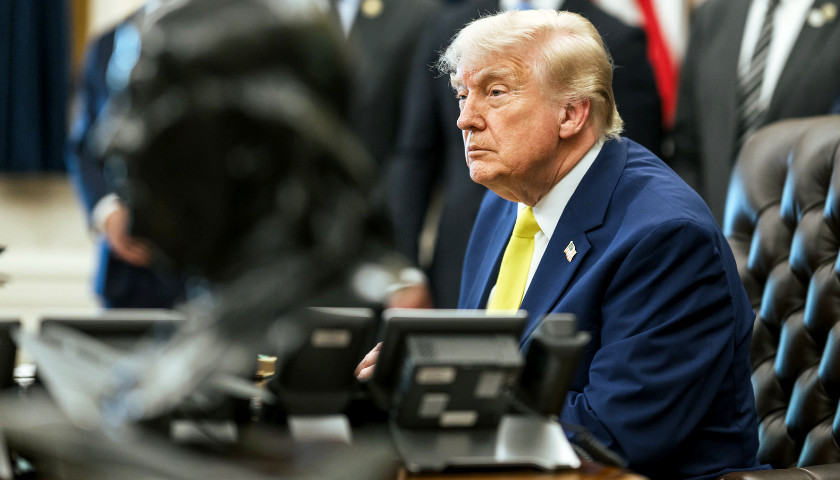
Although Donald Trump’s defenders describe the Russia hoax and other efforts to frame the president as a “grand conspiracy,” RealClearInvestigations has learned that the man now leading the probe of that scandal is pursuing multiple conspiracy prosecutions that are smaller and more manageable, according to several sources with direct knowledge of the probe.
Read the full storyAuthor: RealClearWire
Commentary: Patients Are Dying While the FDA Certifies ‘Effectiveness’
Congress introduced legislation this month allowing seriously ill patients to access select treatments their physicians would prescribe – without FDA approval. That would mark a fundamental departure from the FDA’s total control over every prescription drug in America.
Read the full storyCommentary: Fauci, the CIA, and the Unanswered Questions of COVID
Did Anthony Fauci manipulate the intelligence community (IC) investigation of the origin of COVID as outgoing Director of National Intelligence Tulsi Gabbard claims?
Gabbard recently released previously unseen documents and communications during the COVID pandemic between the IC and the key member of the White House Coronavirus Task Force, Dr. Anthony Fauci. She claims they show that Fauci and the IC coordinated the investigation of the origin of the COVID to suggest it was a natural occurrence rather than a laboratory leak. She further charges that the documents reveal Fauci’s direct role in influencing and manipulating IC assessments in an attempt to discourage the lab-leak hypothesis.
Read the full storyCommentary: The Impeachment Trap
Democrats are licking their chops.
The midterm elections are approaching and with them the prospect that Democrats will take control of the House of Representatives and perhaps even the Senate. Even with a majority only in the lower chamber, the Democrats would have the power to torment President Trump.
Read the full storyCommentary: Cities Have Little to Show for Big Spending
America’s largest cities are increasing their spending at almost unprecedented rates.
A RealClearInvestigations analysis of cities with at least 500,000 residents found they cumulatively raised their per-person spending by 18% over the last 10 budget cycles, accounting for inflation. The only equivalents on record are the spending surges ignited by the Great Society programs of the 1960s and Franklin D. Roosevelt’s New Deal during the 1930s.
Read the full storyCommentary: America’s Energy Future Is Being Decided in Obscure Utility Commission Races
Most Americans could not name a single member of their state Public Service or Utility Commission (PSC/PUC).
Radical climate activists are counting on that.
Read the full storyCongress Scrambles on FISA as Pulte Appointment Sparks Revolt
One week ago Thursday, Congress was sailing toward relatively easy passage of a bill to reauthorize Section 702 of the Foreign Intelligence Surveillance Act, which authorizes intelligence agencies to spy on non-U.S. electronic communications without a warrant.
Read the full storyCommentary: Bill Gates’ Billions Shape U.S. Medical Research
Bill Gates has long been one of the most admired people in the world, especially since he stepped down from his role running Microsoft to devote himself and much of his fortune to philanthropy. That reputation has been tarnished recently, however, by revelations of the billionaire’s close relation with sex offender Jeffrey Epstein, and exposés on his own fraught relationships with women.
On the eve of Gates’ private testimony with Congress scheduled for tomorrow, a trove of federal whistleblower documents provided to RealClearInvestigations is renewing questions about how Gates money has bought what critics complain is an untoward influence on government health policy. For almost a quarter of a century, his main vehicle of power, the Bill and Melinda Gates Foundation, has donated hundreds of millions of dollars to the National Institutes of Health (NIH), allowing Gates to shape the direction of the country’s health strategy in ways that have benefitted his own priorities and pet causes while polishing his image as a benevolent global do-gooder.
Read the full storyCommentary: Violent Crime Drops as More Americans Pack Heat
Alessandra Coote was walking on a trail with her 2-year-old daughter and dog two-and-a-half years ago when a man began yelling at her and threatened to kill her dog. When the petite single mom made it back to her Utah home, she decided she needed a firearm for protection.
A few months later, while living in what she described as a “shady part of town,” a homeless man threatened her. After that encounter, she began regularly carrying a firearm under Utah’s Constitutional Carry law.
Read the full storyCommentary: Tom Steyer Will Destroy California’s Historic Small Businesses
In the heart of the Santa Cruz Mountains, just off Highway 9, there is a restaurant that has become a community icon. It has a redwood-paneled dining room with exposed roof timbers that was built in 1912 and a historic bar with a wood-burning fireplace. For over a century, the people in this isolated town have treasured this gathering place.
Near downtown Los Angeles, along a busy commercial boulevard, a family-owned Mexican restaurant has thrived since 1925, offering locals and tourists classic dishes in a dining room filled with memorabilia.
Read the full storyCommentary: The Passing of Bob Woodson
Bob Woodson died peacefully at his home on the evening of May 19, 2026, at the age of 89. He was a national treasure, beloved by the thousands he served through the Woodson Center for over four decades, yet never quite understood by Presidents, from Ronald Reagan to Donald Trump, who often invited him to the White House. Senators, Congressmen, and every Speaker of the House from Jack Kemp to Paul Ryan caught sight of Bob’s vision of an America fully redeemed from its “birth defect of slavery,” as he called it, but few fully embraced his remarkable plan to heal wounds, foster hope, and ennoble resilience.
Bob was wedded to neither political party. He called himself a “radical pragmatist,” and talked with ease and grace to both the left and right. When he first came to prominence, conservatives should have been his natural constituency; but before the fall of the Berlin Wall, their reverential allusions to the mediating institutions through which Bob understood that the real redemptive work had to take place—our families, local communities, and churches—always seemed to be drowned out by their full-throated defense of free markets. The Communist threat abroad and the ever-growing bureaucracy of the Progressive state at home fixed their attention almost singularly on commerce, as a strategy of resistance, if not of defiance. There were exceptions, of course. The Bradley Foundation, with which Bob worked closely for many years, comes to mind. But by and large, it was the age of the free market veto. Economic efficiency, not the alarming decline of social capital, about which Robert Nisbet had warned decades earlier, in The Quest for Community (1953), was all that seemed to matter. If we were to describe the contrast between what Bob had in mind and what the conservative establishment was defending, we would say that Bob was on the ground, helping to recover and build the world that Tocqueville had described so beautifully in Democracy in America, while the conservative establishment was holding seminars on, and deriving policy prescriptions from, Adam Smith’s The Wealth of Nations.
Read the full storyAnalysis: Flawed U.S. Work Visa Policy Prioritizes Foreign Workers over Americans
U.S. tech workers are at the center of a battle brewing in Washington, D.C., over reforming the troubled H-1B visa program, which is designed to fill highly skilled positions when qualified American workers can’t be found.
Read the full storyCommentary: Harvard Joins the ‘Right-Wing Conspiracy’, Declares College Grades Have Been a Joke for Decades
So, it turns out that the little boy was right all along about the emperor’s new clothes.
In an effort to restore grading standards, Harvard’s Faculty of Arts and Sciences is conducting an email ballot on the administration’s proposal to limit solid A grades at 20% of students per course (plus up to four additional A’s, if merited).
Read the full storyCommentary: Voting Rights Act Never Mandated Racial Districts
Ever since the recent decision of the Supreme Court limiting the use of race in drawing congressional districts, there has been a steady drumbeat of criticism claiming that the ruling somehow took away the rights of blacks and other minorities.
But nothing could be further from the truth.
Read the full storyCommentary: America’s Medicine Supply Chain Is a National Security Vulnerability
The Chinese government is tightening the screws on American investment in its artificial intelligence sector. The core purpose is to keep U.S. capital out of technologies it deems “strategically sensitive” to national security. The protective action is a reminder that Washington also needs to prioritize insulating our own critical sectors from foreign adversaries.
Few industries are more important to our national security than healthcare. More than 131 million people—nearly two-thirds of all U.S. adults—use prescription medications. Yet the United States has allowed its pharmaceutical supply chains to become dangerously dependent on foreign rivals—particularly China.
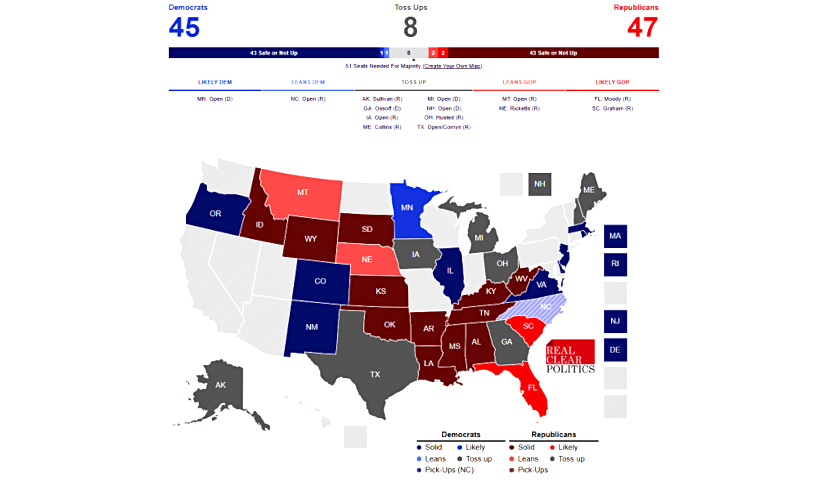
Read the full storyAnalysis: Control of the U.S. Senate Now a Toss-Up
For months, polling and prediction markets have forecast that Democrats will retake the House, but that Republicans will retain control of the Senate. However, recently, the prediction markets have moved toward the Senate being a toss-up.
Read the full storyCommentary: The Rise of Lawfare Candidates
One of the beneficiaries of Virginia’s aggressive attempt to gerrymander the state for Democratic advantage could be a former federal prosecutor whose campaign for Congress hinges on his efforts to use the law to target President Trump and his supporters.
When a slim majority of Virginia voters gave the legislature authority last month to create congressional districts that could give Democrats a 10-1 advantage, J.P. Cooney cheered the outcome in a message on social media, boasting that the new district he was running in had been drawn “expressly for the purpose of standing up to Donald Trump’s and MAGA’s corruption.”
Read the full storyCommentary: A New Direction in Civil Rights Policy
The Trump administration is restoring the core value of equal opportunity to civil rights enforcement. It is eviscerating the race-baiting, intersectional policies of the Biden and Obama administrations, and giving substance to the Supreme Court’s unanimous decision in Ames v. Ohio Department of Youth Services (2025) that whites, men, and heterosexuals are not held to a higher standard in discrimination cases.
This is a time for rejoicing, tempered by concern that the administration will not have time to complete its work, and that its reliance on executive orders, rather than legislation and consent decrees, will allow the next Democratic president to rip asunder President Trump’s laudable accomplishments.
Read the full storyCommentary: Hiding Star Researcher Ralph Baric’s Ties to Global Pandemic
In March 2020, a couple of months after the Centers for Disease Control and Prevention reported the first confirmed case of COVID-19 in the United States, editors at the journal Nature Medicine appended a note to a coronavirus study it had published five years prior. “We are aware that this article is being used as the basis for unverified theories that the novel coronavirus causing COVID-19 was engineered,” the journal editors wrote. “There is no evidence that this is true; scientists believe that an animal is the most likely source of the coronavirus.”
The prestigious journal appears to have taken this extraordinary action for two reasons. First, the study described cutting-edge gain-of-function research that mixed different viruses together to create a man-made chimera, or hybrid of both viruses – experiments some suspected were the origin of the SARS-CoV-2 virus that caused the pandemic. Second, the study’s authors were Shi Zengli of the Wuhan Institute of Virology – a research lab in the city that was ground zero for the pandemic – and Ralph Baric, the world’s leading expert on coronaviruses, of the University of North Carolina.
Read the full storyCommentary: What AI Doesn’t Know, Matters
Artificial intelligence has taken the wired world by storm, but the backlash came almost as fast. Progressives complain of job losses, environmentalists question the ecological impacts of huge data centers, and local activists are clamoring for assurances that household utility bills won’t skyrocket because of the centers’ voracious electricity requirements. Others simply worry that the technology will overwhelm humans’ ability to control it.
Read the full storyCommentary: America’s Nuclear Revival
It has been more than seven years since President Donald Trump signed the Nuclear Energy Innovation and Modernization Act (NEIMA) into law – and it has taken all seven years (including four during the Biden Administration) for the Nuclear Regulatory Commission to issue a final rule implementing its provisions.
Even the Washington Post admits that the new Part 53 rules, intended to reduce review times from decades to 18 months or less, will make President Trump’s goal of revitalizing the U.S. nuclear energy industry more competitive – “to everyone’s benefit,” says the Post.
Read the full storyCommentary: America’s Fourth Coast Could Help Close the Shipbuilding Gap with China
In 2024, Beijing’s largest ship maker produced 250 ships. Combined, these ships could carry the weight of the total number of ships America has produced since World War II, according to the Center for Strategic and International Studies. If war were to break out in the Pacific the U.S. shipbuilding industry would not be able to repair and replace losses at the rate in which Chinese shipyards could.
Read the full storyCommentary: The Case Against Public-Sector Unions
America’s public-sector unions have a problem they can’t explain away: Workers are leaving.
Ask a public employee when they joined their union and most couldn’t tell you. Because they didn’t join. The dues just started coming out of their check.
Read the full storyCommentary: Easter Reveals the True Cost of Discipleship
For many people across the U.S., Easter Sunday means pastel-colored clothes, jelly beans, Cadbury eggs, or marshmallow Peeps. But Easter is far more than a cultural tradition or seasonal celebration. It is a declaration that should actually shape the way we live and has the power to transform lives: He is risen!
That truth, echoed by believers all around the world every Easter Sunday, is the foundation of a faith that calls us not to a life of comfort, but to a life of commitment.
Read the full storyCommentary: China Dominates the World’s Critical Minerals Production
Critical minerals are mined all over the world but the majority of the supply ends up passing through China. For a broad range of key metals and minerals, China is either the largest miner, the dominant refiner, or both. This is true for rare earths, lithium, cobalt, graphite, nickel, and many other metals and minerals that are essential to defense, energy and high-tech applications. It is less about where ores are dug out of the ground and more about where they are turned into usable components. In other words, Chinese processing plants are essentially the gatekeepers of global supply.
Australia and South America host much of the world’s lithium, while Congo supplies the lion’s share of cobalt and copper. But the rocks themselves can’t become a battery or magnet without intensive downstream processing and refining. China built those downstream industries at scale over decades through state support and investment. The result is clear — China has effectively monopolized refining for most critical minerals while the rest of the world depends on it for much-needed supply. China is listed as the dominant refiner for 19 of 20 minerals analyzed by the IEA in their Global Critical Minerals Outlook for 2025, making up roughly 70% of the global processing capacity overall.
Read the full storyCommentary: Oklahoma’s Digital Future Will Be Built on Affordable, Reliable, Clean Energy Security
An increasingly familiar story is cropping up across rural America: communities wrestling with when, where, and how to welcome data centers. This month, The New York Times highlighted how Oklahoma in particular is no longer speculating about that challenge — but living it.
“Nobody Owns Us: How Plans for a Google Data Center Roiled an Oklahoma Town,” went the headline.
Read the full storyCommentary: Our Final War for Independence
“The War of Revolution is won, but the War for Independence is yet to be fought” – Benjamin Franklin
One major struggle 214 years ago passed into the history books as something we’d rather forget than celebrate. It was sparked by acts of piracy on the high seas committed against American vessels, stripped of their cargoes and in many cases their sailors, some forced into servitude in the British Navy. When the USS Chesapeake was fired upon off the coast of Virginia, four men taken against their will, Congress called for action. After much debate, on June 18th, President James Madison signed the paperwork. The War of 1812 had begun.
Read the full storySecret Service Agent Faulted for Butler Failures Suspended Again
The Secret Service agent who was in charge of developing and executing the failed security plan for the 2024 rally where President Trump was nearly killed has been suspended and is under internal agency investigation for allegedly improperly reporting her relationship with and eventual marriage to a foreign national, several sources told RealClearPolitics.
This suspension is the third one in a year and a half for the agent, Myosoty “Miyo” Perez, who served as the “site agent” for the Butler campaign rally where a would-be assassin shot Trump’s ear, killed retired firefighter Corey Comperatore, and seriously injured two others in the crowd.
Read the full storyCommentary: The Debt Can Is Getting Harder to Kick
by Timothy Nash, Bob Thomas, George Lang, and Tom Rastin In the book When We Are Free, an anthology published by Northwood University Press with a foreword by Milton Friedman, economic historian Dr. Lawrence W. Reed contributed a chapter titled The Fall of Rome and Modern Parallels.Reed examines how the Roman Empire collapsed and draws striking comparisons to the fiscal habits of modern governments. His warning is worth revisiting today. In the United States, federal law does not allow states to declare bankruptcy. To prevent fiscal collapse, 49 out of 50 states operate under some form of balanced budget requirement. These rules force policymakers to make difficult decisions each year and prevent deficits from spiraling out of control. The federal government operates very differently. Today the U.S. national debt now totals $38.9 trillion, about 125% of GDP, while state and local debt is $3.3 trillion, under 11% of GDP. In 1900, total U.S. debt was just 7.8% of GDP, mostly held by states and local governments. Even in 1981, federal debt was roughly 36% of GDP and barely exceeded $1 trillion. In other words, the federal government has moved from a relatively small borrower to the dominant source of public debt…
Read the full storyVance Embraces ‘Fraud Czar’ Role, Dems Plan to Make It a Liability for the 2028 Midterms
by Philip Wegmann Democrats began laying a trap the moment that President Trump announced during his State of the Union that Vice President JD Vance would lead a new “war on fraud,” salivating at the possibility of political liability and dubbing the MAGA heir apparent the “fraud czar.” “It will be blocks of cement around his ankles,” a senior Democratic official told RealClearPolitics last month after the speech to Congress. Another operative predicted that, come 2028, the new role “will be an albatross around his neck.” A third liberal strategist said, “It will be incredible to watch – it’s like he just needed a job but can’t have foreign policy.” Special responsibilities for vice presidents can later become campaign stumbling blocks for candidates. They provide a measuring stick for the opposition to argue about promises left unfulfilled. Democrats are already accusing the administration of hypocrisy, specifically of targeting their political enemies while turning a blind eye to the alleged fraud originating in the Oval Office. They remember how Republicans pilloried former Vice President Kamala Harris for failing to live up to her billing as “border czar.” That was a role that Harris rejected outright and never requested. Vance, however,…


Read the full storyCommentary: The Terror Threat Americans Aren’t Supposed to Discuss
Many commentators claim that Islam does not pose a threat of violence in the United States. Influencers such as Tucker Carlson often repeat this argument. Others, including then-President Joe Biden and FBI Director Christopher Wray, have argued that white supremacists represent the primary domestic threat.
Yet March alone saw multiple terrorist attacks carried out by Muslims. In Austin, a terrorist wore a sweatshirt reading “Property of Allah” during an attack. In New York City, bomb throwers shouted “Allahu Akbar” while throwing a homemade shrapnel bomb. At Old Dominion University, a shooter also yelled “Allahu Akbar” and had previously been convicted of supporting ISIS. Another attacker, whose brother was a Hezbollah terrorist commander, targeted Temple Israel in Michigan, and yet another attack, involving three men of Iraqi origin, targeted the U.S. embassy in Norway. The Austin, Old Dominion, and New York City bombers and the Michigan synagogue attackers were also all foreign-born individuals who were naturalized U.S. citizens.
Read the full storyCommentary: Amid War with Iran, New Arms Strategy Fortifies America and Strengthens Allies
The war with Iran has made it clear: the United States’ allies’ broad use of American defense capabilities exponentially boosts our nation’s capacity to inflict damage on our adversaries.
Amid the deluge of headlines on the war and the global economy, this dynamic has been overlooked.
Read the full storyCommentary: A Persistent Patient’s Story
The news that the Galleri blood test – which can detect DNA of more than 50 different types of cancer in the blood stream before symptoms otherwise appear – failed to show a 20% reduction in stage 3 and 4 cancer diagnoses among 140,000 Britons over 3 years, crushed the stock price of its parent company, Grail, Inc. It’s down about 50% since last week.
This caught my eye because I have first-hand experience that the Galleri test works. I was one of the first people being served by a major research hospital system in Chicago to take the test – I took the test in connection with my annual physical in September 2023 – and the test results indicated there was a “high likelihood” I already had cancer. I had no symptoms whatsoever, and this was the first “positive” test result anyone in the hospital system had encountered.
Read the full storyDHS IG Launched Probe into $220M Contract for Noem Ads
The Department of Homeland Security Office of Inspector General has for more than a month been investigating the process in which three businesses received $220 million for an ad campaign encouraging illegal immigrants to self-deport and featuring outgoing Secretary of Homeland Security Kristi Noem, according to sources familiar with the probe.
Read the full storyCommentary: Pushback Against Science of Reading Mandates
Half a century after the book “Why Johnny Can’t Read” sounded an alarm about the rise of illiteracy in the U.S., it has only gotten worse: A quarter of all young adults, many of them high school graduates, are now functionally illiterate. Unable to read more than basic, short sentences, their prospects in today’s information economy are bleak.
This crisis gave rise to a movement that embraced the science of reading and produced a surprising success story in the Deep South, a region dogged by the highest rates of childhood illiteracy in the nation. State leaders and education reformers in Mississippi and Louisiana led a remarkable improvement in elementary reading scores that now rank among the highest in the nation.
Read the full storyCommentary: DEI May Be Gone in Name—Its Enforcers Still Hold the Levers of Power
The administration won the policy war. The bureaucracy won the peace—and it is still winning.
Clear directives were issued: eliminate DEI mandates and return personnel decisions to merit, readiness, and warfighting priorities. Public language shifted quickly—readiness over equity, mission execution over identity signaling, command authority over consensus management. Officials emphasized restoring performance-based standards tied directly to operational effectiveness and mission execution.
Read the full storyParents Challenge ‘Secret Gender Transitions’ in Schools as Supreme Court Weighs In
A few weeks before Christmas in 2022, Amber Lavigne was cleaning her 13-year-old’s bedroom when she stumbled upon her daughter’s secret: a chest binder. She learned that Autumn had been wearing the garment, which girls use to flatten their breasts to achieve a masculine appearance, for about two months at school in Maine, where she had adopted a boy’s name, Leo, and was using he/him pronouns.
Read the full storyCommentary: Climate Lawfare Is Handing Moscow and Beijing a Strategic Gift
While state and local officials advocate for climate lawsuits in courtrooms across the country, Moscow and Beijing are quietly benefiting from the outcome. Energy has always been a source of geopolitical power, and America’s adversaries understand that constraining U.S. production—even indirectly—reshapes global leverage in their favor. The growing wave of climate litigation against American energy companies risks accomplishing domestically what rival powers have long sought strategically: weakening the industrial foundation that underpins U.S. economic strength and allied security.
America’s adversaries learned something long ago that some of its own politicians still haven’t grasped: energy is power. The leverage to coerce allies, fund military buildups, and reshape the global order. Russia made that lesson viscerally clear when it weaponized its gas pipelines to squeeze Europe before launching its full-scale invasion of Ukraine. American producers stepped into that breach, stabilizing global markets and keeping allied economies from going dark. Meanwhile, China has spent years flooding global markets with subsidized renewables and electric vehicles in a calculated bid to dominate the energy supply chains of the future.
Read the full storyCommentary: Massive EV Subsidies Not Paying Off
The future was supposed to have arrived this year in a cluster of counties just east of Atlanta in the form of a state-of-the-art factory that would churn out 400,000 electric vehicles a year. But when JoEllen Artz looks about her lifetime neighborhood, all she sees are holes.
“Those shovel holes they made in the ground? That’s it,” she said of the planned site of a Rivian manufacturing plant. “It’s awful, awful.”
Read the full storyCommentary: End the Filibuster or Stop Pretending to Govern
So what has Congress done for you lately?
Big Beautiful Bill? Sure. I’ll give you that one. And it covered a huge amount of ground, from tax cuts to border spending, but that was eight months ago.
Read the full storyCommentary: Healing the Heartland
Rural health care in America faces a host of chronic challenges: high costs, limited access, and aging infrastructure. For millions of families across the heartland, these problems aren’t abstract—they determine whether patients can see a doctor, reach a hospital, or receive timely care close to home.
More than 60 million Americans—nearly one in five—live in rural areas where patients routinely travel long distances only to find fewer doctors, hospitals, and clinics available to serve them.
Read the full storyCommentary: Donald J. Trump Versus the Think Tanks
Since President Donald J Trump first formally proposed a strategic defense of America in December of 2017, opponents have mounted a public campaign against it. It is a well-trod path of resistance. They first claim it “can’t possibly work.” Then, “even if it COULD work, it will be prohibitively expense and unaffordable.” Finally, “even if it could work and even if the Congress were foolish enough to pay for it, it can be easily overwhelmed, defeated and spoofed.”
How do I know this? Because this is exactly the trajectory of reasoning the opponents of the Strategic Defense Initiative adopted in the 1980s.
Read the full storyCommentary: The Need for Lent
The Temptation of Christ in the Wilderness (1898) by Briton Rivière, a British-born artist, prominently hangs above my home office desk. I bought the print after encountering it in a daily Lenten devotional, Born of Fire, written by Father Innocent Montgomery, CFR, and published by the Knights of Columbus.
To me, the scene elicits conflicting emotions: guilt and loneliness, but gratitude and joy. More importantly, the work captures the heart of Lent: rediscovering our true identity.
Read the full storyCommentary: Caring for Mom Is an Education in Scams and Fraud
It was summer 2021, and my mother’s desk was a mess, including a torn envelope from the IRS shoved in the back of a drawer.
Read the full storyCommentary: America Needs a Better Healthcare Approach than Obamacare
After more than a decade dealing with the so-called Affordable Care Act (aka “Obamacare”), Americans are still struggling with rising health care costs.
Overall health care costs continue to climb—and employers, families, and taxpayers are all paying more. Health care has, in fact, become less affordable for families. Insurance premiums are skyrocketing. Meanwhile, patients’ choices are shrinking, and access to care hasn’t improved.
Read the full storyCommentary: Young America’s Affordability Crisis Has Political Consequences
One and a half million more young adults live with their parents today than a decade ago. They’re losers … economically.
Since the pandemic, fair market rents have increased as much as 40% in Chicago, the cost of owning a car is up more than 40%, and car insurance and health care prices have spiked. Student loan debt has quadrupled since 2000, and entry-level wages haven’t kept pace with inflation.
Read the full storyBiden’s Push for Renewables Funding Trump’s Push to ‘Drill, Baby, Drill’
Looking to reorient U.S. energy policy toward fossil fuels and nuclear plants, President Trump has access to an enormous sum of money made available by an unlikely source: the Biden administration and congressional Democrats.
Read the full storyTrump Allies Push Potential Noem Successors
Unlike during his first term, President Trump has, so far, been reluctant to tell any of his aides or Cabinet members, “You’re fired!”
Read the full storyCommentary: The Campaign Against ICE Is All About Open Borders
Most of the recent vitriolic opposition to ICE is a feint by unrepentant open-borders progressives. They won the first round when Joe Biden was elected president, lost the second when Donald Trump returned to office, and are back for a rematch.
Democratic leaders portray ICE agents as violent Gestapo thugs and murderers. They claim ICE kidnaps good people off the street, rips apart their families and communities, and deprives them of due process. They give lip service to deporting the “worst of the worst,” but they lead sanctuary cities that release hardened criminal illegal aliens and incite protesters to harass and prevent ICE from arresting rapists, child predators, and killers.
Read the full storyCommentary: Obama’s Fingerprints All over Investigations of Trump and Clinton
In the run-up to the 2016 Democratic Party convention, FBI Director James Comey gained access to at least eight thumb drives containing large volumes of former Secretary Hillary Clinton’s sensitive State Department emails – as well as some from President Obama – that appeared to have been compromised by foreign hackers.
Instead of investigating the explosive new batch of evidence revealed in recently declassified documents, Comey rushed ahead to close an investigation into whether Clinton improperly transmitted and received classified material from a private, unsecured server she kept in her basement. Comey also took the extraordinary step of bypassing the attorney general and personally exonerating Clinton of wrongdoing during an unusual press conference on July 5, 2016.
Read the full story