
by Robert Romano
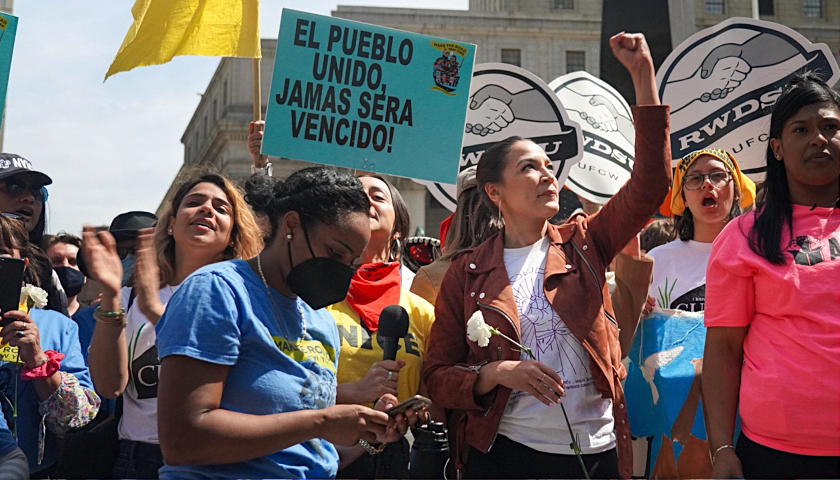
Don’t look now but U.S. Rep. Alexandria Ocasio-Cortez (D-N.Y.) has jumped to a slight lead in the Democratic primary in New Hampshire, edging out Pete Buttigieg 22 percent to 21 percent, according to the latest University of New Hampshire poll taken between July 15 and July 20.
The shift in the poll, which had Ocasio-Cortez at 14 percent in October 2025 and 15 percent in February. In February, California Democratic Gov. Gavin Newsom was at 15 percent and former Vice President Kamala Harris was at 10 percent. In July, Newsom was down to 8 percent and Harris was down to 5 percent. Their loss was Ocasio-Cortez’ gain.
What changed? The U.S. and Israel resumed their offensive against Iran, arguably which began with June 2025’s Operation Midnight Hammer to destroy its nuclear facilities, and inflation has consequently reheated. The cost of living remains a problem, with record property values and rents, and that has always been a foothold socialists can use to gain power.
What kind of socialism? Some iterations call for abolishing private property, religion, sex, race, class and other distinctions that lead to perceived inequalities. Others call for ownership of the means of production. And so forth.
Never mind that the Fifth and Fourteenth Amendments state that no person can be deprived of property without due process of law — effectively rendering communism’s core mission unconstitutional — committed socialists won’t mind it, either. The only barrier usually is whether the party can get into power in the first place, regardless of the system that is being overthrown.
Historically, communists, socialists and fascists have prospered when the economy was not. Communism got a foothold in the extreme poverty of World War I in Russia; fascism and national socialism (Nazism) for its part in the post-war hyperinflation and depression in Italy and Germany. Economic conditions generally made it possible for these radical parties to gain footholds.
In Russia, this led to February Revolution in 1917 that set the stage for new elections that socialists and communists easily swept — socialist and communist parties garnered more than 73 percent of the vote — and then the Bolsheviks then disbanded the assembly and seized one-party rule.
In Italy, fascists swept the elections in 1924 easily amid widespread blackshirt violence.
In Germany, the Nazis swept into power in the 1932 elections at the height of the Great Depression. In January 1933, Adolf Hitler was appointed Chancellor by President Paul von Hindenburg.
In these instances, those were the last free elections those countries had until the end of the Cold War and World War II, respectively. And they’re not alone.
In China, Cuba, Venezuela, Nicaragua, Grenada, North Korea, Vietnam, Laos, Cambodia (Khmer Rouge), Burma, East Germany, Yugoslavia, Poland, Czechoslovakia, Hungary, Romania, Bulgaria, Albania, Mongolia, Ethiopia, Angola, Mozambique, Congo, Benin, Somalia, South Yemen, Iraq, Syria, Tanzania, Zambia, Guinea, Ghana, Algeria, Libya, in the cases of communists and socialists, and in Spain in the case of fascists — although the communists would have done the same if they had won the Spanish Civil War — the result was all the same: These parties came to power and ended competitive elections, squelching and in many cases murdering opposition parties.
That’s what they usually have in common: Once in power, they consolidate power.
This contrasts with other democratic socialist parties that maintained competitive elections upon claiming power, like the Labour Party in the United Kingdom (UK) — its Clause IV called for “common ownership of the means of production” — but also France, Spain, Portugal, Chile and Uruguay.
Even if one leaves the fascists and Nazis out of the equation, the overwhelming majority of self-described socialist parties, once in power, 34 to six, or in 85 percent of cases, ended competitive elections and crushed the opposition. If you include the fascists and Nazis, it goes up to 86 percent. That’s more than just a branding problem, it’s a history of political violence that cannot easily be discounted. Indeed, the odds suggest you should count on it.
And it is one that can occasionally be hastened by economic turbulences like inflation, unemployment and recessions — and also wars.
That’s why President Donald Trump has sounded the alarm in 2026 to warn of the rise of socialism and communism in the Democratic primaries. It’s a literal red flag.
Candidates have to go out of their way to call themselves socialists, and the onus is on them to prove they respect constitutional norms because, when in power, they usually do not. History shows that when a candidate tells you they are a socialist, democratic, national or otherwise, you should listen — for your own sake.
– – –
Robert Romano is the Executive Director of Americans for Limited Government Foundation.
Photo “Alexandria Ocasio-Cortez ” by Alexandria Ocasio-Cortez.



I am still trying to figure out why all-out-crazy is declared attractive/beautiful by the media. She looks to me like she has been on an all-night drunk at the bar where she used to serve liquor.