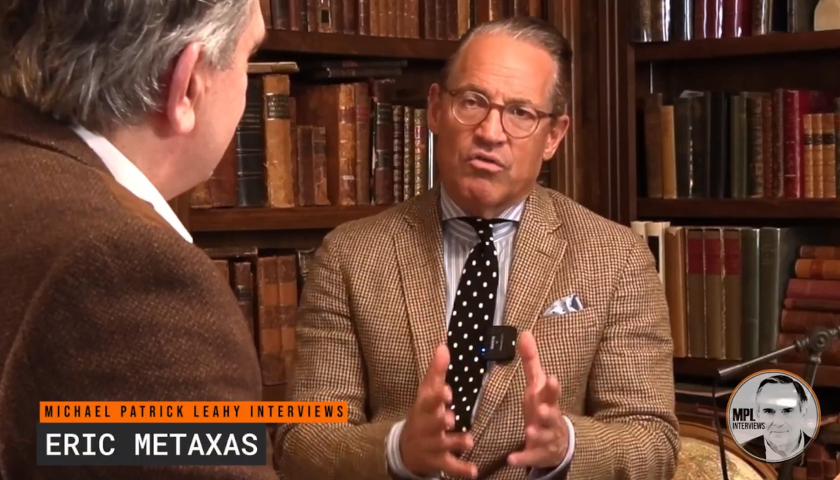
Eric Metaxas, author and conservative radio host, sat down for an exclusive interview with The Tennessee Star’s CEO and Editor-in-Chief Michael Patrick Leahy at Landmark Booksellers to discuss his latest book, Revolution: The Birth of the Greatest Nation in the History of the World.
Metaxas explained that his book traces the ideological origins of the American Revolution to a pivotal 1761 courtroom argument by attorney James Otis Jr., an event that future President John Adams later identified as the true beginning of the Revolution.
“The book starts with that,” Metaxas said, referring to Adams’ recollection decades later. “Years later when Adams was being asked about this… he says, ‘It began in a courtroom in 1761.'”
According to Metaxas, the dispute centered on the British government’s use of “writs of assistance,” which allowed officials to search colonists’ homes in an effort to curb smuggling.
“They could basically come into your house,” Metaxas explained. “James Otis Jr. effectively says, ‘We are British subjects and we have rights, and you cannot come into my house. It’s my castle. Every British subject, we have these rights. These rights come from God and no government has any right to abrogate my rights.’ It’s an amazing thing.”
Leahy noted that Metaxas also references the 1689 Massachusetts rebellion following England’s Glorious Revolution and philosopher John Locke’s writings on God-given rights.
Metaxas argued, however, that the colonists’ understanding of individual liberty predated Locke.
“I think the colonists felt that even before 1689,” he said. “The very idea that some of them are coming over from England in 1620, many are coming over in 1630 and after that, they’re already saying that our rights are being infringed, encroached upon in England. We gotta get out of here.”
“So we’re gonna go across the vast ocean so that we can govern ourselves and be free. Basically, that’s already happening,” Metaxas continued. “They already have a sense that their rights come from God even before John Locke writes about it. They have a sense that because of the Reformation, because of what the Bible says, they are free. Their obligation is to be under God—not under some king.”
Metaxas said that theological beliefs shaped the colonists’ understanding of liberty and self-government.
“That’s really, it’s a theological thing that, of course, like everything theological, it filters into everything else. How do I live? What is liberty? How much liberty do I have? Who has rights over me? How does that work? That comes out of the Reformation,” he said.
While acknowledging that he does not extensively explore the Protestant Reformation in the book, Metaxas said his research convinced him that its influence was foundational to the Revolutionary generation.
“It all points back to the Bible, and that is… it ends up being inescapable,” he said. “As I was doing my research, I thought they all understood that, even to the point where maybe they weren’t explicit about it sometimes because they thought, ‘We all know this. That’s the whole reason we’re doing this.'”
Leahy also highlighted Metaxas’ argument that faith and virtue were viewed by America’s founders as prerequisites for constitutional self-government.
“They all felt that,” Metaxas said. “This is before there’s any kind of a constitutional republic—before the Constitution. But they all believed that. Some of them wrote about it. Most of them wrote about it or spoke about it, but it’s clear that was foundational, that they all knew that we can’t govern ourselves unless we’re under God.”
Leahy agreed with Metaxas’ assessment, adding that even founders commonly viewed as less religious, including Thomas Jefferson and Benjamin Franklin, understood “the biblical covenant” that rights originate from God rather than government or monarchs.
Tune in now to The Michael Patrick Leahy Show – your AMERICA FIRST news talk!
– Watch LIVE here on X
– Watch LIVE on YouTube / Rumble / Roku / AppleTV
– Listen on Spotify
– Listen on WENO AM760 in Nashville
– Read more at @TheTNStarhttps://t.co/64oMLoLej3— Michael Patrick Leahy (@michaelpleahy) July 27, 2026
– – –
Kaitlin Housler is a reporter at The Tennessee Star and The Star News Network.