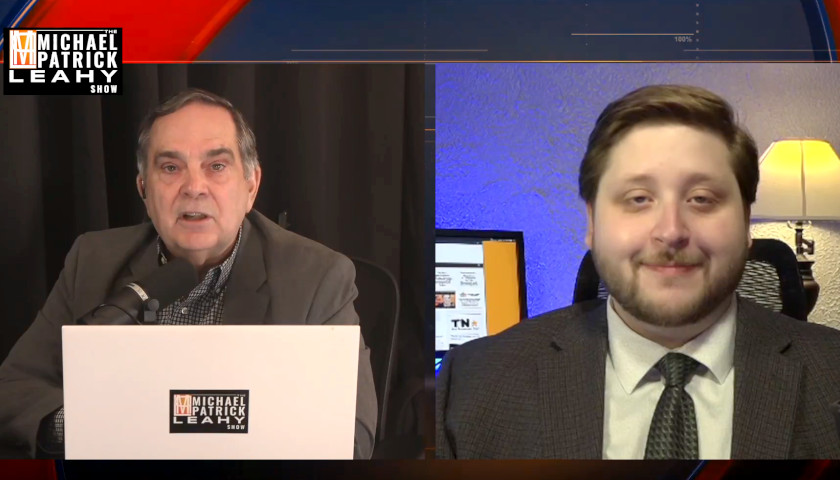

Tennessee State Representative Scott Cepicky (R-Culleoka) sat down for an exclusive interview Tuesday with The Tennessee Star‘s CEO and Editor-in-Chief Michael Patrick Leahy, where he discussed a sweeping education reform agenda throughout the Volunteer State’s education system.
During an interview on The Michael Patrick Leahy Show, Cepicky said the state’s education policies must prioritize student outcomes and better prepare young Tennesseans for future success.
“It’s about winning, right?” Cepicky said. “And we have to win with our kids.”
Cepicky said one of the state’s priorities has been restoring order in classrooms by giving teachers greater authority to address disruptive behavior.
“One of the things that we’ve tried to do was really focus on, one, setting up a classroom that teachers can teach in to begin with, getting discipline back into the classroom,” he said, pointing to legislation he previously sponsored that allows teachers to permanently remove disruptive students from classrooms when necessary.
“We’ve got to stop this mentality of we’re gonna hold back the education of 29 kids because one kid doesn’t wanna behave,” Cepicky said. “It’s gotta stop.”
The Republican lawmaker also advocated for increasing parental accountability when students face disciplinary action.
“Touch the parents with a little bit of pain and we’ll get the reaction that we want for the children,” he said.
Among his proposals for next year’s legislative session is a renewed emphasis on traditional classroom instruction, including the use of textbooks, handwriting, and direct teacher-led learning.
“We are looking at getting textbooks back in the classrooms in K-5, tried and true, proven,” Cepicky said.
“Hard copy textbooks,” he added. “Pen and pencil with the kids.”
Cepicky argued that physical books and handwritten work engage students more effectively than screen-based learning.
“We want the direct instruction coming from the teachers day after day, getting the kids’ noses in their books, turning the pages, writing with pen and paper so you’re engaging multiple tactile functions,” he said. “Every time you do that, it imprints on another part of the child’s brain.”
He also expressed support for expanded cursive writing instruction.
“Yes,” Cepicky said when asked whether schools should be doing more cursive writing. “Because that triggers different parts of the brain.”
Beyond classroom methods, Cepicky emphasized the importance of education in preserving civic society. Recalling a conversation with former state representative and Shelby County mayoral candidate John DeBerry, Cepicky said education prepares future generations to confront challenges their parents will never face.
“The reason why education for our children is so important is because they’re gonna go to a time and place that you and I will not go,” Cepicky said, quoting DeBerry. “For the republic to withstand the pressures of everything out there, our children must be educated.”
Cepicky also promoted competency-based education, arguing students should demonstrate mastery before advancing to the next grade level.
“We have got to get back to that,” he said. “When we grew up, you had to show that you knew so that you could go on to the next grade level and perform.”
He criticized current practices that advance students despite academic deficiencies.
“What we do now is we hope they’re close, but now you put the next grade level’s teacher at a disadvantage because the kids are not ready to learn what they’re supposed to learn,” Cepicky said.
The lawmaker reserved some of his sharpest criticism for federal education initiatives.
“No Child Left Behind and Race to the Top gutted education,” Cepicky said. “It took accountability out of the classroom for the teachers and for the students.”
Instead, he called for higher standards across the education system.
“We are going to demand excellence from our students, from our teachers, from our administrators, from the whole system,” Cepicky said. “And we’re gonna provide the support to do that.”
While acknowledging Tennessee’s academic gains in recent years, Cepicky said more work remains.
“We were 47th in education,” he said. “We’re now 22nd.”
He noted that third grade literacy rates have risen from approximately 26 percent to the mid-40 percent range during his tenure, but said those gains are still insufficient.
“If we get to 50, they’re gonna be patting me on the back and patting everybody on the back about how great a job we’re doing, and 50 percent of our kids still can’t read and comprehend on grade level,” Cepicky said. “If you were in sports, you’d be terminated immediately.”
Cepicky used prison literacy rates as an example, citing testimony presented before the House Education Committee.
“Women in our penitentiary system read on a third-grade level, men read on a first-grade level,” he said. “Over half have high school diplomas from Tennessee.”
According to Cepicky, those outcomes stem from policies that prioritize student growth metrics over actual achievement.
“Growth does not mean literacy. It does not mean achievement,” he said. “We gotta get back to where achievement is the driving force in education.”
The representative additionally criticized the expansion of virtual learning following the COVID-19 pandemic, saying, “The worst thing we ever did in COVID was we opened up virtual schools.”
He referenced legislation passed this year to impose additional restrictions on virtual schools after poor academic performance.
“The word profitability and education should never be in the same sentence,” he said.
On higher education, Cepicky highlighted investments in Tennessee Colleges of Applied Technology (TCATs), describing them as a model for workforce development.
“Our TCAT centers basically have almost a 99 percent graduation rate and almost 100 percent placement,” he said.
Students in technical programs often secure employment before graduation, he noted.
“You go in there, and you talk to the HVAC guys,” Cepicky said. “They’ll be three weeks away from graduation, and every one of them will know exactly where they’re going to work.”
Looking ahead, Cepicky said Tennessee’s universities must focus more closely on preparing students for in-demand jobs.
“We have got to really look at higher ed and say, ‘Okay, if you come to the University of fill in the blank and you take this course that we’re gonna offer for a degree, we know you’re gonna have a job waiting for you in that degree.'”
He also highlighted military service as a pathway to high-tech careers, noting that lawmakers recently took action to ensure military recruiters have access to public schools.
“If you score high enough on the ASVAB, they’re giving huge sign-on bonuses to these kids to come in and do military encryption or high-tech jobs,” Cepicky said. “It is a great career.”
Ultimately, Cepicky said Tennessee’s challenge is to modernize education while returning to proven instructional methods.
“We are trying to take an educational system 20 years ago that was gutted by federal policy … and rebuild it looking forward to how innovative and creative we can be,” he said. “Direct instruction is something that’s been tried and true.”
“The worst thing that we ever did to our teachers was we told them to meet their students where they are,” Cepicky added. “No. We demand excellence from everybody. You have to get to this level, and therefore, you can be successful.”
Tune in now to The Michael Patrick Leahy Show – your AMERICA FIRST news talk!
– Watch LIVE here on X
– Watch LIVE on YouTube / Rumble / Roku / AppleTV
– Listen on Spotify
– Listen on WENO AM760 in Nashville
– Read more at @TheTNStarhttps://t.co/XD2NZr6dHx— Michael Patrick Leahy (@michaelpleahy) June 9, 2026
– – –
Kaitlin Housler is a reporter at The Tennessee Star and The Star News Network.