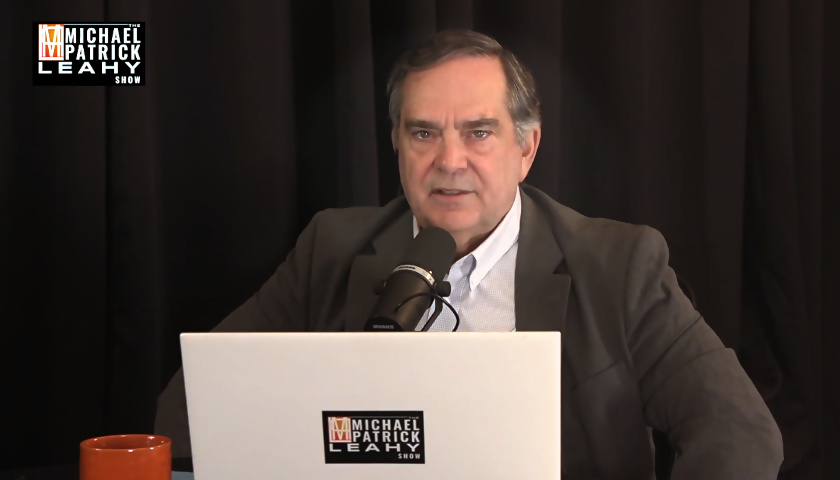
Michael Patrick Leahy, CEO and Editor-in-Chief of The Tennessee Star, criticized the U.S. Supreme Court’s 5-4 decision striking down President Donald Trump’s executive order restricting birthright citizenship, calling the ruling “the worst Supreme Court decision” since the late 19th century and arguing that Justice Clarence Thomas’s dissent could become one of the court’s most significant dissenting opinions.
“The Supreme Court decision on Tuesday called Trump v. Barbara, the majority of the Supreme Court said it is constitutional to allow birthright citizenship for illegal aliens, the children of illegal aliens,” Leahy said during Thursday’s edition of The Michael Patrick Leahy Show. “It is the worst Supreme Court decision since the 1890s when in an 8-1 decision, the Supreme Court allowed states to discriminate racially against Black Americans. It was the beginning of the separate but equal Jim Crow era. That was the 1890s. This is the worst decision since then.”
Leahy added that, in his view, the ruling was “a little bit worse than Roe v. Wade, the 1972 decision, which again mangled the 14th Amendment to create a right that didn’t exist.”
In Trump v. Barabra, the Supreme Court ruled 5-4 that the 14th Amendment guarantees U.S. citizenship to children born in the United States, including those born to parents who are in the country unlawfully or temporarily.
Chief Justice John Roberts wrote the majority opinion concluding that Trump’s executive order violated the Constitution’s Citizenship Clause. Justice Clarence Thomas filed a 91-page dissent, joined separately by other dissenting opinions from Justices Samuel Alito and Neil Gorsuch.
During Thursday’s program, Leahy highlighted an article by Rachel Bovard published by First Things, saying it accurately characterized the significance of the ruling.
Leahy quoted the article’s argument that, “In a sense, it is another Roe v. Wade—freezing a foundational question of self-government into judicial amber, out of reach of the American people and their elected representatives,” before adding, “Yeah. I think it’s exactly right.”
Turning to Thomas’s dissent, Leahy argued the justice correctly focused on the constitutional concept of domicile.
“Basically, he contended the Citizenship Clause… incorporates common law principles of allegiance but requires more than mere territorial birth. That’s the key,” Leahy said. “He emphasized domicile, that’s permanent home residence with intent to remain, as central to full subject to the jurisdiction. Hello. Yeah. Intent to remain that’s a key element of domicile.”
Leahy then quoted directly from Thomas’s opinion.
“‘The Civil Rights Act and the citizenship clause guaranteed citizenship to persons born and domiciled in the United States, regardless of their race. Neither guaranteed citizenship to persons who are not domiciled in the United States,'” Leahy read, describing the passage as central to Thomas’s argument.
He said Thomas argued that the Citizenship Clause was intended to overturn the Supreme Court’s Dred Scott decision while applying to formerly enslaved Americans who, as Leahy quoted from the dissent, “had no other homeland, owed no allegiance to any foreign power, and were subject to no other authority.”
Leahy also highlighted another section of Thomas’s dissent criticizing the majority opinion.
“‘The court today takes the extraordinary step of holding facially unconstitutional the president’s order excluding from citizenship the children of foreign temporary visitors and illegal aliens,'” Leahy read from the opinion.
Leahy also discussed the Supreme Court’s 1898 decision in United States v. Wong Kim Ark, which has long served as the leading precedent on birthright citizenship.
Reading from the majority opinion in the current case, Leahy quoted: “Attempts to narrow Wong Kim Ark by noting that the court’s opinions repeatedly referred to the domicile of Wong’s parents fail because the holding’s underlying reasoning cannot be squared with a domicile requirement. The court exhaustively canvassed the text and history of the citizenship clause, and at no point identified any evidence that the ratifiers thought themselves to be imposing a domicile limitation.”
Leahy rejected that interpretation, saying, “The principal dissent… distinguished this case and argued that Wong Kim Ark, if anything, supported their positions. And he’s right about that.”
Closing the segment, Leahy criticized Chief Justice Roberts and Justice Amy Coney Barrett for joining the majority.
“I think they’re legal narcissists. They’re trying to create some kind of fiction here, and they completely lack common sense,” Leahy said. “Did they consider the Constitution a suicide pact? They didn’t even ask that question. Their ruling, that interpretation would make the Constitution a suicide pact, and it is not.”
🚨The majority SCOTUS decision in Trump v. Barbara, written by Chief Justice Roberts and endorsed by Justice Barrett, which grants citizenship to children born in the USA to illegal aliens and temporary foreign visitors, TEMPORARILY transforms the Constitution into a SUICIDE PACT… pic.twitter.com/SDCG9uRppu
— Michael Patrick Leahy (@michaelpleahy) July 2, 2026
– – –
Kaitlin Housler is a reporter at The Tennessee Star and The Star News Network.