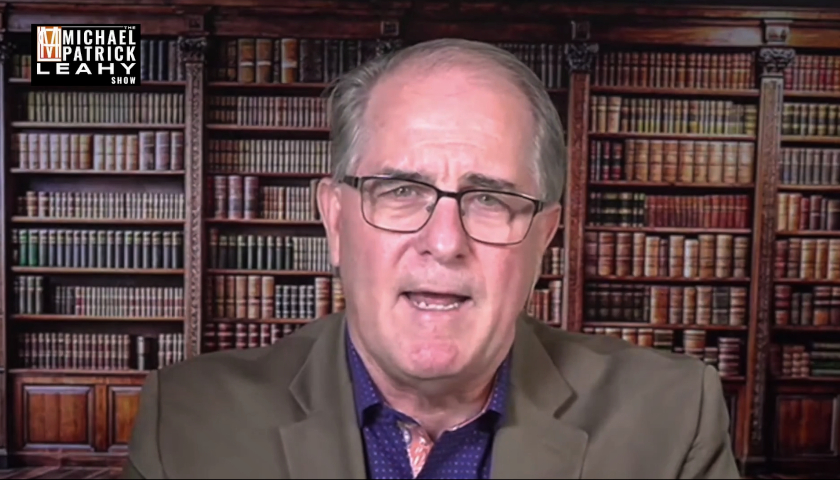
Former Kansas Attorney General Phill Kline said former White House COVID-19 adviser Dr. Anthony Fauci could have been compelled to testify before the U.S. Senate Homeland Security and Governmental Affairs Committee if the U.S. Department of Justice (DOJ) had approved granting him “use immunity,” arguing the legal mechanism would have prevented Fauci from invoking his Fifth Amendment rights during Wednesday’s hearing.
Discussing the hearing during an appearance on The Michael Patrick Leahy Show, Kline explained that Biden’s pardon significantly limits potential criminal liability for Fauci but said Congress still had another legal option available.
“His pardon eliminates any prospect of criminal liability from 2014 through his service with the government, so that’s a challenge,” Kline said.
Kline said lawmakers could have sought DOJ approval to grant Fauci “use immunity,” which would have prevented his testimony from being used against him while preserving prosecutors’ ability to use independently gathered evidence.
“The way to force him to testify is to give him what is called use immunity, in which they would not use his testimony against him, but they would preserve the right to use the evidence that they have gathered,” Kline explained. “Under those circumstances, a judge would order him to testify, and if he did not testify, he could be held in contempt of court, and the court could take immediate action.”
Kline said he was uncertain why that step was not taken.
“They decided not to do that, and I’m not quite sure why,” he said.
Asked whether the committee should have granted use immunity, Kline said the decision ultimately requires approval from the DOJ.
“The DOJ would have to sign off on it. And perhaps they didn’t want to do that at this stage and might do it later. I’m not certain. But that’s the way they could have forced him to testify,” Kline said. “I’ve done that with plenty of witnesses during the years that were actually potential targets of an investigation. To forward the investigation, I would grant them use immunity, and then they were forced to testify.”
Kline also noted that Fauci could still argue he faced potential criminal exposure for matters outside the scope of Biden’s pardon, including possible future perjury allegations.
“The pardon alone, the Fifth Amendment can’t be pled unless a person arguably has the potential for being held or subjected to criminal liability for their statements,” Kline said. “But Fauci has an argument that with the pardon, he could under perjury or any specific action outside that scope of the pardon. And that could have been eliminated with use immunity, I believe.”
Responding to comments that U.S. Senator Ron Johnson (R-WI) has indicated Fauci could be questioned again in writing, Kline said that possibility helps explain why Fauci invoked the Fifth Amendment.
“That’s why he’s pleading the fifth,” Kline said. “Everybody has the right to plead the fifth. I still think that they have a difficulty in forcing him to testify unless they give him use immunity.”
Kline added that although Fauci was within his constitutional rights, he found the former public health official’s refusal to answer questions troubling.
“It was rather extraordinarily discomforting to watch a public servant who was willing to speak to the public on the drop of a hat about important issues previously, who is unwilling to provide any transparency into his thinking and why he made the decisions that he made, which harmed Americans so significantly,” Kline said. “That is extraordinarily disturbing.”
When asked about U.S. Senator Rand Paul’s (R-KY) reported plan to recommend a contempt of Congress referral to the DOJ, Kline said prosecutors would have a stronger case if Fauci had first been granted use immunity and then refused to testify.
“The Trump administration has demonstrated a willingness in cases like this to really push hard towards prosecution,” Kline said. “But I believe they would be in a much better position to prosecute Dr. Fauci—actually, he would be held in contempt of court—for them to offer him use immunity and not to push the definition of pardon in this fashion.”
Kline also suggested the DOJ may have strategic reasons for delaying any decision on use immunity, including possible coordination with state investigations or broader federal inquiries.
“They could be looking at information pertaining to the post-pardon conduct by Fauci. They could be cooperating with state attorneys general or prosecutors… They could even be developing a broader investigation into the wrongdoing,” Kline said. “There’s a lot of reasons why you might want to hold off on that.”
Still, Kline maintained that granting use immunity during Wednesday’s hearing “made sense” because it would not have prevented prosecutors from using documentary evidence, including emails and other records, in any future case. He also praised Paul’s handling of the hearing.
“Those questions, many of them, were very factually focused,” Kline said. “Mr. Paul… did an excellent job in tone and manner in keeping these things properly focused, and revealing how a public servant served himself and refused to speak about…how government assumed more power than we have ever seen in this nation, in controlling the population at the direction of one man.”
Tune in now to The Michael Patrick Leahy Show – your AMERICA FIRST news talk!
– Watch LIVE here on X
– Watch LIVE on YouTube / Rumble / Roku / AppleTV
– Listen on Spotify
– Listen on WENO AM760 in Nashville
– Read more at @TheTNStarhttps://t.co/oVaHmggL8g— Michael Patrick Leahy (@michaelpleahy) July 30, 2026
– – –
Kaitlin Housler is a reporter at The Tennessee Star and The Star News Network.