
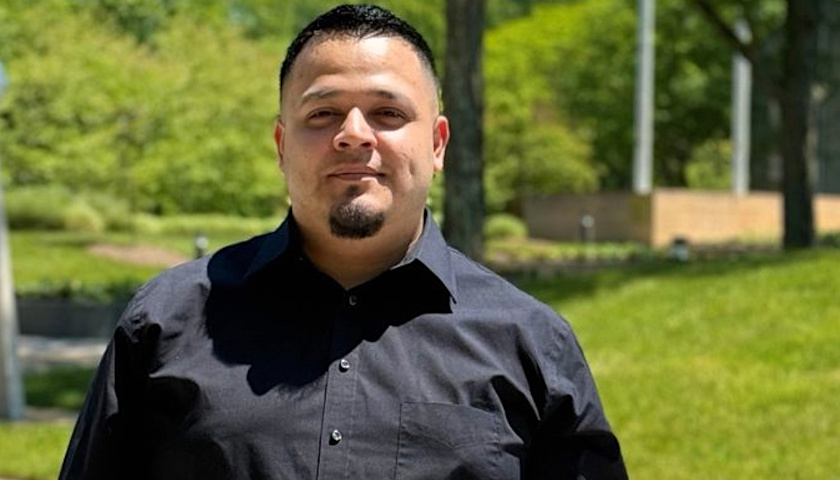
Tom Pappert, lead reporter at The Tennessee Star, detailed the latest developments in the case of Kilmar Abrego Garcia on Wednesday, including Abrego Garcia’s departure from the U.S. for Spain, a newly unsealed court order authorizing his self-deportation, and the Trump administration’s ongoing effort to reinstate the federal human smuggling charges dismissed earlier this year by U.S. District Judge Waverly Crenshaw.
Appearing on Wednesday’s edition of The Michael Patrick Leahy Show, Pappert noted how The Star first reported in April 2025 that Abrego Garcia had been stopped by Tennessee Highway Patrol (THP) troopers in November 2022 after allegedly failing to maintain his lane.
During the traffic stop, troopers discovered that Abrego Garcia did not have a valid driver’s license and was transporting nine passengers who did not speak English or have any identification or luggage.
The Star was also the first to report that the Biden-era FBI instructed THP troopers to release Abrego Garcia following the stop.
During Monday’s show, Pappert explained how that reporting eventually prompted federal investigators to pursue the case.
“Nothing further came from it until a Homeland Security Investigation special agent in Nashville, Tennessee read our April 2025 reporting on Abrego Garcia, forwarded it to the then acting US attorney for the Middle District of Tennessee, and that launched the human smuggling case against Abrego Garcia that is now on appeal,” he said.
Pappert also revealed that U.S. District Judge Paula Xinis signed the order authorizing Abrego Garcia’s self-deportation on November 20, the same day the Department of Justice (DOJ) submitted its latest brief to the Sixth Circuit Court of Appeals seeking to overturn the dismissal of the human smuggling charges.
The order, which had previously been sealed, confirmed that Abrego Garcia’s departure would complete his final deportation order dating back to 2019.
“It’s on appeal as Abrego Garcia is in Spain,” Pappert said. “He self-deported yesterday.”
The appellate court has scheduled oral arguments in the case for February 4, 2027.
Pappert said the Trump administration could theoretically pursue extradition proceedings to bring Abrego Garcia back to the U.S. to face the charges, although there is no indication that such a move is underway.
“There may be this human smuggling case hanging over his head as a sword of Damocles should he try to cross back into the United States,” Pappert said.
He also questioned how Abrego Garcia expects to return to the U.S., noting that deportation orders generally carry a 10-year prohibition on reentry for individuals removed from the country.
“Typically when an illegal alien is ordered deported from the United States and then deported, there is a 10-year prohibition on re-entry, and that can be indefinite under certain conditions,” Pappert said.
The discussion also touched on the legal arguments in the Trump administration’s appeal of Crenshaw’s dismissal of the human smuggling charges.
Crenshaw dismissed the case earlier this year after finding that prosecutors failed to overcome the presumption of vindictive prosecution, citing statements from Trump administration officials and internal DOJ communications.
Pappert explained that the DOJ argues Crenshaw considered the possibility of vindictive prosecution too early in the proceedings, when the case was still at the indictment stage.
“What the Trump administration is saying is that Waverly Crenshaw was totally wrong to consider the possibility of vindictive prosecution at this stage in the case,” Pappert said.
He added that prosecutors argue vindictive prosecution should generally be considered after a case has advanced and a defendant has exercised certain legal rights.
Pappert described the government’s position as a compelling argument and said he expects the Sixth Circuit to reject Crenshaw’s reasoning.
“I think it’s a compelling argument. I think that a court of appeals is going to essentially laugh in Crenshaw’s face,” Pappert said.
Pivoting to discuss the broader immigration scene under the Trump administration, Pappert said the administration had pursued alternative destinations for deportees who cannot be returned to their home countries because of withholding-of-removal orders.
He pointed to El Salvador, Liberia, and potentially Spain as examples of countries willing to accept deportees under those circumstances. Pappert argued that the administration’s approach represented a departure from how such cases had traditionally been handled.
“It used to be for generations, if you obtained a withholding of removal because you were afraid to of torture or whatever the case may be in your home country, then you had de facto permission to remain in the United States as an illegal immigrant until you reached the natural end of your life,” Pappert said.
In closing Pappert pointed to U.S. Census Bureau figures indicating that the Trump administration has presided over a decline of approximately three million aliens, including about two million illegal aliens.
“The U.S. Census Bureau says the Trump administration has presided over a decrease of three million aliens, including about two million illegal aliens, in the time it took to get Kilmar Abrego Garcia out of the country,” Pappert said.
“So while we are all focused on this poster child that the Democrats created, the Trump administration was quietly and effectively keeping its promises on the low-hanging fruit, shall we say,” he added.
Tune in now to The Michael Patrick Leahy Show – your AMERICA FIRST news talk!
– Watch LIVE here on X
– Listen on Spotify
– Listen on WENO AM760 in Nashville
– Read more at @TheTNStarhttps://t.co/UiQDTbWFsW— Michael Patrick Leahy (@michaelpleahy) November 25, 2026
– – –
Kaitlin Housler is a reporter at The Tennessee Star and The Star News Network.
Photo “Kilmar Abrego Garcia” by We are CASA.