
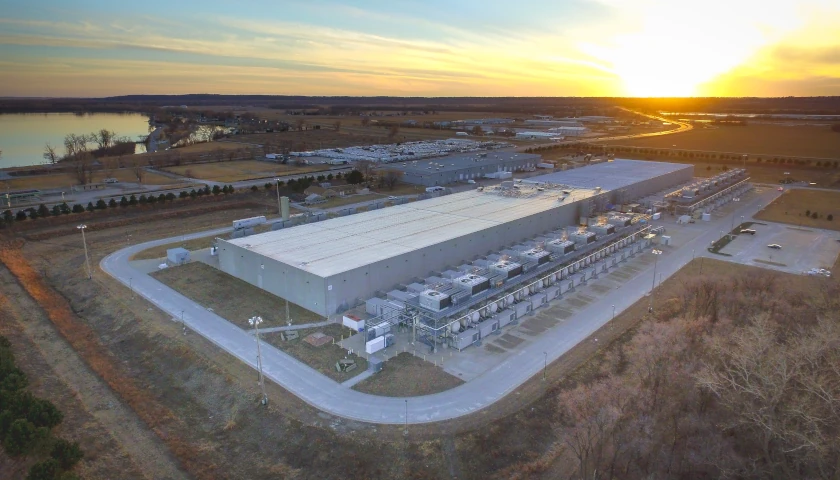
Public affairs specialist and veteran journalist Clint Brewer argued that opposition to data centers is being driven more by fear and uncertainty than facts, warning that widespread moratoriums could undermine America’s competitiveness in artificial intelligence (AI).
Speaking on Thursday’s edition of The Michael Patrick Leahy Show, Brewer described data centers as “the planning and zoning boogeyman of America right now.”
“There’s just a sort of reflexive fear of them without a whole lot of information,” Brewer said. “We certainly need them as a country. There’s no question we need them.”
Brewer acknowledged that resistance stems from multiple concerns, including apprehension about AI and preserving rural communities.
“It’s a complicated mix of fear of AI taking people’s jobs, coupled with… and rightfully… people in rural areas wanting to keep them rural,” he said. “If you look at where data centers go, disproportionately they go to rural areas.”
When asked about claims that data centers drive up electricity costs, Brewer said more research is needed.
“I don’t know if that’s empirically true,” he said. “They obviously use a lot of electricity. I think the truth is that not a whole lot is known. And I think there are people who’ve had bad experiences with having them near, but there needs to be a more organized way to promulgate these as an industry than the way it’s being done right now.”
Brewer noted how many communities have responded by imposing restrictions before fully evaluating the industry’s long-term benefits.
“I think there are many states and counties and communities reflexively putting a moratorium on them,” Brewer said. “I think it’s bad for the country overall. We desperately need data centers.”
He argued that data centers are essential to the nation’s technological future and its competition with China.
“As a country, we are in a race with the Chinese… on artificial intelligence,” Brewer said. “You have to have them. They’re just… they’re non-negotiable. And they’re an incredibly important part of our tech industry’s infrastructure.”
Brewer also rejected the notion that data centers fail to generate lasting employment.
“Data centers do create jobs not just in the construction phase, but there will be a long-term legacy sector for maintaining them, servicing them. It is not a jobless endeavor,” he said.
He said local zoning codes often fail to address the unique characteristics of modern data centers.
“Current zoning rules and regulations in most places never anticipated a data center,” Brewer said.
At the same time, he praised Southern utility companies for preparing their electrical grids to accommodate growing demand.
“I think the utility companies across the South have done a terrific job ramping up production to accommodate data centers,” Brewer said.
Brewer pointed to neighboring states as examples of governments embracing artificial intelligence and related infrastructure.
“Mississippi’s all in… Arkansas,” he said. “They’re incorporating them into their power grid plan. They’re incorporating artificial intelligence into making state government more efficient. There’s some real forward-looking things happening in some parts of the South.”
Elsewhere, however, he said opposition has intensified.
“In the Midwest, you’re seeing county by county moratoriums and bans,” Brewer said.
He argued the issue has created an unusual political coalition.
“It’s one of those weird places politically where, if you think of politics as traditionally a spectrum with a right on the one end, left on the other end, this is one of those issues where the right and the left come in the back door behind the spectrum and get together,” Brewer said.
According to Brewer, that alliance combines “pro-rural populism coupled with progressive anti-Americanism and anti-growth and anti-industrialization.”
“So on the one end, we’re enjoying this industrial reindustrialization of America, where we’re back to building things and making things,” he said. “On the other hand, we’ve got this going on, which is hamstringing one of our biggest and best industries that’s gonna take us into the future.”
Brewer warned that communities rejecting major technology investments could face long-term economic consequences.
“Economically, it’s gonna hurt these places for decades,” Brewer said, referring to outside groups opposing projects. “Corporate investment in America comes and goes in waves, and right now this is what we’re looking at.”
He concluded by questioning whether opposition to new technology projects could expand beyond data centers.
“Originally, we tried to make ourselves energy independent by going solar, and then we pivoted to drilling more, and now we’re looking at these micro nuclear power plants,” Brewer said. “Is that what’s next? … Are we gonna oppose those soon?”
Tune in now to The Michael Patrick Leahy Show – your AMERICA FIRST news talk!
– Watch LIVE here on X
– Watch LIVE on YouTube / Rumble / Roku / AppleTV
– Listen on Spotify
– Listen on WENO AM760 in Nashville
– Read more at @TheTNStarhttps://t.co/Y3sxcwHpp0— Michael Patrick Leahy (@michaelpleahy) June 25, 2026
– – –
Kaitlin Housler is a reporter at The Tennessee Star and The Star News Network.
Photo “Data Center” by chaddavis.photography. CC BY 2.0.




Come on Clint Brewer – give us facts, not just your politicized opinion.
Below is what I’ve read. Is it true?
From the Internet > “Hooking up a giant data center takes new substations and heavy-duty transmission lines. Guess who foots the bill?
Under old utility rules, that cost gets spread across everybody. One report found ratepayers in seven states paid $4.3 billion for data center grid connections in 2024.
A Harvard expert calls it a “cost shift.” In plain English, you’re subsidizing the wires to Amazon’s warehouse. Add in skyrocketing demand, and residential prices jumped about 7% in 2025, nearly double inflation.
One big facility can use 5 million gallons of water a day, the same as a town of 50,000 people. The “fix”? Switch to waterless air cooling, which burns even more electricity. They’re stuck. So are you.
One Microsoft site in Illinois got $38 million in tax breaks and created 20 jobs. Virginia alone gave up $1.6 billion in tax revenue last year. That’s your school and road money walking out the door.”
>> Data Centers need to pay for the costs they cause – not taxpayers.
100