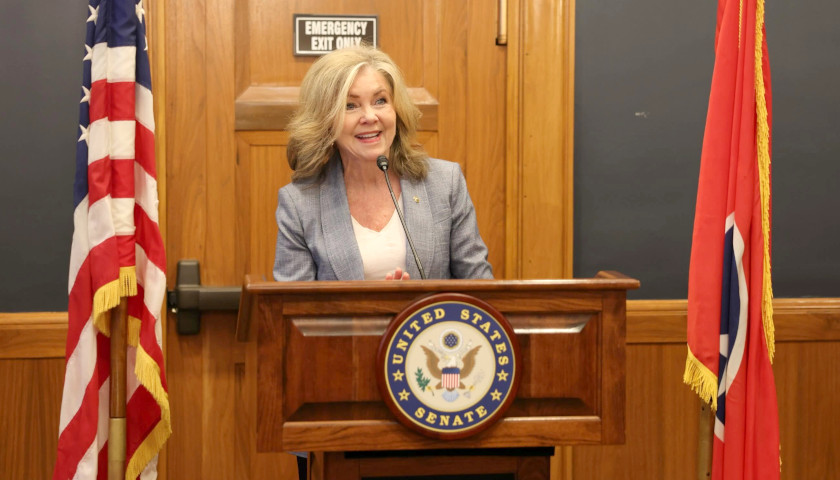
U.S. Senator Marsha Blackburn (R-TN) spoke exclusively to The Tennessee Star’s CEO and Editor-in-Chief Michael Patrick Leahy on Tuesday, promoting a new bill that would provide additional federal election security funding to states that submit voter registration data to the U.S. Department of Homeland Security (DHS) for citizenship verification.
During an interview on The Michael Patrick Leahy Show, Blackburn discussed the Election Security Partnership Act, legislation she introduced with U.S. Senator Lindsey Graham (R-SC) that would provide bonus election security funding to states that participate in DHS’s Systematic Alien Verification for Entitlements (SAVE) program.
The bill would appropriate $20 million for eligible states and allow participating states to receive up to a 10 percent increase in election security grant funding if they enter into an agreement with DHS to submit their voter registration lists for comparison through the SAVE system.
Blackburn said the legislation is intended to encourage wider use of the federal database.
“What the bill does is to incentivize the states to use the Department of Homeland Security SAVE system,” Blackburn explained. “This is a registry of individuals that are in the country. Many are on visas or work permits or permanent residents, but they’re not citizens, and it also contains the names of people that they know are in the country illegally.”
According to Blackburn, states can use the system to identify registered voters who are not U.S. citizens.
“So the good thing to do, the good thing you can do with this is the state can run their voter rolls against this, and it will kick out names that are not citizens that are actually registered to vote,” she said.
Blackburn noted that not all states currently participate in the SAVE program.
“Now, 26 states use this system. We’ve got 24 that do not,” she said. “So we have encouraged all states to do this to make certain that it is only citizens that are voting in our elections.”
Blackburn noted how the legislation uses financial incentives rather than mandates to encourage participation.
“The good thing is, the federal government will pay a 10 percent bonus to states that have their grants that are there to help with election integrity,” Blackburn said. “They’ll get a 10 percent bonus if they are using this system.”
She also emphasized that states would not be required to transfer their voter registration databases to the federal government.
“The system is free. President Trump has made it free. You are not turning over your data. You are double-checking your data against their database,” Blackburn said.
Blackburn connected the legislation to broader election integrity efforts, including provisions she said are related to the SAVE Act.
“And this is a big part of our push to make certain we get the Save America Act implemented,” she said. “And we have had such trouble getting that finished that those of us that have been with this bill since day one, we say even if we have to break it apart and pass it piece by piece, we’re determined to get the job done.”
Asked whether there are estimates of how many noncitizens may have voted in federal elections nationwide, Blackburn said no comprehensive national figure exists.
However, she cited examples from individual states.
“What we do know is that if you take a state like Texas, who ran their voter list against this list, they found 2,700 people on their voter list that showed up on the SAVE system that were not citizens, but in Texas they had registered to vote,” Blackburn said. “Ohio found over 1,000, and out of that they found 160 that had been voting regularly since the year 2000.”
She added that broader participation by states could provide a clearer national picture.
“So we do not know how many there are specifically across the country. What we do know is that as the states begin to use this, we’re going to be able to get a better idea of how many people it is in total,” Blackburn said.
When asked about the bill’s prospects in Congress, Blackburn said she and Graham are exploring legislative avenues to advance the measure.
“Senator Graham and I are trying to push this through the judiciary committee, and then get it included in some other piece, maybe a reconciliation bill or something that is moving,” she said. “It involves money, so therefore it could go into a reconciliation bill.”
Blackburn said persistence is essential to advancing legislation.
“But if you’re not out there pushing a piece of legislation and working to find a way, you’re never going to find that way,” she said.
Tune in now to The Michael Patrick Leahy Show – your AMERICA FIRST news talk!
– Watch LIVE here on X
– Watch LIVE on YouTube / Rumble / Roku / AppleTV
– Listen on Spotify
– Listen on WENO AM760 in Nashville
– Read more at @TheTNStarhttps://t.co/By8OdBW2CX— Michael Patrick Leahy (@michaelpleahy) June 16, 2026
– – –
Kaitlin Housler is a reporter at The Tennessee Star and The Star News Network.
Photo “People Voting” by Lorie Shaull. CC BY 2.0.