
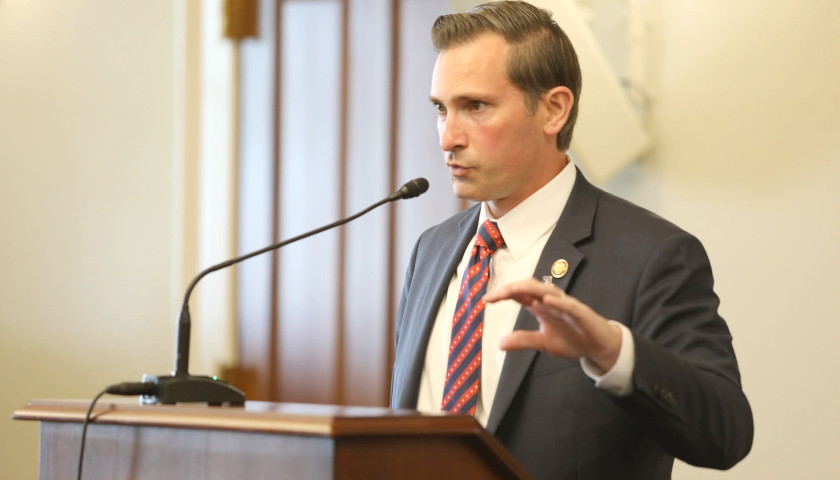
Tennessee U.S. Rep. Matt Van Epps (R-TN-07) is shifting his attention to the U.S. Senate after the House approved his first piece of legislation, saying his next objective is securing passage of the Major Non-NATO Ally Terror Threat Assessment Act and ultimately seeing President Donald Trump sign the national security measure into law.
Speaking Thursday on The Michael Patrick Leahy Show, Van Epps said his office is already working with senators to advance companion legislation after the bill cleared the House earlier this week.
“We’re working on that part right now to get the companion legislation moved,” Van Epps said. “We believe this is common sense… We hope to get it to the president’s desk.”
If signed into law, the legislation would require the U.S. Department of Homeland Security, in coordination with the U.S. Department of State and the U.S. Director of National Intelligence, to submit recurring assessments to Congress on terrorist threats originating within America’s Major Non-NATO Ally (MNNA) countries.
The reports would identify terrorist organizations operating in those countries, evaluate their capabilities – including the use of emerging technologies – and recommend ways the U.S. can address potential threats.
Van Epps said the legislation fills what he views as an important oversight gap in Congress’ understanding of terrorism risks among some of America’s closest security partners.
“This is a really critical piece of legislation that came out of the Counterterrorism and Intel subcommittee of Homeland that I sit on,” Van Epps said. “What we wanted to do with this legislation is increase oversight where there’s a current gap where terrorist organizations may operate within these Major Non-NATO Ally countries without consistent congressional visibility.”
“So essentially, this bill has Homeland Security work with the State Department and the Director of National Intelligence to evaluate the terrorist organizations that are operating in these countries, the capabilities, whether or not they have access or are using emerging technologies, and then provide that assessment back to Congress so that we can assess what DHS capabilities are, and then to resource and fill any of those gaps,” he added. “It’s a bit technical, but really important to our counterterrorism efforts.”
Van Epps credited the bill’s progress to months of work by his congressional office, the Homeland Security Committee staff, and House leadership.
Although he is among the House’s newest members, he said his office made a deliberate effort to become deeply involved in committee work.
“We’re not the newest anymore, but we’re still pretty new, like the third newest. And we got this done in the first seven months, and it really is a testament to just the teamwork and collaboration,” Van Epps said.
He explained that he was not originally assigned to the counterterrorism and intelligence subcommittee but requested a seat after a vacancy opened in January.
“When a member left in January, it opened a seat there, and so I just went to the chairman, and I made a request, and he granted that for me to be on that subcommittee where this bill originated,” Van Epps said.
Van Epps said he and his staff were committed to attending every Homeland Security hearing and regularly participating in classified intelligence briefings.
“We took an approach where we said, ‘Every single day, every time that we can engage with the Homeland Security Committee, we’re gonna show up. We’re gonna be present. We’re gonna stay for the full committee hearings if they’re five hours long. We’re gonna be prepared and ask good questions of witnesses, and really just dive into the process and be a good team player.'”
The freshman congressman also pointed to his military background as preparation for the committee’s work. A West Point graduate and former Army helicopter pilot with the 160th Special Operations Aviation Regiment, Van Epps said his experience shaped his focus on national security issues.
“I was there on 9/11. I was a part of the first seminar course for terrorism studies that West Point launched in 2004. And then serving in the 160th and our special operations missions provided a conducive background to work in service on the Counterterrorism and Intel Subcommittee,” he said.
Looking ahead, Van Epps said he is optimistic the legislation can attract bipartisan support in the Senate because of its national security focus.
“It really is common sense, and it’s really important. It fills and solves a critical gap. And I think there are a lot of national security-minded Republicans in the Senate [who] are interested in this kind of work,” he said.
If the measure ultimately reaches President Trump’s desk, Van Epps said he hopes to witness the bill become law in person.
“Would love to be in the Oval Office when he signs it and to take some pictures and bring that pen back too,” Van Epps said. “That’s our objective. That is absolutely the objective.”
— Michael Patrick Leahy (@michaelpleahy) July 16, 2026
– – –
Kaitlin Housler is a reporter at The Tennessee Star and The Star News Network.
Photo “Matt Van Epps” by Matt Van Epps.