
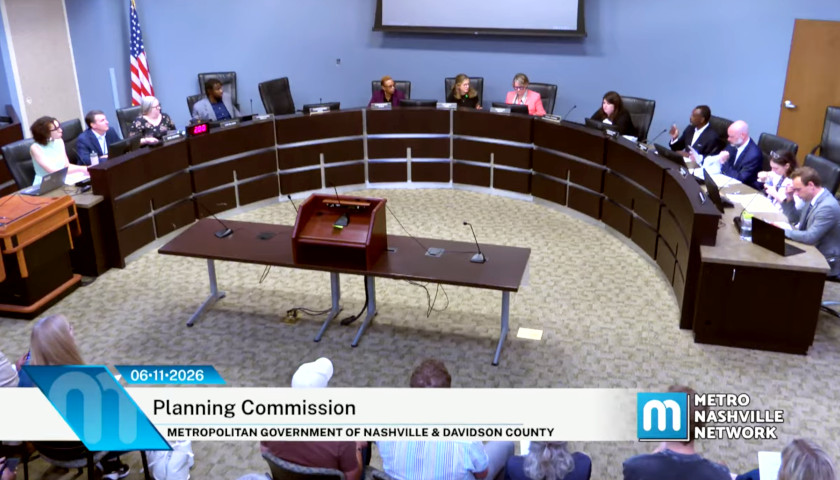
The Metropolitan Planning Commission decided to put off a decision on regulating data centers in Davidson County.
The planning commission will consider a proposed ordinance on June 25th that will provide a “comprehensive regulatory framework for data centers.”
The ordinance would place restrictions on data centers in Davidson County, such as prohibiting campus data centers over 500,000 square feet or requiring more than 100 megawatts of power demand.
Small data centers would be allowed only in certain commercial and industrial districts, with specific restrictions, while medium data centers would be permitted only in select industrial districts.
The ordinance would require large data centers to obtain special approval to operate in the county.
Under the ordinance, small data centers are those with less than 20,000 square feet, or that use up to 5 megawatts of power. Regarding medium data centers, the ordinance defines them as those between 20,000 and 99,000 square feet or using 5 to 20 megawatts of power. The ordinance defines large data centers as those between 100,000 and 499,000 square feet or using between 20 and 100 megawatts of power.
According to the ordinance, these data centers will need to be a certain number of feet away from homes, daycares, schools, parks, churches, zoos and other data centers.
Small data centers must be at least 100 feet from these entities, while medium and large data centers must be at least 500 feet and a half-mile, respectively, from these entities.
If data centers were to operate in Davidson County, they would need to have a closed-loop cooling system that recycles water and minimizes water consumption, the ordinance says.
Data centers’ backup generator usage would be limited to only emergencies and can operate for no more than 72 consecutive hours, the ordinance notes.
Regarding noise levels, the ordinance limits data centers’ noise decibels to 65 during the day and 55 at night. According to Yale University, 65 decibels sounds like a busy office, and 55 decibels sounds like a household refrigerator.
Before a data center operator receives a zoning permit from the Metro government, the ordinance requires that Nashville Electric Service be able to supply power to the data center, and that water and sewer utilities demonstrate they can support it.
Data center operators will need to file annual reports on water usage, energy usage, environmental compliance and compliance with regulatory standards.
At the nearly 6-hour-long meeting on Thursday, Nashville residents spoke out against data centers coming into Davidson County.
Dr. Joy Henningsson said she was “gravely concerned about the detrimental health impacts of data centers,” such as “increased carbon emissions, noise and light pollution, and electronic waste generation.”
“AI data centers almost certainly pose threats to human health, both mental and physical, that we don’t know about yet,” she said.
Henningsson urged the planning commission to ban data centers in the county.
Numerous people came to the meeting to speak out against a proposed data center near the Nashville Zoo.
John David Bumpus, the communications director for TennGreen Land Conservancy, said the way Tennesseans “use land today determines the quality of life not just for us, but for every generation to come.”
“I am not opposed to technology or economic development of Nashville,” Bumpus said.
He noted data centers “may be an appropriate neighbor” in an industrial district, but not for neighborhoods or schools.
“The Nashville Zoo is existing critical infrastructure to [Nashville], he said. Bumpus highlighted the zoo as an “economic engine” for Middle Tennessee, referencing its 1.4 million annual visitors.
He said the burden should be on data centers to prove their “worth and compatibility with Nashville.”
– – –
Zachery Schmidt is the digital editor of The Star News Network. Email tips to Zachery at [email protected].

The sky is falling!!
The sky is falling!!
It would have been appropriate for the governing agencies to foresee the introduction of data centers considering AI has been the #1 domestic topic for a long while.
Really not sure what all the fuss is about, but being correctly informed might be a good place for these folks to begin.
“Before a data center operator receives a zoning permit from the Metro government, the ordinance requires that Nashville Electric Service be able to supply power to the data center, and that water and sewer utilities demonstrate they can support it.”
This didn’t seem to matter when they decided to pass density zoning.
Bunch of NIMBYs