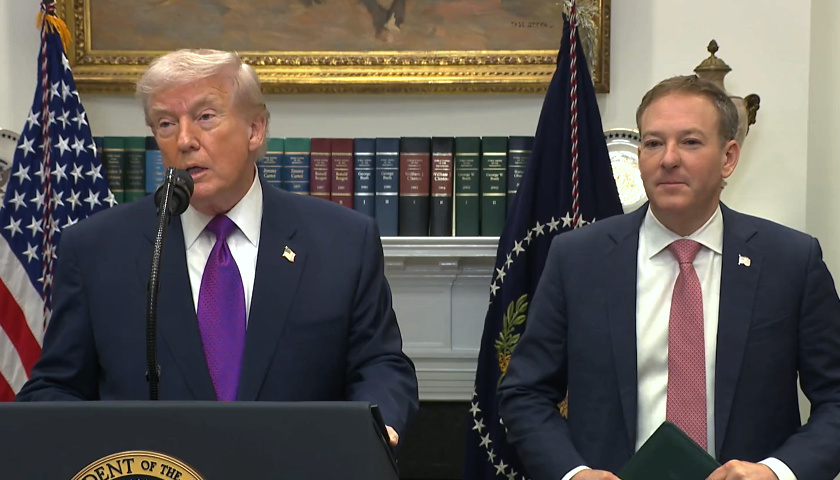
President Donald Trump and EPA Administrator Lee Zeldin on Thursday announced the repeal of the Obama-era 2009 Endangerment Finding that classified greenhouse gases (GHGs) as pollutants endangering public health and welfare under the Clean Air Act.
“This is about as big as it gets,” President Trump said in remarks announcing the landmark policy shift.
The rule, described by the administration as the single largest deregulatory action in U.S. history, eliminates the Endangerment Finding itself and rescinds all subsequent federal GHG emission standards for motor vehicles and engines from model years 2012 through 2027 and beyond. It also wipes out all associated “off-cycle credits” — including those that incentivized the automatic engine start-stop feature, which Zeldin repeatedly called “almost universally despised” by drivers for its intrusive operation and inconvenience.
The EPA projects the action will save American taxpayers and consumers more than $1.3 trillion over time, translating to an average reduction of over $2,400 per new vehicle through lower compliance costs passed on by manufacturers. Officials emphasized restored consumer choice, reduced vehicle prices (especially for trucks that affect goods transportation costs), and relief for families, small businesses, and rural communities.
The 2009 finding identified six well-mixed GHGs as contributing to atmospheric concentrations that threaten human health and welfare through climate impacts like rising temperatures, extreme weather, and sea-level rise. It formed the legal basis for federal GHG regulations across sectors, starting with vehicles as the “cause or contribute” source under Clean Air Act Section 202(a).
The six gases combined account for less than 0.05% of the total atmospheric volume include:
– Carbon dioxide (CO₂, the dominant tailpipe emission from burning gasoline and diesel)
Approximately 422–427 ppm (parts per million), or about 0.042–0.043% of the atmosphere by volume
– Methane (CH₄, from exhaust and fuel systems)
Approximately 1,930 ppb (parts per billion), or 0.000193%
– Nitrous oxide (N₂O, from combustion and catalytic converters)
Approximately 338 ppb, or 0.000034%
– Hydrofluorocarbons (HFCs, from air conditioning refrigerants)
Varies by specific compound (e.g., HFC-134a around 100–200 ppt or parts per trillion), but collectively in the low ppt range, or <<0.000001%
– Perfluorocarbons (PFCs)
Extremely low, in the ppt range (e.g., CF₄ around 80–90 ppt), or negligible fraction
– Sulfur hexafluoride (SF₆)
Approximately 11–12 ppt, or ~0.0000000012%
These miniscule substances, according to the EPA’s analysis, shows that even if all U.S. vehicle GHG emissions were hypothetically eliminated, modeling shows no detectable impact on global temperatures, sea-level rise, or other climate indicators through 2100. This draws from tools and assumptions used in prior administrations’ assessments but is framed here to argue that vehicle-specific GHG regulation lacks meaningful environmental justification under the Clean Air Act’s localized pollution focus.
The legal foundation authorizing the policy change rests on recent Supreme Court decisions — Loper Bright Enterprises v. Raimondo (ending Chevron deference to agency interpretations) and West Virginia v. EPA (limiting major questions doctrine application) — which the administration says constrain EPA’s authority to regulate GHGs as “air pollution” without explicit congressional direction. The rule reinterprets Section 202(a) to exclude global atmospheric effects from the agency’s endangerment purview.
The New York Times noted that the finding and rule repeal process moved unusually quickly. Following Trump’s January 20, 2025, Day One executive order directing review, Zeldin launched formal reconsideration in March 2025, proposed repeal in July 2025 (announced at a truck dealership in Indiana), and finalized it after a 52-day public comment period that drew over 572,000 submissions and included four virtual hearings. This robust — but often glossed-over — stakeholder input is cited as evidence of thorough process.
Trump, speaking alongside Zeldin in the White House Roosevelt Room, called the 2009 finding a “disastrous Obama-era policy” that damaged the auto industry and inflated prices. Zeldin labeled it the “Holy Grail” of what he termed the “climate change religion,” adding that scrapping the start-stop credits was an “added bonus” for everyday drivers.
Critics, including environmental groups like the Environmental Defense Fund, condemned the move as a dangerous denial of climate science that strips EPA authority over the nation’s largest GHG source (transportation) and threatens ripple effects on power plants, factories, and state-level rules. Former Biden-era advisers warned it “doesn’t change the reality of climate change — it just denies it,” while some labeled it a “gift to billionaire polluters.”
Legal challenges are widely expected, potentially testing the administration’s statutory reinterpretation and Supreme Court precedents. The EPA is also proposing a separate two-year delay on remaining Biden-era vehicle GHG rules.
– – –
Christina Botteri is the Executive Editor of The Tennessee Star and The Star News Network. Follow her on X at @christinakb.