
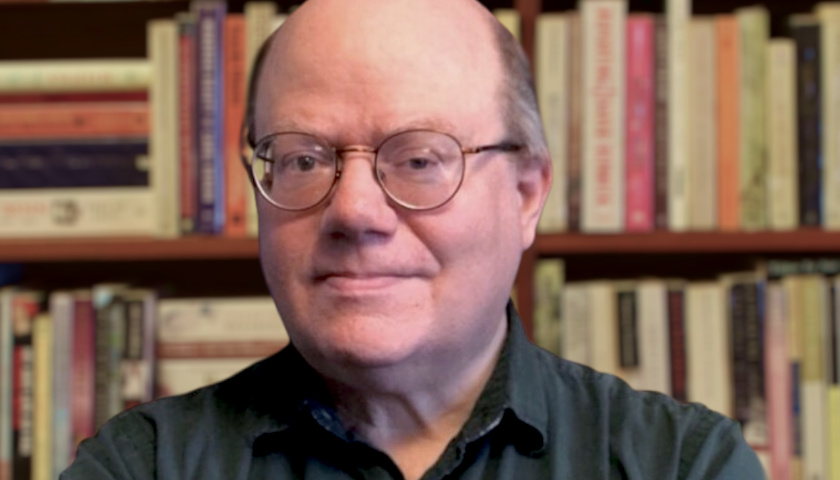
Larry Sanger, who co-founded Wikipedia in 2001, coined its name, and helped draft its early core policies, said on Thursday that he is permanently banned from editing the English-language version of the site.
The indefinite block, imposed by a “consensus” of mostly anonymous administrators in June, followed Sanger’s public promotion of a new WikiProject Intellectual Diversity. He detailed the episode in a Washington Examiner column, describing it as evidence of Wikipedia’s capture by a small clique of ideologically driven, anonymous editors who wield unchecked power.
In the op-ed, Sanger wrote that he was “permanently blocked from editing Wikipedia, the website I named and led in 2001.” He said he endured three days of abuse by administrators before the ban, which he called part of a pattern where powerful anonymous admins “gang up on people who don’t fall in line.”
Wikipedia administrators cited two main reasons: off-wiki “canvassing” – Sanger posted on X about the WikiProject to encourage broader participation – and the vague charge of “Not here to build the encyclopedia.” Sanger rejected both, calling the process a “kangaroo court” lacking formal charges, a designated prosecutor, due process, or impartial adjudication. He described Wikipedia’s governance as “mob-rule anarchy” ruled by “a few hundred anonymous demagogues” who operate through vague rules, alliances, and intimidation.
Sanger noted that Jimmy Wales, his co-founder, initially defended him, leading to a temporary unblock, but the permanent ban was later upheld by administrator consensus. He argued that the real issue was his push for reform against what he sees as entrenched ideological bias.
Sanger left active involvement in Wikipedia in 2002 but has been a vocal critic since at least 2004. In early October 2025, he published his “Nine Theses About Wikipedia” on his site explicitly modeled on Martin Luther’s 95 Theses. A version also appeared in his Wikipedia user space.
The nine proposals include:
– Ending decision-making by “consensus” (which he calls an institutional fiction that silences dissent)
– Allowing competing articles written from explicitly declared perspectives
– Abolishing source “blacklists” (Wikipedia’s Perennial sources page, which he says deprecates or restricts many conservative outlets while favoring left-leaning ones)
– Reviving the original neutrality policy
– Repealing or reforming “Ignore all rules”
– Letting the public rate articles
– Ending indefinite blocks
– Adopting a proper legislative/governance process
– Requiring transparency for the most powerful (often anonymous) editors and functionaries
The theses gained significant attention. In late September 2025, Sanger was interviewed by Tucker Carlson. Clips circulated widely among conservatives. Elon Musk shared the post and announced xAI’s development of an alternative encyclopedia project, later dubbed Grokipedia.
In interviews throughout 2025 and 2026 — including a December 2025 appearance on The Peter McCormack Show and a June 2026 CNN-News18 discussion — Sanger expanded on alleged systemic issues. These included left-leaning bias on topics such as politics, Israel/Palestine (which he said intensified after Oct. 7), climate, vaccines, and religion; dominance by a small group of anonymous “power users;” influence of activist editing groups; and questions around paid editing. He has long argued that Wikipedia functions more like a captured institution than the neutral, open encyclopedia it claims to be.
For its part, the Wikimedia Foundation, the 501(c)(3) public charity that owns Wikipedia, insists that it does not make editorial or content decisions. A Foundation spokesperson told reporters that “Wikipedia is governed by a community of volunteer editors around the world who develop and enforce policies through open, transparent discussions and consensus-based decision-making. The Wikimedia Foundation does not make editorial or content decisions on Wikipedia.”
Sanger ended his op-ed by reflecting on the information platform he helped create. He wrote that it “is decidedly not a lovely, idealistic project staffed by students, scholars, and retirees who just want to share their knowledge to benefit the world.” Instead, “the site has manifestly been captured by a small clique of ideologically motivated bullies” who ban those who do not fall in line.
“Wikipedia is one of the most powerful media platforms in history,” he wrote. “It is past time we learned who really controls it.”
– – –
Christina Botteri is the Executive Editor of The Tennessee Star and The Star News Network. Follow her on X at @christinakb.
Photo “Larry Sanger” by Larry Sanger CCSA.


Of course he’s banned. He is not a raging leftist.