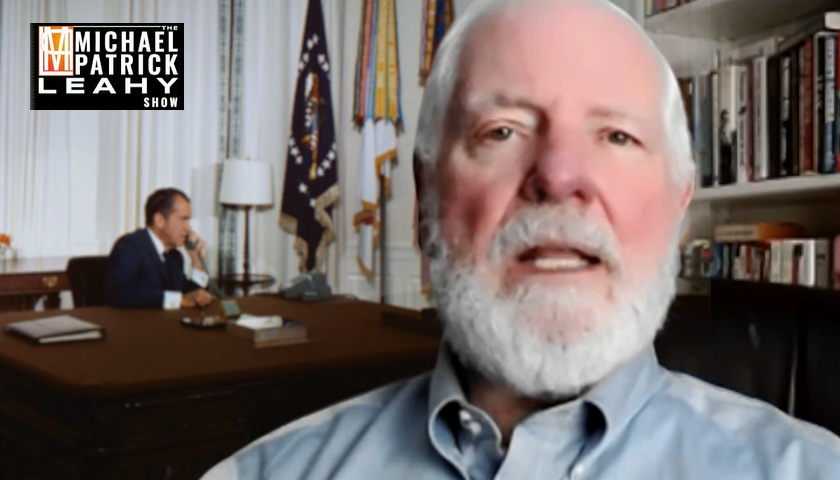
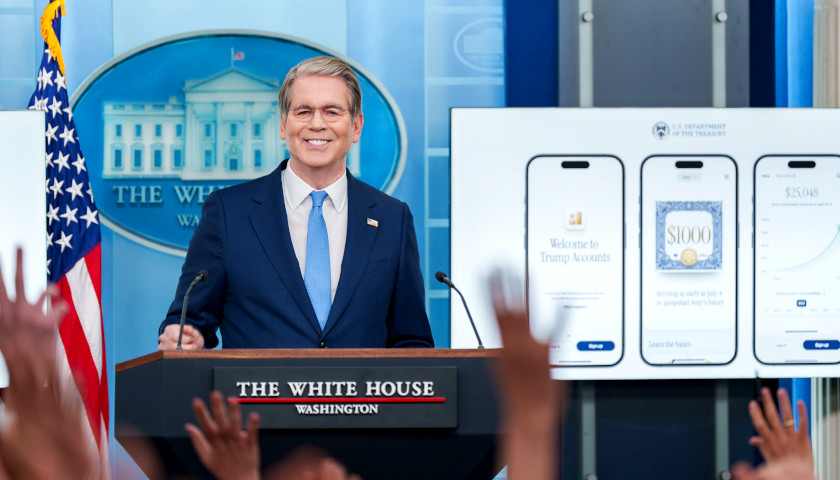
U.S. Treasury Secretary Scott Bessent defended the Trump administration’s economic agenda in an exclusive interview with The Tennessee Star’s CEO and Editor-in-Chief Michael Patrick Leahy, highlighting the administration’s new Trump Accounts, tax policies, manufacturing strategy, and efforts to reduce the federal deficit.
During the wide-ranging interview, which aired Friday on The Michael Patrick Leahy Show, Bessent discussed the administration’s efforts to expand investment opportunities for American families, reduce taxes on workers, reshore critical industries, and restore what he described as America’s economic sovereignty.
He also offered insight into his working relationship with President Donald Trump, the pace of the administration, and bipartisan cooperation in Congress.
Bessent was interviewed shortly after his return from Tennessee, where he participated in a ceremony to rename a bridge over the French Broad River in honor of President Trump.
Reflecting on Tennessee’s economic climate, Bessent remarked, “I made the observation which is, I don’t understand why, but the lower the state taxes, the better the roads.”
“I was just so impressed by what’s going on in your state,” he added. “What a boom town Knoxville is.”
The conversation turned to migration from high-tax, Democratic-led states to lower-tax, Republican-led states such as Tennessee and South Carolina. Bessent argued affordability is driving population shifts.
“When you talk about affordability, the best way to change your affordability calculus is to move out of a blue state,” he said.
Bessent cited energy prices and taxation as major factors influencing relocation.
“We see it on electricity, which we can’t control at the federal level… it’s the blue states that haven’t added any capacity, where the prices are skyrocketing. And, it’s also with the high-tax jurisdictions. South Carolina, my home state, has the highest percent of arrivals relative to the population, and part of it is that we don’t tax Social Security.”
Much of the interview focused on the administration’s newly created Trump Accounts, which Bessent described as one of the administration’s most significant initiatives.
“They’ve been a home run. I think those are the most important social benefits for young people since the GI Bill, and 38 percent of American households have no exposure to the equity market, and this is going to give everybody a piece of the action,” Bessent said.
He said the program is intended to accomplish more than simply creating savings accounts.
“Our goal is, with these accounts, not only to get everyone invested in the equity markets, but also a real-time experiment in financial literacy, and to bring people into the system,” he said.
According to Bessent, enrollment has been strong since the program launched.
“Signups have been excellent. We’ve got 6 million [signups], 1.4 million of those are eligible, if your child is born during President Trump’s term… the account gets seeded with $1,000 from the treasury, and that can compound until they’re 18. They could take it out then or roll it into a traditional IRA. Also parents, family, friends can contribute.”
Beyond government funding, Bessent said private philanthropy and employers are expected to significantly increase the value of many accounts over time.
“Sue and Michael Dell put in $6.25 billion, which is about $250 for every child who is not in the top 20 percent of ZIP codes. We’re expecting a lot more of that. Many states are matching. I think it is going to become an employee benefit that employers either put money in directly or match,” he said.
Bessent added that the long-term financial impact could be substantial.
“This could be a substantial amount when the child turns 18, or it could maybe be well over half a million dollars when people retire,” he stressed.
Asked why every eligible family would not participate, Bessent suggested politics was preventing some people from enrolling.
“We’ve got some recalcitrant people who don’t wanna do it because President Trump’s name is on it. But I would say, I think there are plenty of Republicans who’ve signed up for Obamacare,” he noted.
Bessent said he believes the initiative will become a defining part of Trump’s presidency.
“This is part of President Trump’s legacy. President Trump is going to leave the American people with assets, not debt,” he said.
The Treasury secretary also defended the administration’s tax agenda, citing the first tax-filing season under the new policies.
“I also oversee the IRS, and I could tell you for this filing season it was a home run. Forty-four percent of the returns we received had one of the president’s four signature policies, no tax on tips, no tax on overtime, reduced taxes on Social Security. Eighty-five percent of our seniors did not pay tax on Social Security, and deductibility of interest for American-made cars,” he said.
Bessent said one proposal had become considerably more popular than expected.
“I would’ve thought that Las Vegas would’ve been the tip capital of America, but… no tax on overtime was by far the most popular,” he noted.
Conversations with restaurant owners and other small businesses reinforced that observation, Bessent said.
“Especially in the service industry, they told me that the no tax on overtime, not only do the employees love it, but the employers love it because if you’ve got a great employee, you just get them to work more,” he said.
“It’s the American way. If you wanna work harder and longer, you keep more of your pay,” he added.
Discussing the administration’s broader economic philosophy, Bessent referenced a recent speech he delivered at the Economic Club of New York on Alexander Hamilton.
“It’s President Trump’s enduring theme, which is that economic security is national security, and we are retaking our sovereignty,” he said, noting that the COVID-19 pandemic exposed dangerous weaknesses in America’s supply chains.
“The only good thing about COVID, in my opinion, was it was a beta test in case we were to ever get cut off from some critical supply chains, whether it was from a kinetic war or from some kind of natural disaster,” Bessent said.
Among his greatest concerns was pharmaceutical production.
He said, “80 or 90 percent of our pharmaceutical precursors come from China and India, mostly China… Anyone with children has given their child amoxicillin, and that gets made overseas, so we’ve gotta reshore all of that and make sure that we are safe and sound at home.”
Bessent added that the administration’s message extends beyond domestic manufacturing to America’s allies and competitors.
“We’re putting our allies on notice that we have expectations. If you want to join us, this administration is going to lead. We’re the leader in energy. We’re the leader in AI. Our economy’s pulling away from everyone else. We want you to join us, but we also want your interests to be aligned with ours,” he said.
Bessent added, “We’re telling our adversaries that do not try to stifle our growth. Do not try to impinge on our national security.”
Asked about working for President Trump, Bessent described the experience as demanding but rewarding.
Although he acknowledged that the pace can be exhausting, he said that interacting with Americans across the country has been the most fulfilling aspect of the job.
“Many of you may think that the highlight of being Treasury Secretary is getting the calls at 1:52 a.m. from the president. It’s not. The real highlight is getting to come out into the country and meet the Americans who President Trump works for every day to try to make their lives better, and see that it’s working,” he said.
When asked about Trump’s reputation for late-night phone calls, Bessent joked about the conversations: “It always starts with, ‘Scott, did I wake you up?’ And then, ‘No, sir. I’m always up at 1:52 a.m. on a Tuesday.'”
Rejecting suggestions that Trump has slowed down, Bessent said the president continues to operate at full speed.
“For anyone who says that he’s slowing down, it’s fake news. It is full speed all the time,” Bessent said. “He can multitask like no one I’ve ever seen. We were talking about a round of golf that he had played five years before… and he was going hole by hole on that person’s shots, his shots. His mind never stops working.”
Bessent also discussed the administration’s fiscal priorities, saying the Treasury inherited historically large deficits.
“Here at the Treasury, we inherited the worst deficit to GDP in history when we weren’t at war and weren’t in a recession… We brought that down to about 5.5 percent deficit to GDP. We’re trying to get it down to 3 before the president leaves,” he said.
Acknowledging the demanding workload, he joked about his future after leaving office.
“I’m already thinking about what am I going do in the spring of 2029. Am I going to go on a beach somewhere? Am I going to go to a health clinic in Switzerland? But I’ll worry about it then,” he said.
🚨MUST WATCH EXCLUSIVE: Treasury @SecScottBessent told me Trump Accounts, Trump economic agenda were inspired by Alexander Hamilton. And explained why people are moving from HIGH TAX BLUE STATES to NO STATE INCOME TAX RED STATES like Tennessee. pic.twitter.com/5euAJCa7NG
— Michael Patrick Leahy (@michaelpleahy) July 10, 2026
– – –
Kaitlin Housler is a reporter at The Tennessee Star and The Star News Network.