
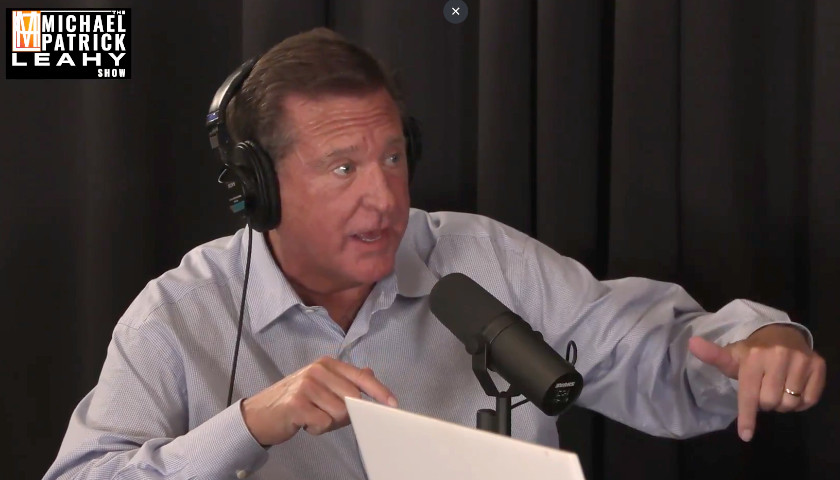
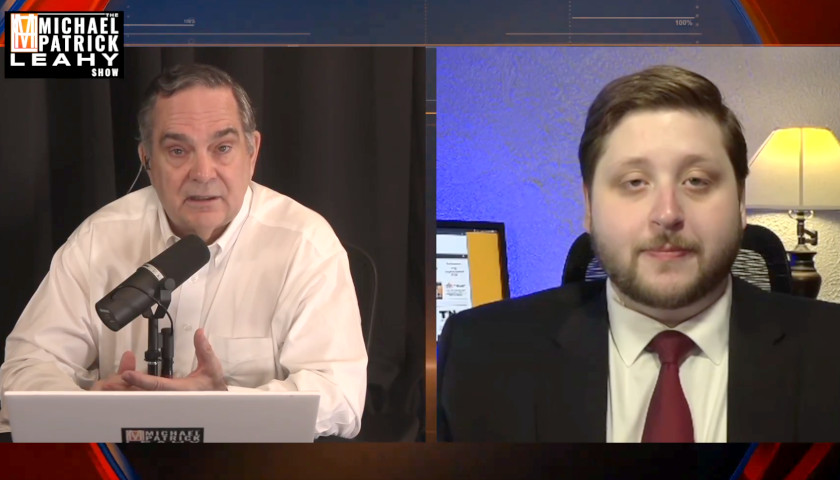
JC Bowman, founder and president of Professional Educators of Tennessee, joined The Tennessee Star’s CEO and Editor-in-Chief Michael Patrick Leahy for a sit-down discussion regarding the future of K-12 education in the Volunteer State, examining everything from direct instruction and charter schools to education freedom scholarships, civic education, and workforce development.
Kicking off the conversation, which aired during Monday’s edition of The Michael Patrick Leahy Show, Leahy, who recently launched the nonprofit education advocacy organization Tennessee Leads, first described a five-point plan he says would improve educational outcomes across the state.
“We need to champion the adoption of direct instruction methodology as the proven evidence-based standard for teaching K-5 reading, writing, and arithmetic in Tennessee’s public schools,” Leahy said, also advocating expanding vocational education, increasing education freedom scholarships, streamlining charter school approvals, and strengthening civic education.
Bowman, a veteran education advocate with more than four decades of experience, agreed that direct instruction has a strong research foundation.
“Project Follow Through, which was the original direct instruction, did prove that it was one of the most successful teaching methods,” Bowman said, referencing the federal education study.
While supporting the approach, Bowman cautioned that implementation matters.
“If you’re teaching something and a student doesn’t grasp the concept, you have to revisit it. You reteach it,” Bowman explained. “When you’re doing guided instruction, you’re rapidly going through the process. And kids get left behind somewhere in that.”
Leahy argued that properly implemented direct instruction ensures mastery before students move forward.
“The theme is this methodology is for every kid,” Leahy said. “As it demonstrates that it is the most effective way to teach reading, writing, and mathematics, I think it should be mandated as the methodology to teach reading, writing, and math in K-5 public schools.”
Both men expressed concern over reading and math proficiency levels among Tennessee students.
“If you can’t read and write and do math, you can’t think critically,” Leahy said.
Bowman agreed, saying, “Absolutely. There’s no dispute…When we graduate kids who are unprepared and we’re just graduating them, we’re failing society.”
Shifting the discussion to charter schools, both men viewed them as an important component of educational reform, with Leahy arguing that greater competition could improve statewide educational performance.
“Don’t you think on principle right now, because the K-12 public schools are performing so poorly across the board in urban areas, in rural areas, and in suburban areas, that competition is a way to solve that?” Leahy asked.
“Competition has always made us all better when it’s fair,” Bowman responded. “We’re ultimately, with taxpayer dollars, accountable to taxpayers for how we spend those dollars.”
Bowman also criticized Metro Nashville Public Schools for routinely rejecting charter school applications.
“Metro Nashville Public Schools are actually hurting public schools with their Doctor No approach on every single opportunity the parents come through here because they’re not serving their constituents, which are the kids,” Bowman said.
Asked why local officials oppose charter expansion, Bowman answered, “Because it will take money away from their system, and they won’t get to control it. It’s not about the kids.”
Leahy agreed, saying, “It has nothing to do with the kids.”
“And on that, we agree 100 percent,” Bowman replied.
Shifting focus to Tennessee’s Education Freedom Scholarship program, Leahy said he would like to see participation expand dramatically.
“I’d like to see 200,000,” he said, referring to the number of students who could eventually receive scholarships.
Bowman, however, raised concerns about private-school capacity and accountability.
“The vast majority of the kids who come through this program or are getting these scholarships were kids already enrolled in private school,” Bowman said. “So how does that improve public schools?”
Drawing on his experience working for former Florida Governor Jeb Bush, Bowman argued that scholarship expansion must be accompanied by additional capacity.
“You have to build the capacity. You have to build the need for kids,” Bowman said.
He also called for stronger oversight.
“First, accountability needs to be; you need to be financially audited and make sure that’s occurring,” Bowman said. “Number two, you’re looking at test scores. Can those kids read, write, and do basic arithmetic? If they can, fine.”
Despite their differences on school vouchers, both Leahy and Bowman repeatedly returned to the importance of literacy and numeracy.
“At the end of the day, if you can’t read, write, and do basic arithmetic, we’re failing them,” Bowman said.
Turning to civic education, Leahy argued that students must understand American government and constitutional principles.
“Kids need to read, write, do math, they need to understand the Constitution, they need to be able to build stuff, they need to be able to think critically,” Leahy said.
Bowman said Tennessee leaders must do more to prioritize civics instruction.
“We need to make sure we have a literate citizenship who can exercise their right, and we’re losing that,” Bowman said.
Addressing Governor Bill Lee directly, Bowman added, “Our governor has promised this from day one, and you have to ask yourself, are we better in civics in the last eight years than we were when he came in there? If we’re not better, that’s on you. We’ve got to do a better job in civics.”
Bowman further questioned whether state officials are adequately monitoring implementation.
“If it’s a priority, then I want to know who at the state’s going to make sure it’s getting done,” he said.
While critical of civics education efforts, Bowman praised Tennessee’s progress in career and technical education.
“As much as I think he has failed on civics, I think he has done a good job on vocational education,” Bowman said of Lee.
He highlighted successful culinary arts programs in Wilson County and workforce preparation initiatives across the state.
“Those kids are graduating and going into a career,” Bowman said.
Although Bowman and Leahy disagreed on certain policy details, both concluded that Tennessee must focus on raising student achievement and preparing young people for citizenship and employment.
“The teachers are trying to do their job,” Leahy said. “They’re stuck.”
Bowman echoed that sentiment, adding, “That’s exactly right, and that’s where we’re losing it.”
Tune in now to The Michael Patrick Leahy Show – your AMERICA FIRST news talk!
– Watch LIVE here on X
– Watch LIVE on YouTube / Rumble / Roku / AppleTV
– Listen on Spotify
– Listen on WENO AM760 in Nashville
– Read more at @TheTNStarhttps://t.co/5CLKpSeC1o— Michael Patrick Leahy (@michaelpleahy) June 1, 2026
– – –
Kaitlin Housler is a reporter at The Tennessee Star and The Star News Network.
Hard to disagree with most of these comments but I have three major points to make concerning school vouchers.
1. For every public student awarded a voucher that district should lose an equivalent amount from the state funding. We already pay enough for failed education without paying double.
2. What is the big deal about students attending private schools receiving vouchers. Why should personal financial sacrifices disqualify a student (family) from receiving a voucher. It is their tax money as well.
3. I believe the voucher concept is just a way for the state to sticks its head in the sand regarding the abysmal performance of the public schools. The correct action would be to actually fix the public education problems. One component should be instituting a merit-based compensation system for classroom workers. A second action should be to force the trimming of the fat from the grossly top-heavy administrations.