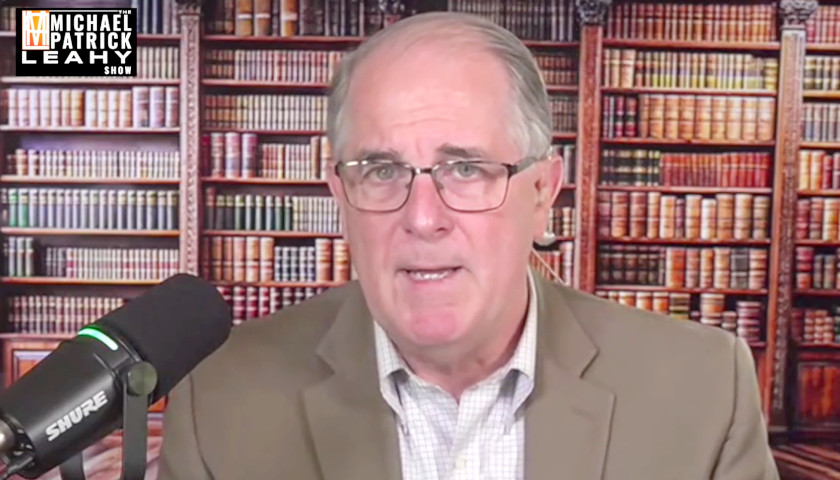
Former Kansas Attorney General and law professor Phill Kline said Missouri’s ongoing congressional redistricting dispute has created a complicated legal situation after the U.S. Supreme Court blocked the use of a Republican-backed congressional map for the November election.
During an interview Friday on The Michael Patrick Leahy Show, Kline explained the competing legal challenges surrounding Missouri’s 2025 congressional map, which was expected to improve Republicans’ chances of gaining an additional seat in the U.S. House.
“There are several things which make it somewhat procedurally and legally confusing,” Kline said.
He said three separate challenges had been brought against the map, including challenges over whether Missouri could redraw its congressional districts between censuses and whether the new districts violated provisions of the Missouri Constitution.
The Missouri Supreme Court rejected those challenges and allowed the 2025 map to stand until a separate referendum challenge changed the legal landscape.
Kline explained how opponents gathered approximately 300,000 signatures for a referendum seeking to suspend the map. The Missouri Supreme Court later ruled that the referendum was valid and that the 2025 map could not be used unless voters approved it.
“The referendum applies to all actions of the Missouri legislature. It doesn’t distinguish between redistricting and other measures,” Kline said.
The dispute then moved into federal court after a federal judge ordered Missouri to use the 2025 map for the November election, despite the state Supreme Court’s ruling.
On Thursday, the U.S. Supreme Court stayed that federal order, leaving Missouri to use its 2022 congressional map for the November general election. The court’s order did not include a public dissent.
Kline said the Supreme Court’s refusal to intervene earlier in the dispute was likely connected to the state-law issues at the center of the case.
“The Missouri Supreme Court has answered yes on both counts, so the Supreme Court is hesitant to get involved,” Kline said.
The legal conflict has created an unusual situation because Missouri held its August primary under the 2025 map, with more than 1.2 million voters casting ballots under those district boundaries.
“It is a mess,” Kline said.
Kline said Missouri may ultimately need legislative action or a constitutional amendment to clarify how its referendum process applies to redistricting.
“But these conflicts of laws were not the court’s doing,” he added.
With the November election approaching, Kline said additional legal challenges could follow, but he acknowledged the practical difficulties of changing district boundaries after the primary.
“Right now they’re saying the 2022 map is the law,” Kline said. “That’s both the Missouri Supreme Court and, by refusing to accept these arguments, the United States Supreme Court.”
The Supreme Court’s order means Missouri is currently set to hold its November congressional elections using the 2022 map, despite having held its August primary under different district boundaries.
Tune in now to The Michael Patrick Leahy Show – your AMERICA FIRST news talk!
– Watch LIVE here on X
– Watch LIVE on YouTube / Rumble / Roku / AppleTV
– Listen on Spotify
– Listen on WENO AM760 in Nashville
– Read more at @TheTNStarhttps://t.co/9Sbk7AjmxB— Michael Patrick Leahy (@michaelpleahy) September 11, 2026
– – –
Kaitlin Housler is a reporter at The Tennessee Star and The Star News Network.