
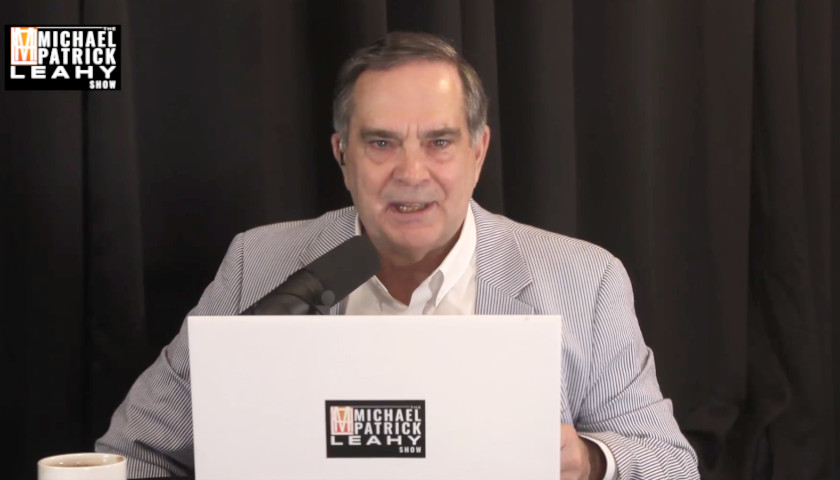
The Tennessee Star’s CEO and editor-in-chief, Michael Patrick Leahy, said Monday that he intends to challenge Metro Nashville Mayor Freddie O’Connell’s refusal to release records related to nearly $1.5 million in appropriations for two immigration-focused nonprofits through litigation.
During a discussion with The Star’s lead reporter, Tom Pappert, Leahy argued that Metro’s assertion of attorney-client privilege improperly withholds records sought under the Tennessee Public Records Act.
“We’re going to talk to them in court, obviously. We have to sue them,” Leahy said on Monday’s edition of The Michael Patrick Leahy Show.
His comments came after Metro Nashville produced only five documents in response to The Star’s public records request seeking information about O’Connell’s decision to include $735,000 for the Tennessee Immigrant and Refugee Rights Coalition (TIRRC) and $718,000 for Tennessee Justice for Our Neighbors (TNJFON) in the Fiscal Year 2027 budget.
Metro withheld the remaining responsive records, claiming they were protected by attorney-client privilege.
Pappert said the response from O’Connell’s office was unexpected, as he had anticipated Metro would either provide additional records or offer another explanation for the absence of documents.
“This one very much surprised me,” Pappert said. “I was expecting another document dump. Perhaps they would claim they didn’t have anything. Perhaps they would give us something that predated the mayor’s administration, perhaps from 2022 when the city of Nashville began using Biden-era American Rescue Plan Act money to give these two nonprofits millions and millions of dollars.”
Pappert said Metro instead argued that records related to the origins of the $1.5 million appropriation were protected by attorney-client privilege.
“We had a very short response saying that the entire request, which sought very mundane things, that by the way, seem to be covered in state statute, and they said the entire request, everything related to the genesis of this $1.5 million for the Tennessee Immigrant Refugee Rights Coalition and the Tennessee Justice For Our Neighbors nonprofit, everything related to it is covered by privilege, by attorney-client privilege,” he explained.
Pappert said he questioned Metro’s legal reasoning.
“I don’t quite see the argument there, but the meaning is clear. They’re lawyering up, and if we, The Tennessee Star, or members of the public would like to know more, we seem to have been invited to go talk to their lawyers,” he added.
Leahy said he believes Metro’s response represents an attempt to delay public access to records that should be available under state law.
“This is a pattern. It is a brazen and blatant violation of the Tennessee Public Records Act,” Leahy said.
He argued that Metro officials are using their legal resources to prevent the public from learning why taxpayer dollars were allocated to the nonprofits.
“They’re using the fact that they’ve got numerous attorneys and all sorts of bureaucrats there to hide what this $1.5 million that Metro Nashville is paying these pro-illegal alien nonprofits is for,” Leahy said.
Pappert said Metro’s own records may have revealed the city’s anticipated legal argument. According to Pappert, a response from the Metro Clerk’s Office included an internal email from Metro Assistant Director of Law Lora Fox explaining the city’s interpretation of the relevant statute.
“They’ve given away the entire legal strategy, and that was thanks to the Metro clerk,” Pappert said, noting how the internal communication indicated Metro believes it only needs to comply with one portion of Tennessee law governing nonprofit appropriations.
“We discovered in one of them that a city attorney, a Metro attorney, Lora Fox, is the one who claimed that Metro is only actually… it only actually has to follow part of the law,” he said.
Pappert said Metro’s interpretation relies on the idea that only final contracts must be disclosed, rather than earlier funding requests or proposals.
“According to the city attorney, they do not have to follow the portion of the law that says anytime a nonprofit asks for money and then the city gives it out, Metro gives it out, then that needs to be made available to the public,” he said.
“They claim that by following one portion and not the other portion, they’re compliant with the entire code. I don’t think that’s right,” Pappert added.
Tune in now to The Michael Patrick Leahy Show – your AMERICA FIRST news talk!
– Watch LIVE here on X
– Watch LIVE on YouTube / Rumble / Roku / AppleTV
– Listen on Spotify
– Listen on WENO AM760 in Nashville
– Read more at @TheTNStar https://t.co/pYAcNaH8k7— Michael Patrick Leahy (@michaelpleahy) July 13, 2026
– – –
Kaitlin Housler is a reporter at The Tennessee Star and The Star News Network.