
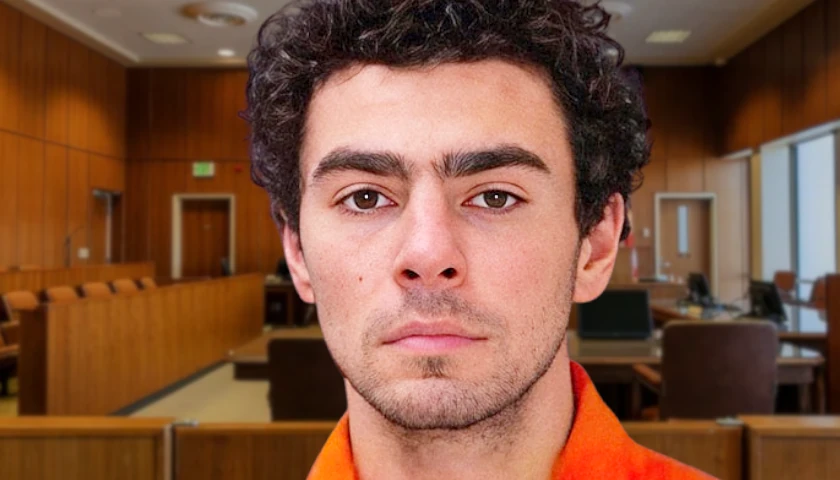
Judson Phillips, Tea Party Nation founder and former prosecutor, said the defense strategy reportedly being pursued by accused killer Luigi Mangione is a mental-health-based legal defense that rarely succeeds and is typically used when other legal options are limited.
As reported by Just The News, Mangione’s attorneys indicated in a New York court hearing Wednesday that they plan to argue he was suffering from an “extreme emotional disturbance” at the time of the 2024 fatal shooting of UnitedHealthcare CEO Brian Thompson.
Under New York law, the defense is available to defendants charged with murder.
Discussing the development on The Michael Patrick Leahy Show, Phillips, a former prosecutor with a decade of experience, explained the legal significance of the defense.
“It is a mental health defense,” Phillips said. “Now, let’s go back and start with some basics. What does a mental health defense do? It gives you something when you don’t have anything else to hang your hat on.”
Phillips noted that defendants who pursue such a strategy are effectively conceding key facts in the case.
“When you do an insanity defense, or in this case, this is a variation on insanity, that you’re admitting to everything,” Phillips said. “And so once you admit to everything the only issue is okay, what’s your out? And in this case, the out is not insanity, but extreme emotional distress, et cetera.”
According to Phillips, traditional insanity defenses are seldom successful.
“So now, as a practical matter, insanity defenses almost never work. They are so rare. Maybe not to the level of getting hit by lightning, but it’s pretty rare,” he said.
Phillips explained that when defendants are genuinely found to be legally insane, cases often do not proceed to trial.
“And the reason it is, if somebody is truly insane, they get evaluated by government psychiatrists first, and then, the government psychiatrists take a look at it and go, ‘Yeah, this guy is insane.’ The case never goes to trial. It’s resolved on what’s called an NGRI, not guilty by reason of insanity,” Phillips said.
He said a successful extreme emotional disturbance defense would not necessarily result in freedom for the defendant.
“The result of that would be, if successful, he’s in a psychiatric hospital instead of a prison,” Phillips said.
Phillips also pointed to the complications created by Mangione facing both state and federal charges.
“Now, Mangione’s got two issues. Got federal charges, state charges, and this is not available on the federal side,” he said. “And he’s gotta be really careful with what he does in the state court because under the law, there’s something called admissions against interest. And if you say something wrong, it can be used against you.”
Because the state case is expected to proceed before the federal case, Phillips said statements made during the state proceedings could have consequences later.
“And so if the state case goes first, he’s gotta be very careful, and his lawyers have to be very careful because if they say the wrong thing, it can be used against them in federal court,” he said.
Phillips said the defense’s broader objective is likely not an acquittal but a reduction in potential criminal liability.
“Now, from a lawyer’s point of view, why do you use an insanity defense, or why do you use a mental health defense? Essentially, you’re trying to downgrade what the person’s going to be convicted of,” Phillips said.
Using Tennessee law as an example, Phillips described how different mental states can result in dramatically different sentences.
“So you start going down the list of where, what lawyers call mens rea, the culpable mental state,” he said.
Ultimately, Phillips said he does not believe Mangione will avoid criminal responsibility altogether.
“So that’s the purpose of this here. Mangione is not going to walk from these charges,” Phillips said. “He may have a better chance in state court than he does in federal court.”
Phillips also defended New York Judge Gregory Carro’s decision to require Mangione’s attorneys to promptly disclose information supporting the defense, including the identity of any psychiatric expert witness.
“This judge is playing it right down the middle — the way he should,” Phillips said.
He explained that prosecutors are entitled to examine the basis of any expert testimony offered by the defense.
“If you’re gonna have an expert to get up and testify, in this case it was the defense getting up to, to do that, the prosecution, A, has the right to have the person, in this case Mangione, examined by their own expert. They have the right to examine all the documents that the defense expert used to reach his or her conclusion, and then be able to rebut that,” Phillips said.
Phillips emphasized that courts routinely enforce disclosure deadlines for specialized defenses.
“You have a timeline in which you have to produce these documents,” he said. “And judges will tell you if you don’t comply with a deadline that they tell you, they will do things like not allow the defense to be raised.”
Referring to the court’s deadline for Mangione’s legal team to provide the required information, Phillips added, “In this case, it’s tomorrow.”
Tune in now to The Michael Patrick Leahy Show – your AMERICA FIRST news talk!
– Watch LIVE here on X
– Watch LIVE on YouTube / Rumble / Roku / AppleTV
– Listen on Spotify
– Listen on WENO AM760 in Nashville
– Read more at @TheTNStarhttps://t.co/QCwh56boI0— Michael Patrick Leahy (@michaelpleahy) June 17, 2026
– – –
Kaitlin Housler is a reporter at The Tennessee Star and The Star News Network.