
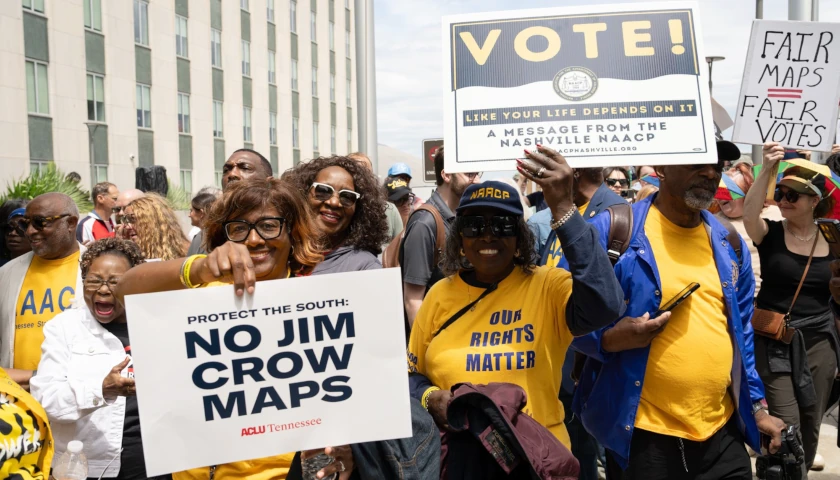
On the same day U.S. Representative Steve Cohen (D-TN-09), State Representative Justin Pearson (D-Memphis), and the Tennessee Democratic Party dropped their lawsuit seeking to block the use of Tennessee’s new congressional maps during the August 6 primary elections, the National Association for the Advancement of Colored People (NAACP) filed a motion seeking a preliminary injunction in their own federal litigation.
The NAACP motion argued that the Tennessee General Assembly pursued the redistricting process with “one goal”: the “dismantling” of the Volunteer State’s “only majority Black congressional district that had been in place for decades,” thereby causing the state to violate the 14th and 15th amendments of the U.S. Constitution.
It noted that prior to the redistricting, Tennessee’s 9th Congressional District was centered entirely on Memphis, Shelby County’s urban center, and a small portion of the surrounding area. It noted that the recent decision by the U.S. Supreme Court in Louisiana v. Callais, which reined in parts of the Voting Rights Act, made it “harder to challenge redistricting plans for discrimination.”
In their ruling, the high court determined Louisiana’s congressional map contained an unconstitutional racial gerrymander, establishing that creating districts to avoid the dilution of racial voting blocs does not justify prioritizing race when redistricting. The ruling determined states may still draw lines on partisan grounds.
After acknowledging the Supreme Court decision, the NAACP briefing submitted alongside its motion noted, “A sponsor of the redistricting bill claimed on the Senate floor that the Census was the only data source used to draw the maps,” and adds, “Census data do not reveal partisan splits, though they do show racial breakdowns.”
As evidence of racial motivation, the briefing cited a statement by State Senator Brent Taylor (R-Memphis), who is now seeking the Republican nomination for Congress in the redrawn 9th Congressional District.
“Senator Brent Taylor, who is white, said the quiet part out loud in an interview with National Public Radio,” the NAACP attorneys wrote, referencing Taylor’s race in their filing.
“I think it’s better for the congressmen in these districts to actually represent the interests and values of Tennesseans,” said Taylor, according to the briefing. “And that’s much better accomplished in districts that look like Tennessee rather than just a simply large urban core district like the old district 9 was.”
Citing various research purportedly conducted since the district was redrawn last month, and the claims that state lawmakers relied on census data to redraw the districts, the NAACP argued simulation analysis allegedly found that maps designed for partisan advantage did not replicate the racial composition of the enacted map.
The filing asked the three-judge federal panel overseeing the consolidated redistricting litigation to issue a preliminary injunction blocking Tennessee’s new congressional map from taking effect during the 2026 election cycle.
Notably, the claim that Tennessee lawmakers could not have drawn the new districts based on partisan affiliation of residents due to limitations in census data was similarly advanced last month by Robert Reich, the Democratic political analyst and former U.S. Secretary of Labor during the Clinton administration, during his interview with State Representative Justin Jones (D-Nashville).
“This is partisan, and we just base this off the census, but if you look at the census, the census does not say what party you are, but it does say what race you are,” said Reich. Speaking to Jones, he added “if what you’re saying is true, if those districts were based upon, and they had to be based upon race, because that was the only census material, they don’t have a breakdown by party.”
Reich told Jones, “they could not have actually done it on a partisan basis. They had to have done it on a racial basis.”
A total of four federal lawsuits and one Tennessee lawsuit were filed to reverse the redistricting process or to stop its use in the 2026 elections. The state filing, which was also filed by the NAACP, has since been dismissed by a panel of three judges. The remaining federal lawsuits have been consolidated before a three-judge panel.
– – –
Tom Pappert is a 2025 recipient of the Dao Prize and the lead reporter for The Tennessee Star. He also reports for the Star News Network. Follow Tom on X. Email tips to [email protected].
Photo “NAACP Protest” by NAACP.

They claim they don’t want “Jim Crow” districts, then clamor for a segregated “black” district …. which has been represented by a pastie old white Jewish guy for years. Did they all go through the Memphis public schools?
smh
The NAACP is totally useless and accomplishes nothing.
This group has to search hard to find justification for its existence in 2026.