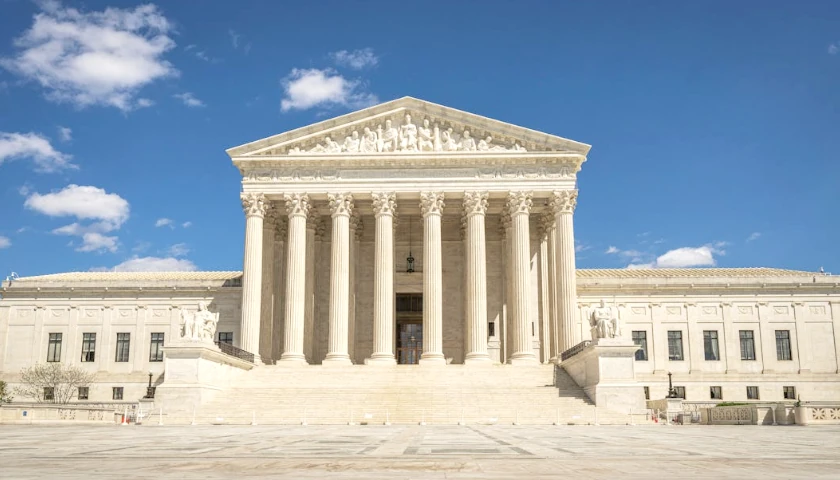
Legal commentator and retired attorney Mark Pulliam said sustained outrage and political pressure against the U.S. Supreme Court’s ruling in Trump v. Barbara will be necessary if opponents hope to eventually overturn the decision.
During an appearance Monday on The Michael Patrick Leahy Show, Pulliam discussed the Court’s decision last week striking down President Donald Trump’s executive order seeking to end birthright citizenship.
The Court ruled in Trump v. Barbara that Trump’s executive order conflicts with the 14th Amendment’s citizenship clause, with Chief Justice John Roberts writing that children born in the United States to parents who are unlawfully or temporarily present in the country are citizens at birth under the Constitution.
Pulliam said the significance of the ruling was reflected in the Court’s lengthy opinions.
“There’s a lot to unpack, and the justices with the majority opinion and concurring opinions and dissenting opinions wrote almost 200 pages, which is a very long bunch of decisions,” he said.
Pulliam, who read the entire set of opinions, described the ruling as deeply flawed, saying his principal concern was not simply the Court’s invalidation of Trump’s executive order.
“It’s a bad decision, and I hope it makes the American public mad, and mad enough that they stay mad, because as with Roe v. Wade, the fact that the American public or significant portions of the public stayed mad for nearly 50 years was the political pressure that the court needed to overturn it in the Dobbs case,” he argued. “That kind of sustained outrage is critical.”
Pulliam said he had anticipated the Court would conclude that an executive order alone could not overturn existing federal law governing citizenship. Instead, he argued, Chief Justice Roberts went much further.
“It wasn’t so much that this executive order was overturned… I was expecting them to say you cannot overturn a statute via executive order, and there’s a statute that proscribes birthright citizenship,” he said.
Instead, Pulliam argued, Roberts reaffirmed the Court’s 1898 decision in United States v. Wong Kim Ark and strengthened its constitutional footing.
“What Roberts’ opinion did was go way beyond that, and to restate a legal principle that if you read it in this 1898 decision, U.S. v. Wong Kim Ark… He said that decision is binding in all respects, and he even took it up a notch,” Pulliam said.
Pulliam took particular issue with Roberts’ reliance on the English common-law doctrine of jus soli, or “right of the soil,” which is the legal principle by which a person’s citizenship is determined by their place of birth rather than the nationality of their parents.
“John Roberts, in this Trump v. Barbara case, says, ‘No, we’re still subjects,’ and that is why he resurrected this dead concept,” Pulliam argued.
According to Pulliam, Roberts’ opinion places the doctrine beyond the reach of Congress.
“Roberts’ decision said that this jus soli is embedded in the 14th Amendment and can never be changed without amending the Constitution. Congress can’t change it… it’s frozen. And that’s a very scary prospect, and it’s an unsustainable one,” he warned.
He argued that the doctrine originated in England under a monarchy and is inconsistent with American constitutional principles.
“At the time, if you were born on the soil of the king, you were a subject of the king. This was a feudal society,” he said, going on to contrast that concept with the ideals of the American founding.
“That whole concept of right of the soil is something that makes no sense if you’re not in some kind of a feudal monarchy where people born are virtually serfs who are under the dominion of the king and have no rights other than the rights that the king grants them, which is completely opposite of the whole premise of the Declaration of Independence and of our Constitution, which says, no, our rights come from God, not the king, and we’re not the subjects of a king,” he explained.
Pulliam added, “We are sovereign citizens, and we are self-governing, and we can make our own rules, and we did make our own rules.”
He called Roberts’ historical analysis misguided, saying, “By hearkening back to this ridiculous feudal concept of being a subject of a king, which we no longer have, I think is an absurdity.”
Pulliam also argued that responsibility for the controversy extends beyond the Court itself.
“Now a lot of people are blaming the Supreme Court… it’s a bad decision. We need to stay mad about this decision. But on the other hand why did we end up in this situation? It goes back to the 39th Congress in 1868,” he explained.
He criticized what he described as the imprecise drafting of the 14th Amendment.
“They drafted and it was ratified, the 14th Amendment, which contains a lot of very sloppy, loose, confusing language, including the citizenship clause of the 14th Amendment, which is the origin of this dispute,” Pulliam said.
He also faulted Congress for failing to revisit the issue after the Court’s 1898 Wong Kim Ark decision, noting, In all the intervening 127 years from that time until President Trump issued this executive order… Congress never fixed this or even tried to fix this.”
Tune in now to The Michael Patrick Leahy Show – your AMERICA FIRST news talk!
– Watch LIVE here on X
– Watch LIVE on YouTube / Rumble / Roku / AppleTV
– Listen on Spotify
– Listen on WENO AM760 in Nashville
– Read more at @TheTNStar https://t.co/j8V5KBvIQ2— Michael Patrick Leahy (@michaelpleahy) July 6, 2026
– – –
Kaitlin Housler is a reporter at The Tennessee Star and The Star News Network.