The Supreme Court on Monday issued decisions in four cases addressing absentee ballot deadlines, police access to cellphone location data, and presidential authority over independent agencies.
In a pair of 5-4 rulings involving President Trump’s attempts to fire officials at the Federal Reserve and Federal Trade Commission, the justices reached opposite conclusions on for-cause removal protections. The Court also expanded Fourth Amendment protections for digital location data and rejected a challenge to Mississippi’s absentee ballot counting rules.
In Watson v. Republican National Committee (No. 24-1260), the Court ruled 5-4 that federal election-day statutes do not preempt Mississippi’s law allowing absentee ballots postmarked by Election Day but received up to five business days later.
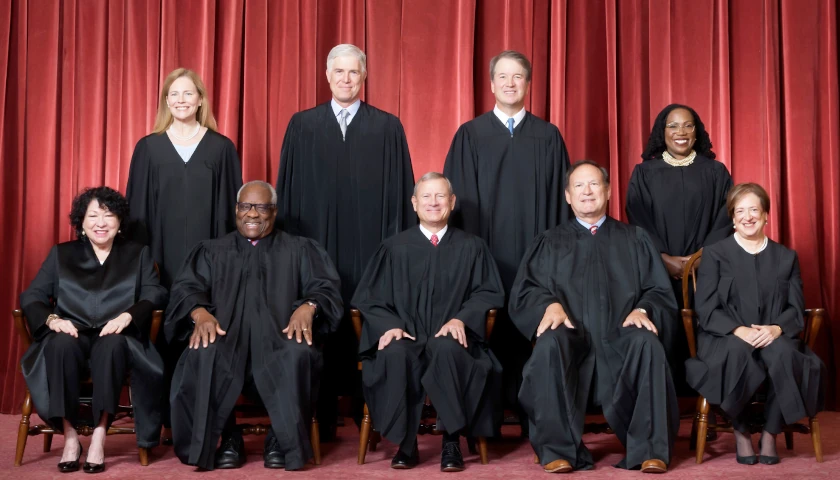
Justice Amy Coney Barrett wrote the majority opinion, joined by Chief Justice John Roberts and Justices Sonia Sotomayor, Elena Kagan, and Ketanji Brown Jackson. The Court held that the defining element of an “election” is the electorate’s choice of candidates through voting, not the receipt of ballots. Historical practice, precedent like Foster v. Love, and the Uniformed and Overseas Citizens Absentee Voting Act supported leaving receipt deadlines to state law.
Barrett emphasized that “[t]he defining element of an “election” has always been the electorate’s choice of candidate.” She explained that “the electorate’s choice is made when voting is complete, not when ballots are received.”
The majority further observed that the Uniformed and Overseas Citizens Absentee Voting Act (UOCAVA) “confirms that while federal law dictates when ballots must be cast, state law governs when they must be received,” noting that UOCAVA repeatedly presupposes state authority over receipt deadlines.
“In sum,” the Court concluded, “the election-day statutes require the electorate’s choice to be made on election day. That occurs so long as election day is the deadline for individuals to vote—as it is in Mississippi. But the election-day statutes do not set a deadline for ballot receipt.”
Justice Samuel Alito dissented, joined by Justices Clarence Thomas and Neil Gorsuch (with Justice Brett Kavanaugh joining in part). The decision reverses the Fifth Circuit and allows Mississippi (and similar states) to continue the practice.
In Chatrie v. United States (No. 25-112), the Court ruled that police obtain a Fourth Amendment search when they acquire cellphone Location History data via geofence warrants.
Justice Kagan wrote the majority opinion, joined by Roberts, Sotomayor, Kavanaugh, and Jackson. Building on Carpenter v. United States, the Court found that Location History data provides an even more detailed portrait of movements than cell-site location information, implicating strong privacy expectations despite third-party storage.
Kagan wrote that “Police officers conducted a Fourth Amendment search when they acquired Chatrie’s location data from Google because an individual has a reasonable expectation of privacy in records about his cell phone’s location information.”
The majority reasoned that “[e]verything *Carpenter* relied on… applies as well or better to the police’s accessing of Location History data,” which “provides an even more fine-tuned picture of a person’s movements” and “allows police to reconstruct ‘retrospective[ly],’ and with no real effort, people’s comings and goings in any area, enabling ‘tireless and absolute surveillance.’”
The majority rejected the application of the third-party doctrine, explaining that “a cell-phone user is not to be viewed as sharing private information with third parties—which then can be freely passed on to the government—just by doing the ordinary things cell-phone users do.”
The justices vacated and remanded for the Fourth Circuit to assess whether the specific multi-step geofence warrant satisfied probable cause and particularity requirements. Justice Gorsuch concurred in the judgment; Justice Alito dissented in part.
In Trump v. Cook (No. 25A312), the Court denied the government’s application for a stay, keeping in place a preliminary injunction blocking President Trump’s attempted removal of Federal Reserve Governor Lisa Cook.
The 5-4 decision emphasized the Federal Reserve’s historical independence, rooted in the nation’s tradition of central banking insulated from direct political control. The Court found it unlikely the government would prevail on the merits, citing statutory for-cause protections and procedural requirements.
Chief Justice Roberts, writing for the Court, stressed the nation’s “long tradition of independent central banking,” tracing it to the Bank of North America that “predates even our Constitution” and noting that the Federal Reserve’s Governors “do not serve at the President’s pleasure—they instead serve staggered 14-year terms, and may be removed only ‘for cause.’”
The opinion noted that “not only the fact of independence but also the appearance of independence is key to the Federal Reserve’s design. That counsels a substantial threshold for ‘cause.’”
The Court found the government unlikely to prevail in part because the President “failed to afford Cook the procedural protections to which she was entitled by statute,” including “notice and some opportunity to respond before her termination.”
“Nothing could be more corrosive of the independence that Congress sought to preserve,” the Court added.
In Trump v. Slaughter (No. 25-332), the Court ruled 6-3 that the Federal Trade Commission’s for-cause removal protections for commissioners violate the separation of powers. The decision overrules Humphrey’s Executor v. United States (1935).
Chief Justice Roberts wrote the majority opinion. The Court held that the Constitution vests executive power in the president, who must have authority to remove subordinates at will to ensure faithful execution of the laws. It rejected the quasi-legislative/quasi-judicial distinction from *Humphrey’s* as unworkable and inconsistent with modern understandings of agency functions.
The Court reaffirmed that “[t]he Constitution vests ‘[t]he executive Power’ in a ‘President of the United States of America’” and that “[t]o remain accountable to the President, those officers must be removable by the President.” Rejecting the old distinction, the opinion stated: “When an agency ‘executes’ a congressional mandate against private parties, it exercises executive power—no ifs, ands, or quasis about it.”
Four cases remain to be published in this term, including Trump v. Barbara regarding so-called “birthright citizenship.”
– – –
Christina Botteri is the Executive Editor of The Tennessee Star and The Star News Network. Follow her on X at @christinakb.