Artificial intelligence (AI) could eventually serve as a decision-maker in legal disputes under a contract-based arbitration system being developed by Arbitrus, a company founded by recent Harvard Law School graduates
Jack Kieffaber, Harvard Law School Class of 2023, who serves as general counsel for the company, discussed the technology during a Friday appearance on The Michael Patrick Leahy Show, where he described a product from Arbitrus Corporation designed to use AI to interpret contracts and potentially resolve disputes.
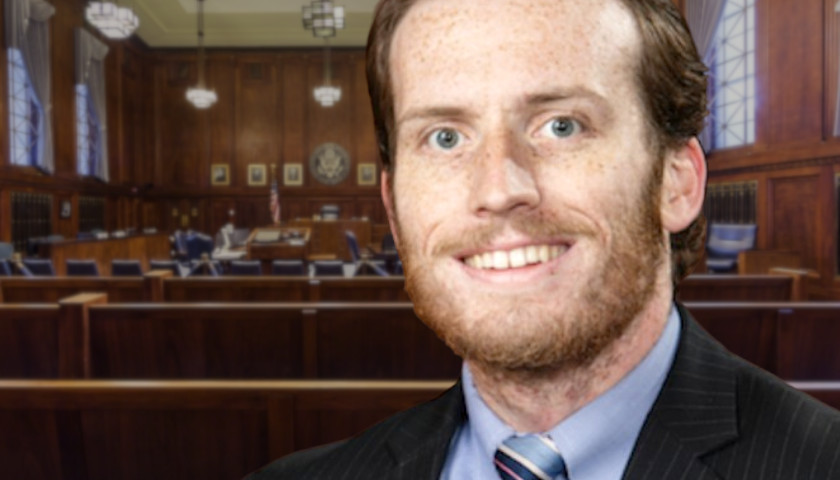
The product uses what Kieffaber (pictured above) described as a “Judge.ai bot” to serve as an agreed-upon decision-maker when parties stipulate its use in a contract.
“My entire theory for the longest time has been, what if you stipulated, in this case, in your contract, that the Arbitrus model, that’s the name of our Judge.ai bot, will be the decision-maker for your case?” Kieffaber said.
“That means two things,” he added. “One, whatever that bot says is right, and two, if you asked it for advice before you took an action, the legal advice it gave you would be correct as well. It wouldn’t even be advice. It would be the contract speaking directly to you authoritatively.”
Kieffaber said the technology could let parties examine a contract’s consequences before signing by asking the AI hypothetical questions.
“Imagine you sit down before you sign a contract. You can ask it 20 questions. What if I did this, that, and the other?” he said.
The system could also allow parties to identify provisions they want to change before entering an agreement, Kieffaber said.
The concept raises legal questions, particularly about whether an AI system can serve as an arbitrator under existing law.
“In the vast majority of states, when two parties agree to it, here’s the thing, a lot of this remains theoretical,” Kieffaber said. “Is it binding as a matter of arbitration? Yes, it is.”
He said courts could eventually have to determine whether using an AI decision-maker is unconscionable.
“There will be a law case that comes down,” Kieffaber said. “I think the legal systems have to get their arms around that question.”
Kieffaber said Arbitrus is developing human oversight options while maintaining that the technology is intended to reduce the cost of resolving disputes.
The company plans to price its service at approximately $5 for lawsuits, while individual questions asked before a dispute could cost “about a buck or two,” Kieffaber said. A full arbitration could cost as much as $5,000.
Kieffaber emphasized that the system would require both parties to agree to its use.
“We don’t want to have unwitting litigants run into Judge.AI, the super machine,” he said. “Where two sophisticated parties are agreeing to it, we think this could make them both even more sophisticated.”
Kieffaber, a Harvard Law School graduate who has clerked for federal appellate and district court judges, also distinguished his approach from the concept of “super intelligence.”
“Super intelligence is too much of a deus ex machina to me,” Kieffaber said. “Obviously, if the bots get that good, they’ll replace the lawyers outright.”
“I’m much more interested in products that can take AI where it is right now, or frankly between us, even a couple years ago, and still do a lot of the tasks lawyers do today,” he added. “That’s the type of product I like to build.”
Tune in now to The Michael Patrick Leahy Show – your AMERICA FIRST news talk!
– Watch LIVE here on X
– Watch LIVE on YouTube / Rumble / Roku / AppleTV
– Listen on Spotify
– Listen on WENO AM760 in Nashville
– Read more at @TheTNStarhttps://t.co/oF6jLiVQ73— Michael Patrick Leahy (@michaelpleahy) September 25, 2026
– – –
Kaitlin Housler is a reporter at The Tennessee Star and The Star News Network.
Photo “Jack Kieffaber” by James Wilson Institute.