
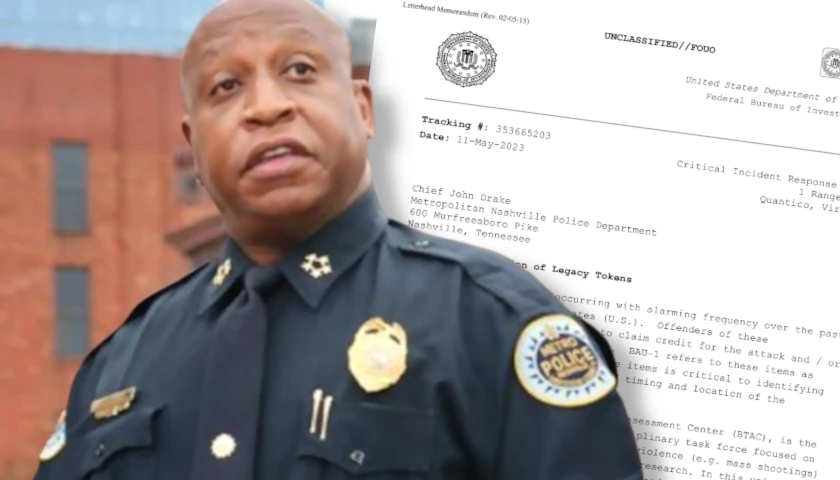
A review by The Tennessee Star of the original FBI materials containing the term “legacy tokens,” which the agency defined in 2018 as any item left by a mass killer to explain their actions, suggests the suppression of such materials is not a policy of the federal government, but instead is the informal guidance of one Behavioral Analysis Unit (BAU), one of a collection of groups nestled within the agency’s National Center for the Analysis of Violent Crime (NCAVC), which itself is part of the Critical Incident Response Group (CIRG).
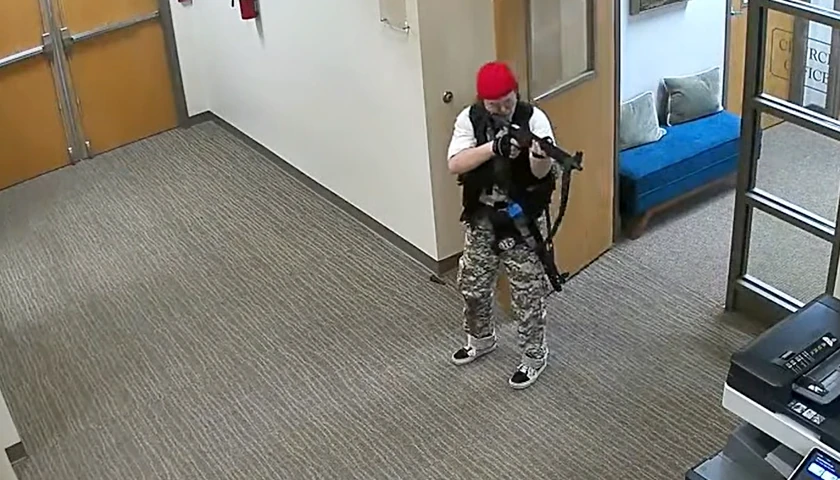
So-called “legacy tokens” were the subject of the May 11, 2023 memo sent by the FBI’s CIRG to Metro Nashville Police Department (MNPD) Chief John Drake, “strongly” advising against the release of the writings left by Covenant School killer Audrey Elizabeth Hale, the biological female who identified as a transgender man when she killed six at the Christian school she once attended on March 27, 2023.
The body of the letter confirms the memo was sent by BAU-1, just one of several units within the FBI division. According to American Military University, BAU-1 is primarily responsible for analyzing criminal activity related to counter terrorism, bombings, and arson cases.
According to the memo, BAU-1 is also “the national-level, multi-agency, multi-disciplinary task force focused on the prevention of terrorism and targeted violence (e.g. mass shootings) through operational support, training and research.”
In this capacity, BAU-1 told MNPD it, “opines that responsible authorities need to take every measure possible to limit the capability of future offenders that are considering,” mass killings.
“On this basis, BAU-1 strongly discourages the public dissemination of any legacy tokens,” wrote the memo, before claiming that the release of legacy tokens will contribute to future attacks, fail to provide closure to victims while creating “the false narrative that the majority of attackers are mentally ill,” and will “facilitate false narratives and inaccurate information,” potentially leading to “pontificators” who offer “inaccurate” assessments, “further confusing or potentially inflaming the public,” particularly those who are “more vulnerable or open to conspiracy theories.”
A review of publicly available FBI materials returned just one, 2018 document containing a definition for “legacy tokens.”
This was the June 2018 document, “A Study of Pre-Attack Behaviors and Active Shooters in the Unite States Between 2000 and 2013,” which noted the term “has been defined as a communication prepared by the offender to claim credit for the attack and articulate the motives underlying the shooting.”
Nowhere in this document do the researchers argue that “legacy tokens” should be suppressed by local and federal law enforcement.
In its brief, one-paragraph description of legacy tokens, the 2018 document includes a footnote to one chapter from the 2014 edition of the scholarly text, “International Handbook on Threat Assessment.”
A version of the 2014 edition of the book was not readily available, but the 2021 edition appears to contain the same chapter, revealing similarly sparse information about legacy tokens.
The authors noted that “some communications” by would-be mass killers “have featured signs that both logistic and psychological preparations for violence were nearly completed and the violent act was fast approaching,” and advised threat assessors to monitor for unusual behavior including reckless sexual or financial activity or the discontinuation of regular use of drugs or alcohol.
It also warned that threat assessors should look for the “preparation and delivery of a manifesto, video will, or other ‘legacy token’ designed to claim credit for the attack and articulate the motivation behind the violence.”
This scholarly work, which appears to contain the first-ever appearance of the term “legacy token,” similarly does not call for such items to be suppressed.
Outside of the May 2023 memo from CIRG’s BAU-1 to Nashville law enforcement, there appears to be no official policy or guidance regarding “legacy tokens.” The FBI did not respond to a press inquiry from The Star that sought to confirm there is no official policy for the suppression of “legacy tokens.”
Of note, a fictionalized version of one BAU is the subject of the television drama “Criminal Minds,” where viewers follow agents in a BAU unit as they solve cases while flying across the country in a private jet and a computer expert conducts real-time analysis using advanced technology from headquarters.
Actual FBI job descriptions for BAU employees suggest agents are mostly engaged in office work, with only part of their job description involving actual threat assessments for potential criminals. Other job duties are likely to include providing local law enforcement with insights into criminals to assist with apprehensions and maintaining criminal databases. Those working at BAU earn between $45,000 and $130,000 per year.
The revelation that no actual federal policy regarding “legacy tokens” appears to exist comes after The Star filed a Freedom of Information Act (FOIA) request seeking all of the FBI’s internal materials regarding “legacy tokens,” the May 2023 memo, and the 2018 document.
Both Star News Digital Media Inc. (SNDM), which owns and operates The Star, and editor-in-chief Michael Patrick Leahy remain plaintiffs in the federal lawsuit that seeks to compel the FBI to release Hale’s full writings.
While The Star legally obtained and published the killer’s 2023 journal last year, the killer’s full writings reportedly number approximately 1,000 pages.
The Department of Justice recently confirmed the FBI is considering a settlement offer from SNDM and Leahy that would end the lawsuit in exchange for the agency, now led by FBI Director Kash Patel, ending its opposition to the release of Hale’s writings.
Patel has not commented on Hale’s writings since his confirmation, but in December 2023 argued former FBI Director Christopher Wray was the only person standing in the way of its release, suggesting that he would err on the side of releasing materials to the public if in the same position.
“The FBI airmailed into that operation and said this is not getting out,” said Patel. “They do that because, this is another government gangster operation, all these local law enforcement agencies get funding from the DOJ and FBI for local programs, and if you don’t cooperate, you’re not getting your million dollars for this. That’s a lot of money to these local districts. That’s how they play the game.”
The Star urged Patel to drop his agency’s opposition to the release of Hale’s writings after he was confirmed by the U.S. Senate.
– – –
Tom Pappert is the lead reporter for The Tennessee Star, and also reports for The Pennsylvania Daily Star and The Arizona Sun Times. Follow Tom on X/Twitter. Email tips to [email protected].

The figleaf fiction of “legacy tokens” was a convenient excuse for the lunatic left running Nashville to protect the killer, Vanderbilt University and every doctor who saw and encouraged the mental illness of the powder keg that was Audrey Hale.
The fact that all of the media has participated in the cover-up should have their FCC licenses reviewed. They, and Phil Williams in particular, who portray themselves as these First Amendment defenders revealed that the only thing they stand for is narrative control. Not one supporting established open records laws.