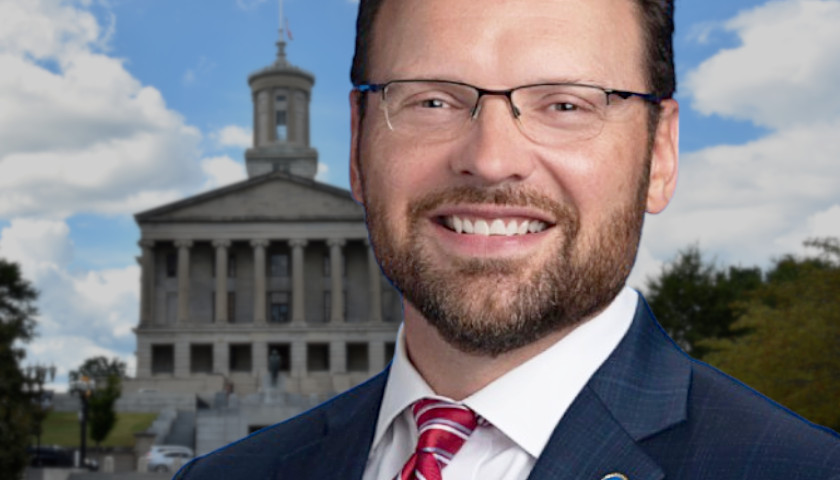
Tennessee House Deputy Speaker Jason Zachary (R-Knoxville) unveiled legislation Thursday that would limit annual local property tax revenue increases in the Volunteer State.
House Bill 12 (HB 12) would limit annual local property tax revenue increases, which Zachary said would give homeowners greater predictability and require local governments to obtain voter approval through a referendum before exceeding those limits.
The proposal would cap annual property tax revenue growth at inflation plus 8 percent over four years. It also provides targeted relief for senior citizens.
“Hardworking Tennesseans should not have to worry about being taxed out of their homes simply because of reckless spending by local governments,” Zachary said in a statement. “Families, seniors on fixed incomes and small business owners need predictability. Without common-sense limits on how much local property taxes can increase year after year, Tennesseans face a tax burden that could destabilize families, discourage investment and drive longtime residents out of the communities they helped build.”
The legislation comes shortly after Tennessee voters approved Amendment 2 in the November 3 election, with 67 percent supporting a constitutional amendment prohibiting the state from imposing a property tax.
The amendment prevents the state government from creating a property tax without another constitutional amendment but does not restrict local governments’ authority to levy property taxes.
Zachary’s proposal would address that separate issue by limiting local property tax revenue increases.
Tennessee is one of only four states without some form of property tax limitation, according to the Beacon Center of Tennessee, which recently published a report showing the Volunteer State has experienced the largest growth in property tax bills nationwide.
The organization’s report found that Tennessee experienced the largest increase in average local property tax bills of any state between 2019 and 2025.
The report highlights significant increases across the state, including Nashville-Davidson County’s two property tax hikes totaling 60 percent in recent years. Other local governments have approved substantial increases, including 52 percent in Red Bank, 60 percent in Dayton, 64 percent in Thompson’s Station, 138 percent in South Pittsburg, and 164 percent in Mt. Juliet.
The Beacon report also compared Nashville-Davidson County with Knox County, where property tax rates have remained unchanged since 1999. Despite not raising its rate in 27 years, Knox County increased its total property tax levy by nearly 20 percent between 2016 and 2025 through new growth.
Beacon found that Knox County continued funding core government services while matching or outperforming Davidson County in several areas, including education, public safety, and fiscal strength.
The report argued that property tax caps could protect residents from significant increases without preventing local governments from generating additional revenue through population growth and new development. It also endorsed allowing voters to approve increases above the cap through referendums.
“A property tax cap policy lets local governments raise additional revenue, up to a limit, while giving residents the peace of mind that tax bills won’t double or triple in a single year. If a local government wants to raise revenue above a cap, it can make its case to residents and let them decide in a referendum. This is the greatest level of local control,” the Beacon Center said in its report.
In a release by Zachary’s office, Jack Powers, vice president of policy and advocacy at Beacon Impact, cited the organization’s November polling showing that 88 percent of Tennesseans want local governments to be more accountable to taxpayers.
“Tennesseans are experiencing an affordability crisis, and the path to relief is clear,” Powers said. “Our polling shows 88% of Tennesseans want local governments to work for them, not treat their homes like an unregulated ATM.”
Powers applauded Zachary for introducing the legislation and said Beacon Impact was ready to support the effort.
The 115th General Assembly is scheduled to convene January 12 at noon.
– – –
Kaitlin Housler is a reporter at The Tennessee Star and The Star News Network.
Background Photo “Tennessee Capitol” by FaceMePLS. CC BY 2.0.