
by Tommy Vallejos
Tennessee families are being squeezed from every direction. Grocery bills are up. Fuel costs more. And when something breaks, whether it’s a car, an appliance, or a piece of farm equipment, getting it fixed has become its own financial ordeal. Some of that is inflation. But some of it is federal policy, and that part is fixable.
Section 1201 of the Digital Millennium Copyright Act (DMCA) was originally written to protect intellectual property. Few could have anticipated that manufacturers of refrigerators, smartphones, and farm equipment would later use it for an entirely different purpose: embedding proprietary encryption and software locks in their products, then invoking federal copyright law to ensure that only their authorized dealers can touch them.
The practical effect is that even when a repair is entirely lawful, accessing the diagnostic software to perform it may not be. Independent repair shops and small, community-based businesses fully trained and equipped for the work are legally shut out. Consumers who want to take their vehicle, appliance, or tractor to a local shop are denied that choice. They can pay whatever the manufacturer’s authorized network charges or buy something new. That is not a free market. It is a rigged one.
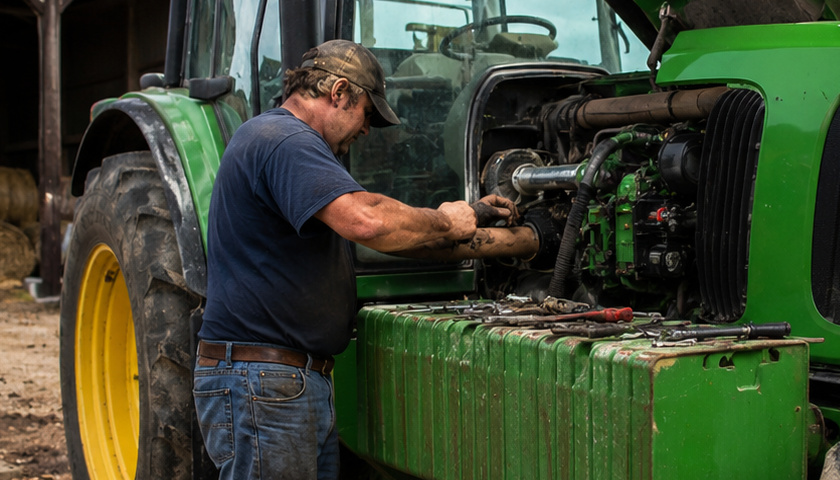
The economic damage is real and widespread. Auto repair shops across Tennessee are losing out on critical revenue because manufacturers restrict access to repair data. Farmers lose time and money waiting on manufacturer-dispatched technicians while equipment sits idle during planting season. These barriers extend far beyond cars and tractors. From refrigerators and power tools to bicycles and consumer electronics, any digitally enabled product is a potential target. The more technology advances, the wider the manufacturer’s grip becomes.
Reforming Section 1201 would not touch copyright protections for artists or innovators, the original objective of the law. It would simply stop manufacturers from using copyright law as a shield against competition in the repair marketplace. Consumers could choose where their products get fixed, whether at a local shop, a national chain, or their own garage. Independent businesses could compete for that work on an equal footing. That is how markets are supposed to function, and it is how this one would function if Congress updated a statute that has been exploited by large corporations.
This is not a partisan question. It is a question of whether federal law should prop up large manufacturers at the expense of working families and small businesses. Policymakers on both sides of the aisle have talked for years about supporting competition and keeping costs down. DMCA reform is a concrete opportunity to deliver on these goals. Representatives Harshbarger and Rose have already led on legislation targeting these restrictions in the automotive sector, and other members of Tennessee’s delegation have engaged the issue in agriculture – a significant part of Tennessee’s ecoonomy. The moment is right to bring these efforts together behind a broader fix.
For Latino families in Tennessee that take pride in self-reliance, work hard to balance their budgets, and build their livelihoods from the ground up, the freedom to repair what you own is not an abstract idea. It is an everyday reality. Our elected leaders should treat it like one.
– – –
Tommy Vallejos is the Executive Director and Co-Founder of Latinos for Tennessee.
Why involve race! It absoulty nothing to do with this subject