by Steven Richards
Chinese President Xi Jinping extended a formal invitation to American students, proposing that as many as 100,000 “young Americans” come to China to study in the coming years. But lawmakers have long warned that the country’s student program serves as a vector of Chinese influence.
“I am glad to announce an invitation for 100,000 young Americans to visit China for exchanges and study in the coming five years,” the Chinese president said in remarks at the White House on Thursday.
“Let us meet the people’s expectation and show our historical initiative. Let us keep advancing the cause of friendship between our two peoples and work together to build a better world,” Xi added.
With this pledge, Xi is doubling the number of American students that China had previously planned to welcome as part of the exchanges. By contrast, U.S. President Donald Trump previously suggested that the United States could welcome as many as 600,000 Chinese students.
But Gordon Chang, an expert on China-US relations, said Americans should be suspicious about Xi’s offer.
“What Xi Jinping is really trying to do is not to have some cultural exchange. What he tried to do is take 100,000 Americans and turn them into Chinese communists,” he said. “We know how this works. I mean, they’re going to see a very glorious China, one that actually doesn’t really exist because that is a Potemkin village in many ways because the problems in China are growing.
“But the other thing, of course, is that when those kids are there, we’re going to see the Chinese try to get blackmail material, and this means that they can turn them into spies,” he added. “They can turn them into weapons against the United States. So it’s not just the propaganda effort. It’s also an effort to basically turn Americans against their own country.”
U.S. lawmakers concerned about influencing policy towards China in other countries
Xi’s flagship Young Envoys Scholarship (YES) program, which the Chinese president announced in 2023, is run by the China Education Association for International Exchange (CEAIE) and presents opportunities for American students “to deepen and expand cross-cultural understanding among countries.”
Yet that organization has been identified by U.S. lawmakers as a part of China’s United Front, which the House Select Committee on the Chinese Communist Party previously defined as “a unique blend of engagement, influence activities, and intelligence operations” that the Chinese Communist Party uses to influence policy towards China in other countries.
Last year, House Select Committee on China Chairman John Moolenaar, R-Mich., wrote to two local jurisdictions whose schools partnered with China’s study program, warning local officials that the trips, which were sponsored by the Communist Party, serve as propaganda and influence operations, rather than genuine cultural exchanges.
“While genuine people-to-people connections and sports diplomacy can be critical channels for promoting mutual understanding, exchanges facilitated by CEAIE, an organization associated with the CCP’s United Front system, are far from authentic cultural engagements,” Moolenaar wrote.
Unlike traditional exchange programs
Paul Runko, the Senior Director of Strategic Initiatives at Defending Education, said on social media that “Parents need to know that the organization that runs this exchange program notes on its Chinese website that it is guided by ‘Marxism-Leninism.’”
Defending Education, a 501(c)(3) charitable organization whose mission is to keep political ideology and activism out of schools, released a report on China’s Young Envoys Scholarship (YES) program last month, exposing how the communist regime uses it to advance its own “political and cultural” agenda and influence American students.
About 83 American universities and at least 27 K-12 schools participate in China’s YES program, according to the group. Defending Education asserts that many trips sponsored by the organization often include “direct engagement with United Front-linked or state propaganda bodies.”
For example, in 2024, a delegation from the University of Chicago purportedly met with a chapter of the Chinese People’s Association for Friendship with Foreign Countries, a group that the U.S. Intelligence Community has warned seeks to co-opt subnational governments and “directly and malignly influence state and local leaders” to promote China’s global agenda.
That same year, a group of 29 students from Columbia University participated in the YES program. The students “interacted with think tanks, universities, high-tech enterprises and nonprofit organizations” and were invited to “attend the ‘Commemoration of the 45th Anniversary of the China-U.S. Diplomatic Relations.’” The event was organized by the China-United States Exchange Foundation, or CUSEF, which U.S. lawmakers and the Intelligence Community have identified as another Chinese United Front organization and “an instrument of the CCP’s approach to political warfare.”
Lower level schools have also participated in the program
In 2024, according to Defending Education, the Muscatine Community School District in Iowa sent a group of 24 students to China at the personal invitation of President Xi Jinping. Chinese state media celebrated the invitation, noting the students would “observe China with their own eyes, listen to China with their own ears and measure China with their own footsteps.”
The students provided gifts to President Xi, including a “school flag with Chinese characters ‘Grandpa Xi, Here We Are’,” according to Chinese state media reports echoed on social media.
In 2025, Fox News reported that YES sponsored 27 Chicago high school students and teachers to travel to the Xinjiang region of China. The students experienced traditional Chinese cultural activities during their cultural tour. However, not addressed on the tour was the local culture of the Uyghur people, a central Asian Muslim group heavily persecuted by Beijing. Radio Free Asia reported that “over a million Uyghurs and other minorities have been subject to mass internment and forced labor.”
The State Department issued a determination in 2021 that Chinese treatment of the Uyghurs, which includes forced imprisonment and sterilization, constitutes a genocide.
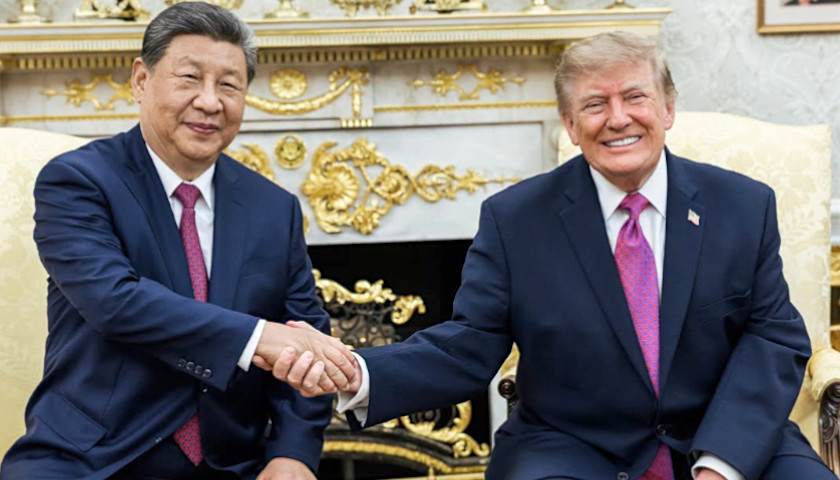
On Friday, the Chinese leader concluded his meeting with Trump and headed back to China. This was the first time he came to America to meet Trump at the White House.
Trump said on Truth Social that the meeting with Jinping “was one of Friendship, Strength, and Success, for both China and the U.S.A. We will be meeting again in November, in China, and then at the G20 in December, in Miami, Florida. Much has been, and will be, accomplished. I look forward to our next meeting!”
“Very productive meeting with President Xi for both the U.S.A. and China. Tremendous things will be happening. Like almost everyone else, he seemed to like calling the poorly and inaccurately named Artificial Intelligence to a far more accurate and important name, SUPER INTELLIGENCE. That would be “SUPER!” Everyone last night agreed, also,” he added.
– – –
Steven Richards is a reporter for Just the News. Zachery Schmidt is the digital editor of The Star News Network and contributed to this story.
Photo “Donald Trump and Xi Jinping” by The White House.