by Edward Ring
On the advent of America’s 250th anniversary, the conventional narrative is that our country is deeply divided. Typical takes on the state of disunity in the United States include this headline from a guest op-ed that recently appeared in USA Today, “America celebrated together at 200. We won’t at 250,” and “We still had a sense of oneness then. We no longer do.” In a related news article, the publication cited major national surveys that “consistently show an anxious nation” and “a divisive president.”
These observations aren’t wrong, but the divisions they cite—partisan politics, old vs. young, racial polarization, bitter disagreements over social issues—are missing the biggest source of alienation of all, which is diminished economic opportunity. Fully half of American households report living paycheck to paycheck. And regardless of what progress may unfold to get inflation under control, to date, households are coping with what is now several years of relentless price increases.
The loss of economic opportunity in America has been a slow and steady decline. In 1970, the median home price in the U.S. was 2.8 times the median household income. By 2025, that gap had widened to 5.1. It is almost twice as hard to purchase a home in the U.S. as it was in the 1970s. In the major cities, that gap is far worse, and there is no end in sight.
This is the shared financial stress that has left a generation of youth without hope of ever purchasing a home, much less starting a family. It is shared by working families who can’t balance their household budgets and are sinking further into debt with no way out. And it is shared by older Americans on limited incomes who are fast being eclipsed by rising costs for everything.
An economic reality this dismal makes it far easier for demagogic populism to flourish, channeling the passions and frustrations of millions into supporting socialist redistribution, along with a grab bag of causes unified under the rubric of “social justice.” Into economic despair rides every opportunistic grifter, nihilist, and fanatic with a message and a brand. But take away that despair, and the scams melt away. Americans aren’t inherently divided. They’re just broke.
History is full of examples where economic hardship rendered an entire nation susceptible to promises of salvation that delivered tyranny instead. But there are also particular examples in American history where we found our way out of what might have become an irreversible tailspin. In the 1930s, when communists and fascists were seducing millions around the world, America had the good fortune to elect Franklin Delano Roosevelt. His legacy may provoke condemnation from libertarians and smaller-government conservatives today, but what he did convinced Americans that full-blown communist or fascist political options were neither necessary nor desirable. FDR brought America back from the brink.
Today, the answers proposed by democratic socialists in America again threaten to engulf the nation in an overreaction that will be hard to unwind. But there is an alternative to further confiscating wealth, solidifying identity politics, demolishing meritocracy, and dragging our culture into a mire of entrenched resentment and polarization. And the example lies in what may be FDR’s greatest achievement, public works projects that still deliver economic dividends nearly 100 years later.
The list of public amenities constructed during the 1930s includes dams on the Columbia, Sacramento, and Colorado Rivers, dams that delivered water and power to the entire American West. It included the Tennessee Valley Authority, bringing to a seven-state region flood control, hydroelectric power, and 650 miles of navigable river channels, all of which are still enjoyed today. The federal infrastructure programs under FDR included the construction of LaGuardia Airport in New York City and National Airport in Washington, DC. There were literally tens of thousands of federal projects completed during the 1930s: hydroelectric dams, airports, bridges, roads and highways, stadiums, libraries, hospitals, post offices, parks, sanitation systems, forestry projects, canals, fire stations, municipal buildings, and more.
The question economically disenfranchised Americans should ask is, “Why aren’t we building similar amenities at a similar pace and scale in the 21st century?” The effort would create millions of jobs, and it would yield front-end investments in value-producing public works, thus taking much of the burden off of ratepayers and end users to fund their construction. And herein lies the equation that would make massive projects like this economically possible. Three basic variables that affect the viability of infrastructure projects in America need to be reset.
First, the nation has to agree on projects that are actually useful. Spending hundreds of billions of dollars to subsidize floating offshore wind installations in California, which, according to official sources, would incur a financing cost of $0.40 per kilowatt-hour, is a complete waste of money. Other examples are plentiful. Sticking to California, spending what has mushroomed to a total project cost estimate of over $230 billion to build a high-speed railroad from San Francisco to Los Angeles is another case of ridiculous waste. There are alternative projects that make far more economic sense—wastewater recycling, desalination, upgraded freeways, upgrades to existing railroads, improving seaport facilities and airports, restoring bridges, dredging silted-up reservoirs and river channels, interbasin water transfer projects, tunnels, nuclear power—the list goes on. We need all this and more.
Second, we have to establish a new consensus regarding what level of regulations is appropriate. Another example of this—of course—comes from California, where dredging the silted-up channels in the Sacramento-San Joaquin Delta must be accompanied on a three-to-one basis by environmental mitigation. For every dollar spent on dredging channels that are so clogged with silt that it will soon become impossible to export water into the aqueducts that deliver irrigation water to five million acres of farmland and drinking water to 25 million urban residents, three dollars have to be spent on “habitat restoration” to compensate for the allegedly harmful impact of dredging. But neglecting these channels, allowing them to become shallow and invaded by introduced species that thrive in warm, shallow water that native fish and plants abhor, has created the environmental havoc. Dredging is environmental mitigation. But we can’t afford it, because only 25 percent of the funding can actually be used for dredging. Regulations like this must be scrapped.
Finally, beyond the necessity to choose projects that yield economic dividends instead of becoming permanent economic drains, and beyond the necessity to reform our regulatory regime so these projects can be completed at a reasonable cost, we have to recognize a fundamental economic trade-off. In a world of finite government budgets, we can invest in public infrastructure that will create jobs and lower the cost of water, energy, and shipping, which in turn will stimulate private investment while making public investments more cost-effective. Or we can do what we’ve been doing for the last fifty years, which is spend more every year on government benefits designed to subsidize households that cannot survive independently because the cost of living is too high.
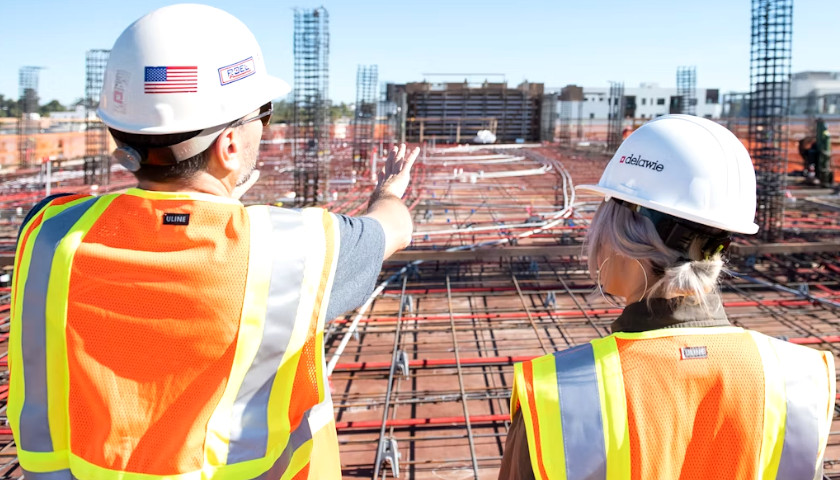
This is not an easy tradeoff. It requires decisions that threaten special interests that thrive on subsidies and mandates. It requires a leap of faith by Americans caught in what today appears to be an impossible challenge. But it can work. What America did in the 1930s is possible today if we embrace common-sense project choices and deregulate our heavy construction industry. People who today collect government benefits could instead be offered productive and high-paying jobs in construction. The dividends of cheaper energy and water, plus less costly construction materials and manufacturing costs, both from the output of new infrastructure and also from deregulated private industry, would mean Americans would not only make more money, but everything they purchased would cost less.
These are the economics of national reconciliation. America is indeed at a crossroads on its 250th birthday. But there is a pathway for millions of disillusioned Americans to have their hope restored by an economy that is reset, not through redistribution of wealth, but through rebuilding our nation.
– – –
Edward Ring is a senior fellow of the Center for American Greatness. He is also the director of water and energy policy for the California Policy Center, which he co-founded in 2013 and served as its first president. Ring is the author of Fixing California: Abundance, Pragmatism, Optimism (2021) and The Abundance Choice: Our Fight for More Water in California (2022).