
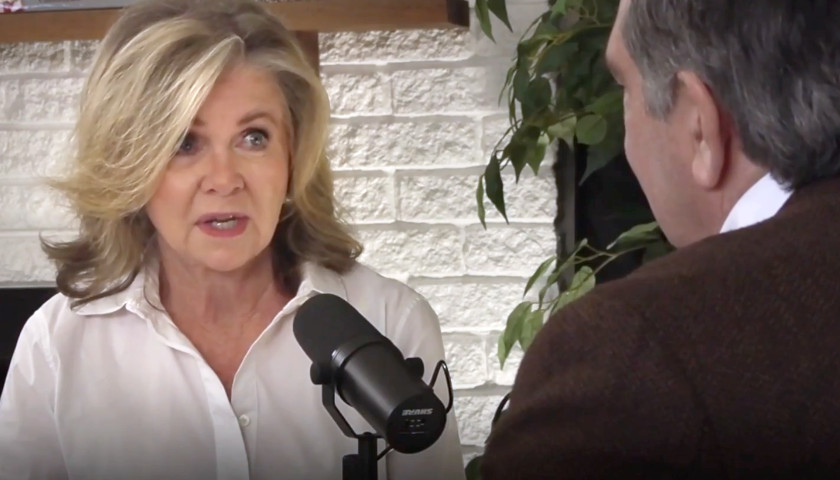
Tennessee Republican gubernatorial candidate U.S. Senator Marsha Blackburn (R-TN) is revisiting one of the defining political battles of her career, describing in an exclusive sit-down interview how she led a four-year effort in the Tennessee General Assembly to defeat a proposed state income tax and arguing that the fight reshaped the state’s future.
During an interview with The Tennessee Star’s CEO and editor-in-chief, Michael Patrick Leahy, Blackburn recounted her opposition to then-Governor Don Sundquist’s proposal, which she said came as an unexpected reversal after his campaign pledge not to support a state income tax.
Blackburn worked in the General Assembly as a state senator in the early 2000s, leading the fight against Sundquist’s plan to impose a state income tax. She was a key figure in the effort, which culminated in 2003 after conservatives mobilized grassroots activists through talk radio to oppose the proposed 3.5 percent state income tax.
Speaking about the proposal’s introduction in 1999, Blackburn said she immediately informed the governor she could not support it.
“That happened in February of ’99, when they first floated the state income tax,” Blackburn said. “I had chaired his campaign in Middle Tennessee, and then as I ran for the State Senate, I made a promise I would not support a state income tax. So I told him, ‘It’s not personal, but it is policy, and I cannot support this.'”
She acknowledged the disagreement created tension with the governor, noting, “It was a very frosty conversation.”
Blackburn said she and then-state Representative Charles Sargent publicly opposed the proposal, beginning what became a years-long legislative and grassroots campaign.
“I continued to move forward to lead that fight against the state income tax,” she said. “And it was four years. It was in 2002 when we finally put that thing to rest and put the death knell in that concept.”
She credited Tennessee residents with helping defeat the proposal.
“It really showed the Tennessee people that they’ve got a grit and a moxie, and they’ve got the ability to challenge their government when their government gets out of line,” Blackburn said. “They joined with me. They fought for that four-year period of time.”
Blackburn also pointed to a subsequent constitutional amendment prohibiting a state income tax, which was approved by Tennessee voters in 2014.
“We will never have a state income tax,” she said. “Never. It would be unconstitutional.”
Looking back on the legislative battle, Blackburn said the experience reinforced the importance of consistency.
“The thing was, over this four-year period of time that our state struggled with this, I kept in mind we had to win every single time,” she said. “The pro-tax crew—they only had to win once…What a lesson that was for me, to realize how important it is to be consistent and how important it is to not give up on your values and your principles.”
She argued defeating the proposal helped Tennessee remain competitive for families and businesses.
“I am ever so grateful that we were able to defeat that tax and put our state on a great path,” Blackburn said.
Blackburn also reflected on what she believes the proposal’s passage could have meant for Tennessee, also arguing that higher tax revenue often fuels government expansion.
“I had somebody today say … ‘What do you think would have happened to us had we gotten that state income tax?’ And I said we would probably be Kentucky,” she explained. “The government grows. They spend every penny of it.”
“I think that being able to make that decision and sticking with it and not giving up, not getting tired, and just fighting through to the end on this really…helped our state turn a corner,” Blackburn added.
One of Blackburn’s strongest memories of the fight was the public demonstrations at the Capitol, where supporters circled the building in their vehicles, honking their horns.
“I still to this day will be out doing a county meeting or going out and about somewhere, and someone will come up and introduce themselves and say, ‘I’m a horn honker,'” Blackburn said. “I would just say, ‘That’s the sound of liberty.’ I love hearing all of these horns honking.”
Early voting for the August 6 gubernatorial primary election begins July 17 and runs through August 1. The last day to request an absentee ballot is July 27.
🚨MUST WATCH: In my exclusive interview with Sen. Marsha Blackburn @VoteMarsha she recounts the 4 year battle she led that stopped the proposed state income tax in Tennessee and paved the way for huge economic growth in the state. pic.twitter.com/mLmNEJ8w57
— Michael Patrick Leahy (@michaelpleahy) July 7, 2026
– – –
Kaitlin Housler is a reporter at The Tennessee Star and The Star News Network.


Why isn’t she FIGHTING for the Save America Act!!! Why is wimpy (traitorous) John Thune still in charge of the U.S Senate when he cannot even succeed in passing something as crucial and popular as the Save America Act? Why hasn’t Marsha Blackburn and Bill Hagerty joined with 3 others to oust Thune? She is not fighting for us. She is just part of the do-nothing Senate.
Why doesn’t this do-nothing just go away?!
I just want to know what Ms. Blackburn would do not if, but when the democrats regain control of the federal government and demand that Americans turn in their their firearms? I only want to voter for a candidate that will tell them the go to hell.
That was 2 decades ago. It is time for Marsha to retire. We do not need another RINO governor. She has been in the senate where talk is the main output. She is not an operations person. She is for the SAVE AMERICA Act, but has done nothing to push it through. Sen Lee is fighting for it. Blackburn is doing nothing.