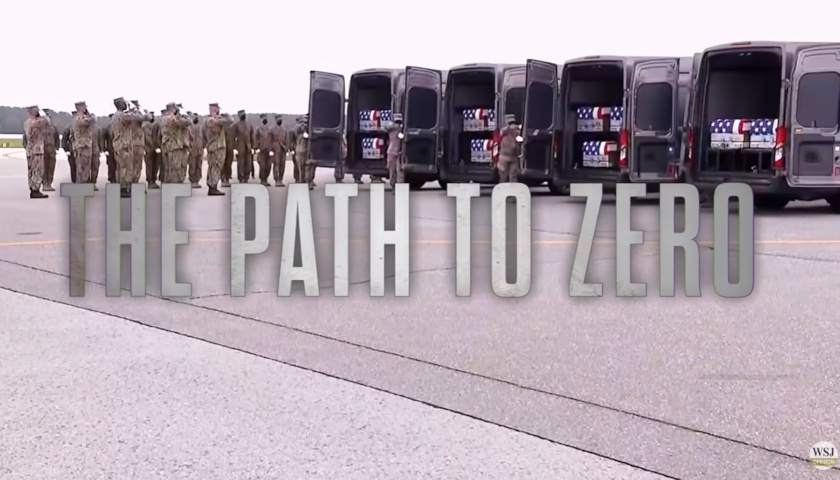
Michael Pack, documentary filmmaker and former CEO of the U.S. Agency for Global Media (USAGM), joined The Tennessee Star’s CEO and Editor-in-Chief Michael Patrick Leahy for an exclusive interview Thursday to discuss his new documentary, The Path to Zero, and the decisions surrounding the 2021 U.S. withdrawal from Afghanistan under the Biden administration.
Produced and directed by Pack for Wall Street Journal Opinion, The Path to Zero examines the U.S. withdrawal from Afghanistan from President Joe Biden’s April 2021 decision to reduce American troop levels to zero through the evacuation from Kabul in August. The film was released in August to coincide with the fifth anniversary of the withdrawal.
Pack said the documentary is intended to examine events that he believes have received insufficient attention.
“The Path to Zero, it’s the fourth in our series with The Wall Street Journal Opinion section that deals with issues, events that have been misreported or underreported, and this is a very good example,” Pack said during Thursday’s edition of The Michael Patrick Leahy Show.
Pack said the decision to withdraw all U.S. troops led to a series of subsequent decisions, including the closure of Bagram Air Base and the withdrawal of support for Afghan forces.
“We left all the equipment behind, and we withdrew support from the Afghan forces that caused them to crumble, laying the groundwork for the Taliban to march with very little fighting into Kabul,” Pack said.
The documentary also focuses on the chaotic evacuation at Hamid Karzai International Airport, including the experiences of Marines stationed at the airport gates and the use of CIA-trained Afghan commandos known as the Zero Units. Pack said Marines interviewed for the film described the experience as contributing to what is known as “moral injury.”
“Moral injury is when you witness something or participate in something, do something that goes against your values, like the Marines watching the Zero Units kill civilians…People are standing in sewage ditches with razor wire. People are dying. People are throwing their babies over the wall to the Marines,” Pack said. “And Marines have to decide who to let in, these young Marines, especially, at the gates.”
“At first they’re told only to admit people with US passports or special immigrant visas and not their families. So they come in with their families, Marines have to escort the women and children out of the gate where the Taliban are watching, possibly to kill them. The next day, the State Department changes the rules, families can leave, too. So these Marines are thinking, “I just took women and children out to be killed that didn’t have to be killed,” and it’s not so easy to live with things like that. So I think the things we put these Marines through have to be better known, and that’s why, one of the reasons we made the films,” he added.
Pack also said his team attempted to interview Biden and other senior officials involved in the withdrawal, including Secretary of State Antony Blinken, national security adviser Jake Sullivan, General Mark Milley, and Defense Secretary Lloyd Austin, all of which he said “refused to be interviewed.”
When asked who ultimately made the decision to withdraw completely, Pack said, “I think it was Biden.”
“There are people who think Sullivan, the national security advisor, was the brains behind the Afghan withdrawal, if you can call it brains. I’m not sure. But President Biden was very committed to it, and he [was] the president, so he is the one that we should hold responsible,” Pack added.
The 57-minute documentary is available through Wall Street Journal Opinion and YouTube.
Watch the interview:
Tune in now to The Michael Patrick Leahy Show – your AMERICA FIRST news talk!
– Watch LIVE here on X
– Watch LIVE on YouTube / Rumble / Roku / AppleTV
– Listen on Spotify
– Listen on WENO AM760 in Nashville
– Read more at @TheTNStarhttps://t.co/HvZHFgZ2f0— Michael Patrick Leahy (@michaelpleahy) September 24, 2026
– – –
Kaitlin Housler is a reporter at The Tennessee Star and The Star News Network.
Image “The Path to Zero” by The Path to Zero.