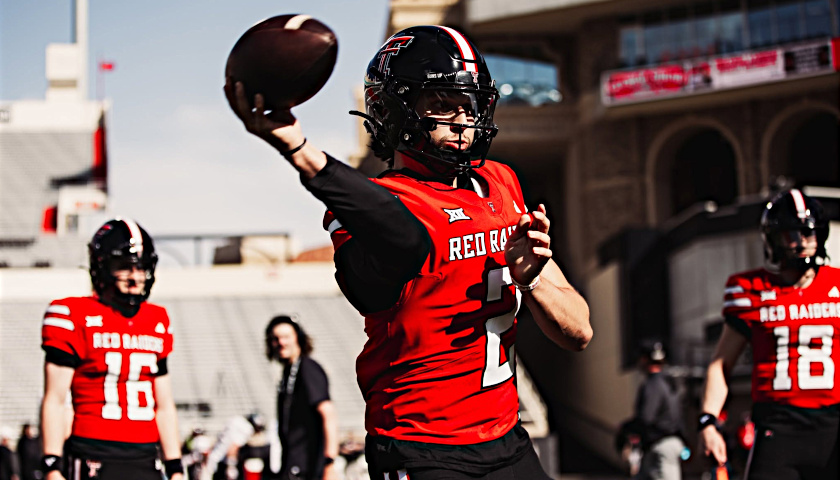
Veteran journalist and public affairs specialist Clint Brewer and The Tennessee Star’s CEO and Editor-in-Chief Michael Patrick Leahy are raising concerns about the future of NCAA oversight and the growing influence of legalized sports betting following a Texas judge’s decision to restore Texas Tech quarterback Brendan Sorsby’s eligibility despite the NCAA’s permanent ban over sports wagering violations.
During a discussion Tuesday on The Michael Patrick Leahy Show, the pair examined the implications of a temporary injunction allowing Sorsby to return to the field after he admitted placing approximately $90,000 in sports wagers over four years, including bets involving his own team while playing at Indiana.
Sorsby, who transferred to Texas Tech after stops at Indiana and Cincinnati, was ruled permanently ineligible by the NCAA. However, a Texas district judge determined that preventing him from playing would cause “probable, imminent and irreparable injury” to his football career and NFL prospects.
Leahy questioned the court’s reasoning.
“So this judge ruled that the NCAA had to put him back and play, because they were harming his ability to earn money. That was his argument. Now, I think that’s a weak argument,” he said.
Leahy noted that gambling has long threatened the integrity of sports, referencing some of the most notorious scandals in athletic history.
“Betting in sports has been, for over a century, a big problem, hasn’t it?” Leahy said, citing the 1919 Chicago Black Sox scandal and former baseball star Pete Rose’s lifetime ban for betting on his own team.
Brewer agreed that the case raises fundamental questions about athlete accountability within the NCAA system.
“If you are choosing to play for an NCAA institution, you are living within the confines of that association. And if they have rules that you have to agree to as a player to play for a member school, you have to live by those rules,” he said.
While acknowledging the complexities introduced by Name, Image and Likeness (NIL) compensation, Brewer argued that NCAA athletes voluntarily participate under established regulations.
The conversation then shifted into a discussion of how legalized sports betting has changed the athletic landscape. Leahy questioned whether widespread legalization has been beneficial.
“Is it a good thing that kind of gambling has been allowed legally in this country?” he asked.
Brewer responded that the issue is more nuanced.
“Do people who use it responsibly enjoy it? Is it a recreational pastime for some people that makes sports more interesting, engaging? I think probably yes. Does it, for people with addictive personalities, create an opportunity for risk? Absolutely,” he said.
Drawing from personal experience, Brewer described attending a college football game where fans appeared more focused on betting apps than the game itself.
“I don’t think they looked up from their phones to watch the game the entire time because they were just placing bet after bet after bet on apps on their phones,” he said.
Leahy pointed to growing concerns about gambling addiction among younger Americans, noting, “There’s a lot of anecdotal reports that a lot of young men are gambling addicts now. That’s not a good social outcome.”
Brewer connected gambling concerns to broader societal changes driven by technology and social media.
“I don’t think we understand as a society even how social media, and by extension mobile media, like these gambling apps, has really affected people,” he said, adding that gambling addiction should be viewed within a larger discussion about behavioral addictions affecting younger generations.
“You can say the same thing for gambling. I think we’re in a period of real transition, and I’m not sure we really even understand what we did to ourselves with the first thing,” he said.
The pair also discussed how NIL compensation may have indirectly contributed to situations like Sorsby’s.
When Leahy wondered how a college athlete could have enough money to wager $90,000, Brewer suggested NIL earnings likely played a role.
Leahy agreed, adding, “I think the NIL probably gave him the money that allowed him to gamble.”
The hosts argued that college sports increasingly resemble professional athletics and may require similar oversight mechanisms. Brewer advocated for stronger financial guidance and professional representation for athletes.
“If we’re gonna have an NIL system, then we need a system of registered sports agents. Just like the players associations in all the major pro sports,” he said, also suggesting colleges adopt financial education programs similar to those used by professional leagues.
“The NFL Players Association gives rookies counseling and training in financial planning,” he noted.
Beyond the Sorsby case, Brewer characterized college athletics as lacking adequate governance.
“College sports is in a big mess,” he stressed.
Brewer went on to criticize what he described as the “Wild West” atmosphere surrounding NIL and transfer portal activity and suggested schools have been reluctant to embrace stronger guardrails.
As for the broader future of college sports regulation, Brewer believes outside intervention may ultimately be necessary.
“Congress is gonna have to regulate it, because the NCAA is incapable and the schools aren’t willing,” he said.
Tune in now to The Michael Patrick Leahy Show – your AMERICA FIRST news talk!
– Watch LIVE here on X
– Watch LIVE on YouTube / Rumble / Roku / AppleTV
– Listen on Spotify
– Listen on WENO AM760 in Nashville
– Read more at @TheTNStarhttps://t.co/XD2NZr6dHx— Michael Patrick Leahy (@michaelpleahy) June 9, 2026
– – –
Kaitlin Housler is a reporter at The Tennessee Star and The Star News Network.
Photo “Texas Tech Brendan Sorsby” by Texas Tech Football.