
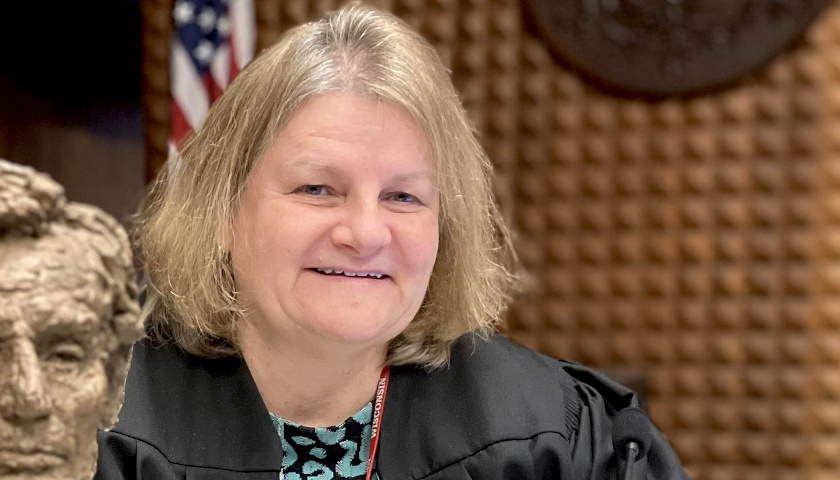
A judge found that criminal charges should proceed against a Wisconsin judge who was charged with obstruction for helping an illegal immigrant evade ICE. U.S. Magistrate Judge Nancy Joseph issued an order on Monday recommending that a lower court judge deny a motion to dismiss based on judicial immunity and other defenses that would throw out the charges against Milwaukee County Circuit Court Judge Hannah Dugan. U.S. District Judge Lynn Adelman, the trial judge, will make the final decision.
Dugan was indicted on May 13 for helping Eduardo Flores-Ruiz elude federal agents who were in the Milwaukee County Courthouse to arrest him. She had him leave the building through a non-public jury door. Agents eventually caught Flores-Ruiz after chasing him outside of the courthouse. The FBI arrested Dugan a week later.
Flores-Ruiz was in court for battery charges. He was deported in 2013 but entered the country illegally again. Prosecutors said he hit his roommate more than two dozen times in the head and choked him for several seconds. When two women tried to intervene, he assaulted them.
Dugan was charged with obstruction of the Department of Homeland Security’s removal proceedings, in violation of 18 U.S.C. 1505, and with knowingly concealing a person for whose arrest a warrant and process had been issued, in violation of 18 U.S.C. 1071.
In her 37-page opinion, Joseph said Dugan “falsely” told ICE agents they needed a judicial warrant to arrest Flores-Ruiz, and told them to leave.
Dugan admitted in her motion to dismiss that there are three types of situations where judges have been prosecuted. They are when a judge takes unofficial acts, criminally deprives someone of a right under 18 U.S.C. 242, or conducts an official act “coupled with an ordinary crime for the pursuit of self-enrichment or self-gratification,” Joseph said. Dugan wasn’t charged under 18 U.S.C. 242.
Joseph said the cases Dugan cited involved judicial immunity from civil lawsuits, not prosecution. Joseph said in one case, Wallace v. Powell, the judges were found to be immune from civil lawsuits, but were not immune from prosecution, even though they were performing official duties.
Joseph brought up a very similar case from 2020, United States v. Richmond Joseph, where Massachusetts District Court Judge Shelley Richmond Joseph assisted an illegal immigrant with evading ICE. She was charged with obstruction of justice and obstruction of a federal proceeding. In that case, the court held that it didn’t even need to address whether a judge has immunity from prosecution over official acts, since the judge acted “corruptly,” and so if there was immunity, it would not shield corruption.
“I do not agree that the case law supports that these judicial acts bar prosecution where the indictment alleges that the acts were done ‘corruptly’ or to facilitate violation of the criminal law,” Joseph said.
Dugan cited Trump v. United States, which held that the president is immune from criminal prosecution for conduct within his exclusive sphere of constitutional authority. Joseph distinguished the case, stating, “Trump says nothing about criminal immunity for judicial acts.”
She explained, “Perhaps in some future case the Supreme Court will expand the judicial immunity principles it has so firmly established in the civil context to the criminal prosecution of judges as Dugan urges. At this time, however, I am unconvinced that either the common law or the Trump decision provide the authority for applying the civil framework of absolute judicial immunity for judicial acts to the prosecution of judges for crimes that relate to official duties.”
Joseph summarized, “[T]here is no firmly established absolute judicial immunity barring criminal prosecution of judges for judicial acts.”
Next, Joseph addressed Dugan’s argument that the Tenth Amendment protected her from prosecution. Dugan asserted that the Tenth Amendment prohibits the federal government from getting involved in state courts. However, Joseph said in the previous Joseph case, the court found that federal prosecutors had jurisdiction since the judge was charged with committing two federal crimes, similar to Dugan’s charges.
Joseph discussed Dugan’s claim that the canon of constitutional avoidance supported dismissal of the charges. “The canon of constitutional avoidance is a canon of statutory construction that comes into play when the language of a statute is ambiguous; the canon is ‘a tool for choosing between competing plausible interpretations’ of the statute,” Joseph said. She said the canon doesn’t apply since there is no ambiguity with interpreting the statute, Dugan is trying to assert that the statutes she is being prosecuted under conflict with the Tenth Amendment. “She is simply repackaging her Tenth Amendment argument, which, for the reasons explained above, cannot be resolved on a motion to dismiss,” Joseph said.
Dugan argued that prosecutors mischaracterized her actions to make them appear to be a crime. She said “she had a right to make decisions involving her courtroom and cases, including directing individuals to use a certain door, conducting a case off the record, and opining ‘off the cuff’ on a legal issue and the federal law enforcement agents improperly interfered with her right to make those decisions.” However, Joseph said those were questions of fact for a jury to decide.
Amicus curiae briefs were filed in the case by 38 former state and federal judges, and the Center for American Rights. Citing precedent, Joseph said she could not consider any of their arguments that Dugan had not brought up in her briefs.
A scheduling hearing was set for Wednesday. Dugan pleaded not guilty in May. Dozens of protesters showed up at the hearing, carrying signs that said “Only Fascists Arrest Judges — Drop the Charges,” and “Si se puede.” She faces up to six years in prison, but nonviolent first time offenses like that often result in no prison time.
Flores-Ruiz pleaded guilty last month and agreed to be deported after serving any required sentence.
– – –
Rachel Alexander is a reporter at The Arizona Sun Times and The Star News Network. Follow Rachel on Twitter. Email tips to [email protected].
Photo “Judge Hannah Dugan” by Judge Hannah Dugan.



She should be removed. Her statue of Lincoln shows her bias clearly. Send her home.
Charles – What are you attempting to communicate?
The judge violated federal law. She should be punished.
“The law perverted! And the police powers of the state perverted along with it! The law, I say, not only turned from its proper purpose but made to follow an entirely contrary purpose! The law become the weapon of every kind of greed! Instead of checking crime, the law itself guilty of the evils it is supposed to punish!
If this is true, it is a serious fact, and moral duty requires me to call the attention of my fellow-citizens to it.”
-Frédéric Bastiat The Law-