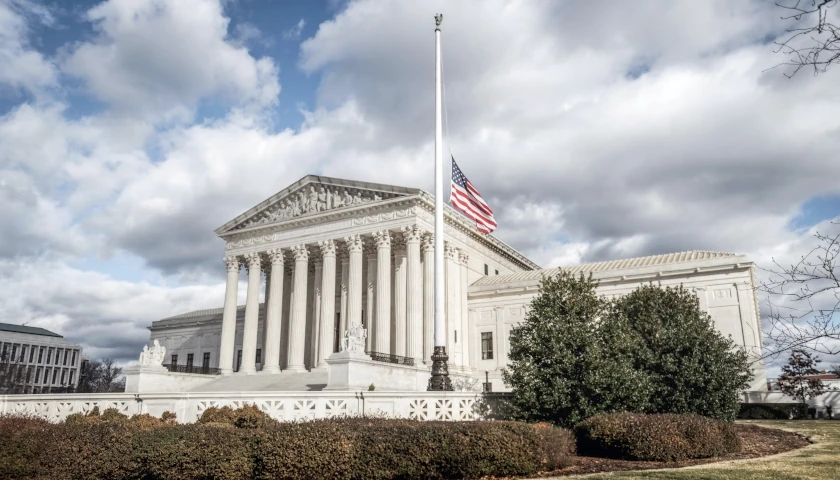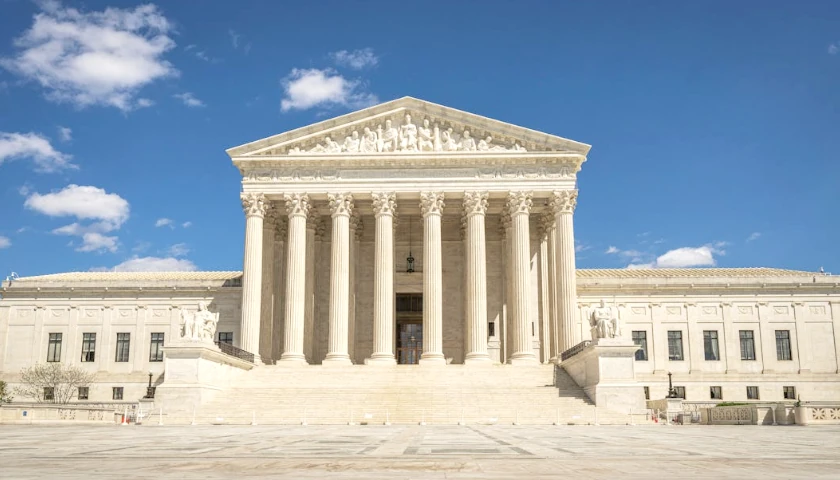
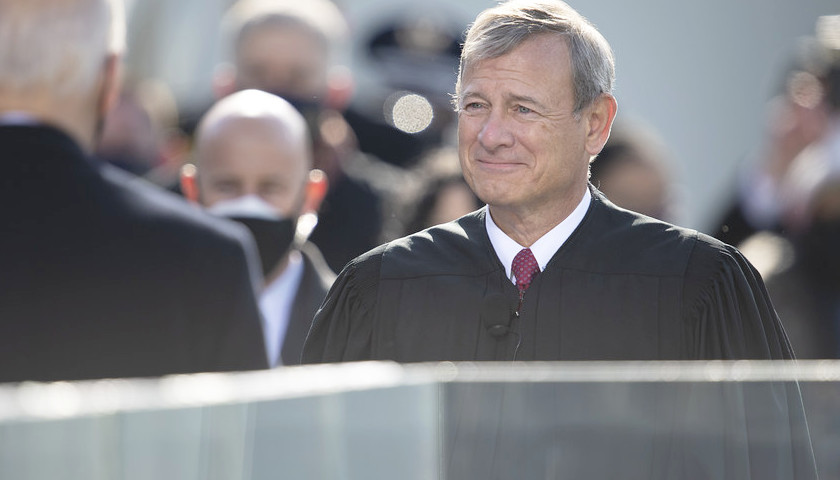
Legal commentator and retired attorney Mark Pulliam said Chief Justice John Roberts’ majority opinion striking down President Donald Trump’s executive order on birthright citizenship misreads the 14th Amendment and risks defining Roberts’ historical legacy alongside one of the Supreme Court’s most controversial chief justices.
During an appearance on The Michael Patrick Leahy Show, Pulliam said the public should understand that the case Trump v. Barbara centers on a single constitutional phrase in the 14th Amendment’s Citizenship Clause: “All persons born or naturalized in the United States, and subject to the jurisdiction thereof, are citizens of the United States.”
Pulliam said the clause was adopted by the Reconstruction Congress for a narrow purpose following the Civil War.
“Why did Congress — the Reconstruction Congress — enact the 14th Amendment and put a citizenship clause in there? It was because they were concerned that the freed slaves would not be deemed to be citizens,” he explained.
He pointed to the Civil Rights Act of 1866, noting that Congress had already declared that “all persons born in the United States and not subject to any foreign power would be citizens,” before deciding to constitutionalize that protection after concerns that legislation alone might not withstand the Supreme Court’s infamous Dred Scott v. Sandford ruling.
Pulliam said the original purpose of the amendment was to ensure citizenship for formerly enslaved Americans, not to establish automatic citizenship for the children of people unlawfully present in the country.
He also challenged Roberts’ reliance on the Supreme Court’s 1898 decision in United States v. Wong Kim Ark, arguing that the case has been interpreted far more broadly than its actual facts support.
“The Supreme Court said… your parents were legally domiciled in the United States, and so therefore we’re going to treat you as being a citizen because of the citizenship clause,” Pulliam explained.
He argued that today’s immigration environment differs dramatically from the circumstances confronting the Court more than a century ago.
“Since the late 1800s and now, we’ve had the advent of intercontinental air travel. We’ve had this trend toward mass migration. We’ve had the phenomenon of open borders,” he noted.
Pulliam claimed that approximately “250,000 to 300,000 anchor babies are being born every year in American hospitals” and cited estimates that “33,000 birth tourists come to the United States every year.”
“We had a tremendous problem, and nobody else would address it. Congress wouldn’t address it. No other president addressed it. President Trump, to his great credit, put this issue on the radar screen for the American public and got shot down by John Roberts,” he said.
While Roberts’ opinion concluded that the Constitution guarantees citizenship to nearly everyone born on U.S. soil, Pulliam said Justice Brett Kavanaugh’s separate opinion offered a more persuasive analysis.
“He went and dissected U.S. v. Wong Kim Ark and said, ‘Does that really what the decision said, and does it kinda create this airtight case for birthright citizenship for anybody born on American soil?’ And he says, ‘No, it didn’t’,” he said.
Pulliam noted that even the Wong Kim Ark decision recognized exceptions to birthright citizenship, including children of diplomats and, historically, Native Americans before Congress granted citizenship by statute in 1924.
“What that shows is that there’s play in the joints, and if there’s play in the joints, then certainly we could point to this avalanche, this tsunami of illegal immigrants and birth tourism and say that Congress can and should fix this,” he stressed.
Pulliam argued Kavanaugh’s reasoning would have left room for Congress to legislate on the issue.
“What Kavanaugh said is that if Congress had passed the same language that Trump issued in his executive order… that, in his opinion, would have been constitutional,” he said.
Pulliam also questioned why the Supreme Court reached the constitutional merits of the dispute at all, arguing the case was still in its preliminary stages.
“He didn’t need to reach the merits. It was a facial challenge. There was no factual record,” he argued, going on to criticize the Court for taking the case before a final judgment had been entered and for relying on what he described as an outdated English common-law principle.
“They resurrected this ancient decision… and said, ‘Oh, that doesn’t matter. As long as you were born here, you’re a citizen automatically,’ because of some archaic English principle,” he added.
Pulliam reserved his strongest criticism for what he believes will be the long-term historical consequences of Roberts’ opinion.
“Roger Taney, who was the chief justice immediately following John Marshall, had this very distinguished career. He’d been a cabinet officer, but he is stained in history as an awful person, and John Roberts is terrified that somehow, someday, he would be put in the same category as Roger Taney,” he argued.
Host Michael Patrick Leahy responded, “With this decision [Roberts] is putting his hand up and volunteering to be put in that category.”
Tune in now to The Michael Patrick Leahy Show – your AMERICA FIRST news talk!
– Watch LIVE here on X
– Watch LIVE on YouTube / Rumble / Roku / AppleTV
– Listen on Spotify
– Listen on WENO AM760 in Nashville
– Read more at @TheTNStar https://t.co/j8V5KBvIQ2— Michael Patrick Leahy (@michaelpleahy) July 6, 2026
– – –
Kaitlin Housler is a reporter at The Tennessee Star and The Star News Network.