
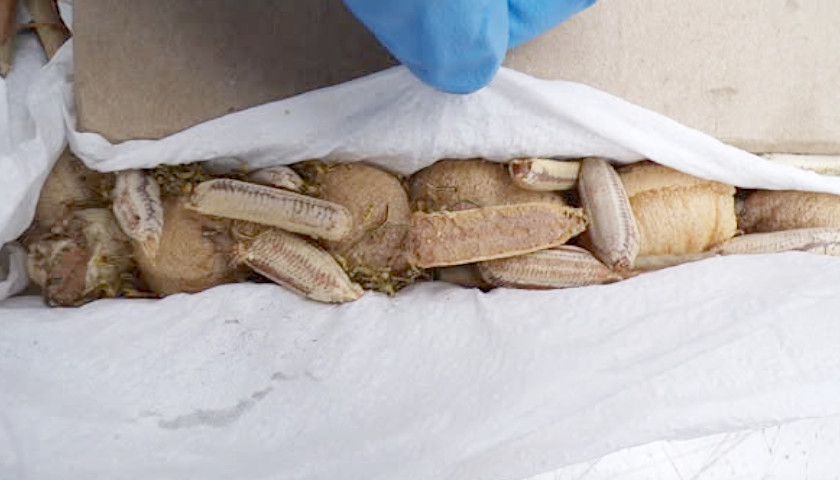
U.S. Customs and Border Protection (CBP) on Monday reported seizing a shipment from Tanzania containing “mantis egg masses.” The CBP Office of Field Operations in Memphis made the discovery, and it is the second seizure involving praying mantis parts in the Tennessee city since 2021.
In a social media post, the CBP Office of Field Operations confirmed that agriculture specialists in Tennessee were brought in to investigate the illicit shipment, in which bug eggs had apparently been disguised within a photo frame.
“CBP agriculture specialists work to safeguard American agriculture. Recently, Memphis CBP agriculture specialists stopped a shipment from Tanzania with concealed mantis egg masses in a photo frame and no valid permits,” CBP announced. “All items were destroyed.”
The agency uploaded photographs showing the frame appeared to contain African-inspired artwork, while part of the package contained numerous insect egg casings.
The egg casings photographed by the agency and shared on social media are visually similar to the image CBP shared in 2021, when agriculture specialists in Memphis intercepted a package sent from Tanzania to Oregon and found it contained three dried loofahs that were “infested with two species of live insect.”
According to CBP, these insects included a form of praying mantis and an invasive wasp that could threaten American cedar trees if introduced to Oregon’s environment.
“Recent shipments from Tanzania have revealed prohibited insects, plants and animal products,” CBP said in 2021. “The motivation for ordering the dangerous insects from Tanzania is unclear.”
While experts were unclear about the motivation in 2021, subsequent research has revealed commercial insect breeders prefer to trade oothecae, or mantis egg cases, over juvenile or adult insects. One ootheca can contain up to 400 eggs, and some home gardeners release the insects to fight backyard pests.
The Utah State University Extension office also noted last year that a growing number of people are keeping foreign praying mantis species as exotic pets, and warned that illegal releases of these insects are “a significant pathway for dispersal” into the environment, despite the one-year lifespan of the bugs, as their eggs can survive in mild winters.
Last year, the Trump administration announced its National Farm Security Action Plan, which, in addition to instituting new requirements for multinational companies that own American farmland, included an import review to “prevent the spread of dangerous biochemicals and biological agents from entering the country.”
The announcement came weeks after Chinese researchers were arrested for allegedly smuggling biological materials into the United States.
– – –
Tom Pappert is a 2025 recipient of the Dao Prize and the lead reporter for The Tennessee Star. He also reports for the Star News Network. Follow Tom on X. Email tips to [email protected].