by Peter Navarro
America is in the midst of a manufacturing renaissance. Unprecedented in its speed, it is driven by Trump’s tariffs and factory-targeted tax cuts.
Companies can now expense 100 percent of the cost of building a factory on American soil instead of depreciating those costs over 39 years. The year you pour the concrete is the year you write it off. For a chief financial officer deciding where to build the next plant, that one provision changes the location decision.
The Trump tariffs are a protective wall. President Trump has said, If you are a foreign company and you want to avoid our tariffs, build here. Invest here. Hire here.
You can see the Trump manufacturing renaissance in the macro data, in the micro data, and along highways across flyover country.
Start with the macro. In the Biden administration’s last two years, America lost 230,000 manufacturing jobs. Since December 2025, American manufacturers have added 72,000 jobs, with factory payrolls rising in each of the last four months through September.
Through most of 2023 and 2024, the ISM Manufacturing Index languished below 50, the line between contraction and expansion. In January it climbed back above 50, where it has stayed for nine straight months.
Not coincidentally, construction employment has increased by 109,000 over the past 12 months. Before the first automobile or aluminum ingot rolls off the line, somebody has to pour the concrete, raise the steel, and install the machine tools. Look inside the construction numbers, and the growth is in nonresidential specialty trades—electricians, steel erectors, and pipe fitters. That’s factory construction, not housing.
Now the micro picture. A preliminary inventory of factory investments announced since Jan. 20, 2025, shows more than $380 billion in investment across more than 500 projects, with more than 160,000 announced direct manufacturing jobs.
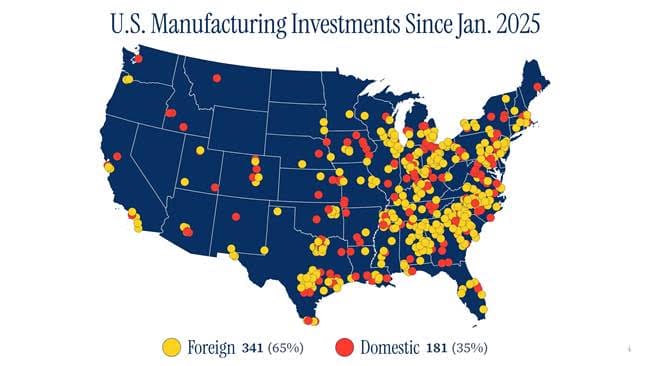
Sixty-three are worth at least $1 billion. But the median project is roughly $90 million. This is not a few giant chip fabs. It is hundreds of smaller new factories and expansions spread across the country.
Nearly half are greenfield—new plants on new sites. The rest are brownfield: existing factories that have been expanded, modernized, or brought back into operation—the Rust Bowl is rising from the ashes.
Most revealing: Nearly two-thirds of the projects are backed by foreign-owned companies. Cheap foreign labor, lax regulation, and, in China’s case, massive state subsidies pulled production offshore. President Trump has turned that equation upside down.
Across America, Taiwanese companies are investing in semiconductors, Japanese companies are expanding auto and machinery production, Korean companies are investing in steel, critical minerals, and shipbuilding, and German firms are building industrial equipment and automobiles. British companies alone are investing nearly $13 billion in 35 projects, from pharmaceuticals in Virginia to aerospace in New England.
TSMC has announced $100 billion in additional investment in Phoenix. Micron is putting $25 billion into memory chips in Boise, Idaho. Eli Lilly is investing $6.5 billion in Houston, $6 billion in Huntsville, Ala., and $5 billion in Goochland County, Va. Hyundai Steel is building a $5.8 billion mill in Donaldsonville, La.
With this manufacturing renaissance, President Trump is proving once again that economic security is national security. A chip fab in Arizona, a steel mill in Louisiana, a shipyard in Philadelphia, and a minerals plant in Tennessee may look like different businesses. Strategically, they are one mission: the capacity to make what we need, when we need it, on American soil. You cannot be a military superpower if you are industrially dependent.
Hanwha is investing $5 billion in the Philadelphia shipyard. Anduril is investing $3.7 billion at Sparrows Point, Maryland, to manufacture components for the U.S. Navy’s Virginia-class nuclear-powered attack submarines, while Hadrian is investing $1.5 billion in automated submarine-component manufacturing in Cherokee, Ala.
Korea Zinc is putting $7.4 billion into critical-mineral processing in Clarksville, Tenn. MP Materials is making rare-earth magnets in Texas. Both projects will help neutralize China’s weaponization of rare-earth magnets.
Just where are the factories going? Of the 522 projects, 368—more than 70 percent—are in 26 Republican-leaning states, accounting for $207.5 billion in investment and more than 125,000 direct jobs. Eighteen blue states account for 90 projects and $44.3 billion.
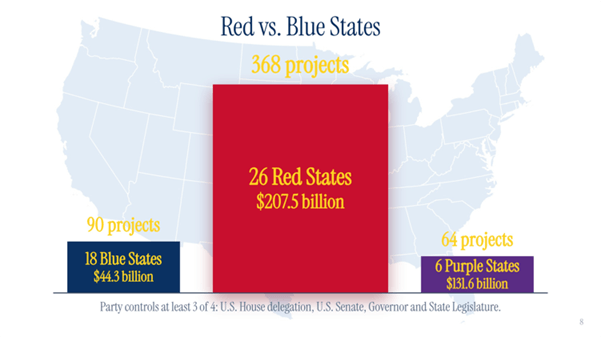
Let me be clear: The White House does not steer projects to Republican states. Companies weigh taxes, regulation, energy costs, permitting, and the workforce, and then they decide. Economists call this “revealed preference,” and the preference being revealed is for states that make it easy to build. Washington provides the framework: competitive taxes, trade enforcement, and tariff protection. The states provide the environment in which investment flourishes or falters.
Memo to blue-state governors like Newsom, Pritzker, and Hochul: If you want these factories, lower barriers, speed permits, and train your workforce.
For decades, Americans were told the decline of manufacturing was inevitable. It was never inevitable. It was a policy choice. The concrete is being poured. The steel is going up. The factories are coming home. Trump’s tariffs and tax cuts are working—and they are working for you.
– – –
Peter Navarro is the White House Senior Counselor for Trade and Manufacturing and author of Why Fauci MUST Rot in Prison.