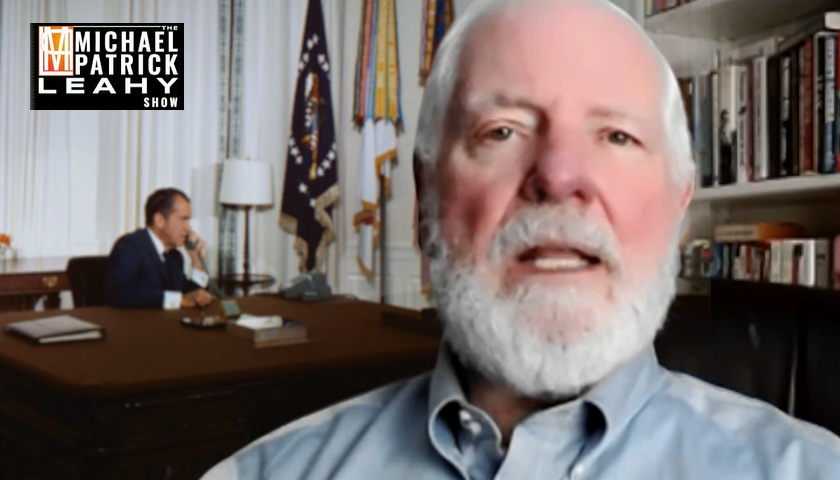
Former Nixon White House attorney and longtime Watergate researcher Geoff Shepard said the Watergate prosecutions involved a series of secret communications and coordination between members of the executive, legislative, and judicial branches of government, arguing that the conduct violated the separation of powers guaranteed by the U.S. Constitution.
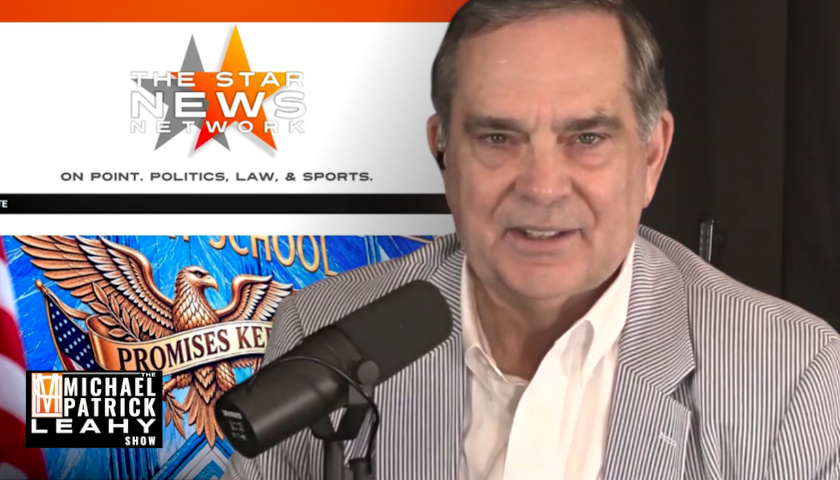
Shepard (pictured above) made the remarks during an appearance Wednesday on The Michael Patrick Leahy Show while discussing Leahy’s new eBook and documentary, How the Deep State Took Down Richard Nixon, which is based in part on Shepard’s decades of research into the Watergate prosecutions.
Shepard said the Constitution establishes three separate branches of government that are intended to operate independently.
“Our Constitution is based on the idea of three coequal branches of government: executive, legislative, and judiciary, separate and equal and they operate independently,” Shepard said.
He argued that the Watergate proceedings departed from that structure through a series of private communications between individuals in different branches.
“What happened in Watergate, you can picture a triangle with the three branches of government at each angle,” Shepard said. “And what happened was a series of secret meetings, secret memos, secret coordination by and between specific members of each of those branches of government, all done in secret.”
Shepard said the documents he has uncovered over decades of research provide evidence of the coordination.
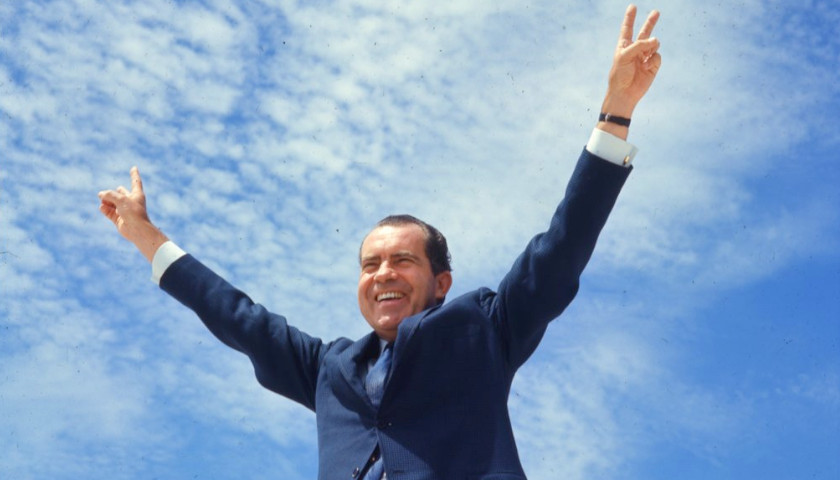
“But that’s what it took to bring down the most popular president elected in our nation’s history, and they left a paper trail,” Shepard said. “So over the years, I’ve been able to uncover these communications and this coordination by and between specific individuals in the branches of government that was…not supposed to happen, is not envisioned by our Constitution.”
A central part of Shepard’s argument involves former Watergate special prosecutor Archibald Cox and the circumstances under which he operated.
Shepard said Cox was not confirmed by the Senate and that the guidelines governing his work were not enacted into law by Congress.
“Archibald Cox was operating without congressional confirmation enforcing rules that he got from Richardson that were not enacted into law,” Shepard said. “We didn’t raise it at the time, but that’s a clear violation of the separation of powers.”
Shepard said he recognized the significance of the arrangement while working in the Nixon White House.
“I remember saying to David Gergen, who was on the Nixon White House staff and one of the speech writers, that he stayed under other presidents. He’s a renowned scholar and distinguished gentleman. I said to Gergen, ‘These guidelines, all they mean is we’re gonna have to fire Elliot Richardson before we can fire Archibald Cox,’” Shepard said.
He argued that Cox ultimately operated with a relationship to Congress that further blurred the constitutional separation between the branches.
“If Archibald Cox reported to anybody… it wasn’t the attorney general in whose department and whose authority he was exercising,” Shepard said. “It was to the Senate Judiciary Committee, which as I keep emphasizing, is a massive violation of the separation of powers structure of our government.”
Shepard said his research also uncovered evidence involving secret meetings between prosecutors, judges, and congressional staff.
“If you put the Watergate…prosecutors up at the top, when they go down the right side to the judges, the secret meetings with the judges, those are violations of due process and the Fifth and Sixth Amendments,” Shepard said.
“You go down the left where you get to the Congress, and they were meeting secretly and giving grand jury information to Congressional staff,” he added. “That’s a violation of separation of the powers, open and shut.”
Shepard said the significance of the evidence is that the participants left behind contemporaneous documents that can be examined today.
“I think the astounding thing is they left a paper trail that I’ve uncovered that describes all these things, these secret meetings with the judges, these secret meetings with the Hill staff,” Shepard said.
Leahy’s How the Deep State Took Down Richard Nixon project is based on Shepard’s research and includes a 90-minute documentary, an eBook in EPUB, PDF, and AZW3 formats, and a “who’s-who” analysis and timeline.
The digital bundle is currently offered for $9.95 through Leahy’s website.
Tune in now to The Michael Patrick Leahy Show – your AMERICA FIRST news talk!
– Watch LIVE here on X
– Watch LIVE on YouTube / Rumble / Roku / AppleTV
– Listen on Spotify
– Listen on WENO AM760 in Nashville
– Read more at @TheTNStarhttps://t.co/I9gzPonQ1q— Michael Patrick Leahy (@michaelpleahy) September 9, 2026
– – –
Kaitlin Housler is a reporter at The Tennessee Star and The Star News Network.