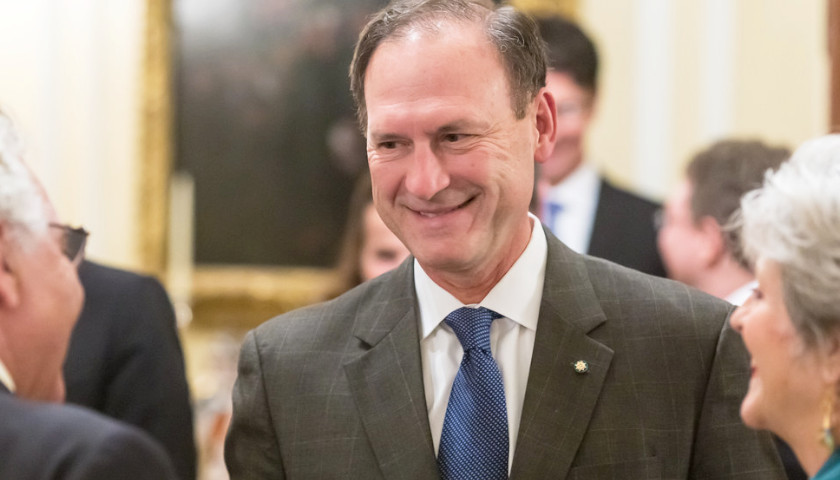
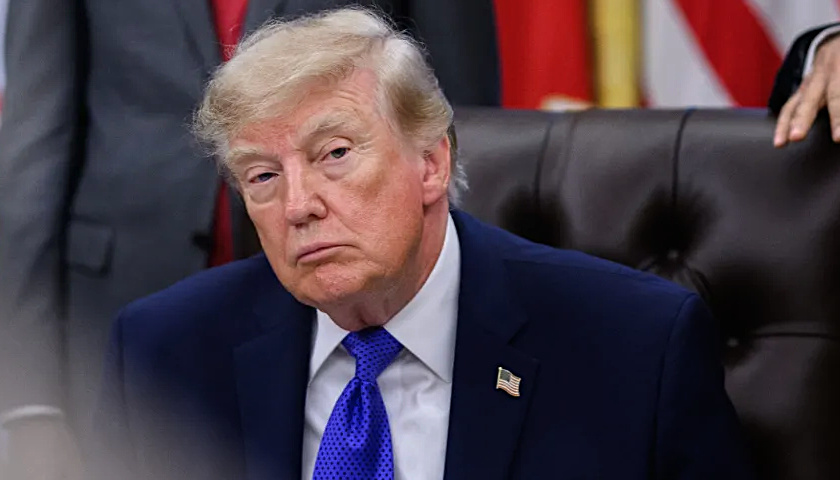
President Donald Trump said he regrets nominating Justices Neil Gorsuch, Brett Kavanaugh and Amy Coney Barrett, telling Time magazine in an interview published Thursday that the three first-term appointees have voted against him too often after he gave them “the position of a lifetime.”
In an interview conducted Monday, Trump said he regretted the nominations. “What can I do?” he said. “I put them in. They voted against me too often;” adding, “I gave them the position of a lifetime, and they vote against me often.”
Pressed on whether he wanted loyalty from the justices, Trump said, “I do like loyalty, yeah,” the article reported.
Subsequent reporting by Reuters, which obtained a transcript of the 75 minute interview noted the president added, “No, I don’t want loyalty. I want good decisions.” He contrasted the three with Justices Sonia Sotomayor, Elena Kagan and Ketanji Brown Jackson, whom he said “stick like glue” and “virtually never vary.”
President Trump’s remarks followed a September 14 order in which the court refused to let the U.S. Postal Service implement parts of a new rule on election mail. In an unsigned order, the justices said the government was unlikely to succeed on the merits of its challenge to a lower-court injunction and that the equities did not favor a stay. Kavanaugh concurred in the denial; Justices Clarence Thomas and Samuel Alito dissented.
Trump later wrote on Truth Social that the justices “not the people I interviewed to serve on the United States Supreme Court, they are merely a shell of their original selves.”
The three appointments, all confirmed in Trump’s first term, make up the court’s current 6-3 conservative majority.
Gorsuch, then a judge on the U.S. Court of Appeals for the 10th Circuit, was nominated on January 31, 2017, to the seat of Justice Antonin Scalia, who died in February 2016. Senate Republicans declined to consider President Barack Obama’s March 2016 nomination of Judge Merrick Garland. Democrats filibustered Gorsuch; Republicans then changed Senate rules to allow Supreme Court nominees to advance by a simple majority. The Senate confirmed him 54-45 on April 7, 2017, with three Democrats joining all Republicans present.
Garland, meanwhile remained chief judge of the U.S. Court of Appeals for the D.C. Circuit. Shortly after President Joe Biden’s inauguration, Judge Garland was nominated to be attorney general. The Senate confirmed him on March 10, 2021, by a vote of 70–30, and he served as the nation’s chief law-enforcement officer until the end of the Biden administration.
Kavanaugh, a judge on the U.S. Court of Appeals for the D.C. Circuit, was nominated in July 2018 after Justice Anthony Kennedy retired. His confirmation hearings were a spectacle, dominated by sexual-assault allegations from Christine Blasey Ford, which Kavanaugh consistently denied. The Senate confirmed him 50-48 on October 6, 2018.
Barrett, a judge on the U.S. Court of Appeals for the 7th Circuit and a former Scalia clerk, was nominated on Sept. 26, 2020, eight days after Justice Ruth Bader Ginsburg died. Republicans moved the nomination through in the final weeks before the presidential election. The Senate confirmed her 52-48 on Oct. 26, 2020. Sen. Susan Collins of Maine was the only Republican to vote ‘no;’ and no Democrat supported the nomination. She was sworn in eight days before Election Day.
While the court sided with the administration this term in expanding presidential removal power, it rejected several of Trump’s signature second-term initiatives, sometimes with his own appointees in the majority.
On June 30, in Trump v. Barbara, the court struck down an executive order that would have denied citizenship to U.S.-born children whose parents were in the country unlawfully or only temporarily. Chief Justice John Roberts, writing for the court, held that those children are “subject to the jurisdiction” of the United States under the 14th Amendment’s Citizenship Clause and are citizens at birth. Barrett joined the majority. Kavanaugh agreed that the order could not stand, relying in part on statute.
In dissent, Justice Samuel Alito called the ruling “one of the most important decisions in the history of the Court” and “a serious mistake.” As interpreted by the majority, he wrote, the 14th Amendment “confers citizenship on virtually everyone who happens to be born in this country, including the children of ‘birth tourists,’ women who come here solely for the purpose of giving birth to a child and then promptly return home.” The amendment, he argued, “does not degrade the concept of United States citizenship in this way.” “Before saddling the Nation with a medieval rule,” he added, “we had better be certain the Constitution requires it. … Too much is at stake.”
Justice Clarence Thomas, joined by Justice Neil Gorsuch, wrote that the majority’s account “is not historically accurate” and rests on an English feudal rule of lifetime allegiance to the sovereign who owned the soil, a principle he said Americans rejected. “The Court today takes the extraordinary step of holding facially unconstitutional the President’s Order,” Thomas wrote, and “adds to the sad history of the Fourteenth Amendment, which was designed and understood to secure equal rights for the freed blacks but has instead been repurposed for political projects that the Reconstruction Congress did not support.”
Gorsuch, in a separate dissent, said the Citizenship Clause reflects “a distinctly American settler’s view of citizenship,” not the feudal rule of jus soli. Children of temporary visitors, he wrote, “cannot claim the privilege of citizenship,” so the order was not invalid in every application. He said he harbored doubts, though, about denying citizenship to children whose parents “have long chosen to make this Nation their permanent home” in violation of immigration law. “If those parents are not domiciled here,” he wrote, “then where are they domiciled?”
On February 20, in Learning Resources, Inc. v. Trump, consolidated with Trump v. V.O.S. Selections, the court held 6-3 that the International Emergency Economic Powers Act does not authorize the president to impose tariffs. Roberts wrote the principal opinion. Gorsuch and Barrett joined the majority and filed separate concurrences; Kavanaugh was among the dissenters.
On June 29, in Trump v. Cook, the court refused to let Trump immediately remove Federal Reserve Governor Lisa Cook while her challenge proceeds. The vote was 5-4. Roberts and Kavanaugh joined the three liberal justices; Gorsuch and Barrett dissented with Thomas and Alito.
While the court sided with the administration the same day in Trump v. Slaughter, holding that Trump could remove a Democratic member of the Federal Trade Commission without cause and narrowing limits on presidential firing power that dated to Humphrey’s Executor, the Cook decision left the Federal Reserve on a different footing.
The same three justices supplied the majority in several of the court’s largest conservative decisions since 2020, including the overruling of Roe v. Wade in Dobbs v. Jackson Women’s Health Organization, the end of race-conscious college admissions in Students for Fair Admissions v. Harvard, the expansion of the individual right to carry a firearm in New York State Rifle & Pistol Association v. Bruen, and the overruling of Chevron deference in Loper Bright Enterprises v. Raimondo. On June 30, the court also upheld state laws barring transgender girls and women from female sports teams, in West Virginia v. B.P.J. and Little v. Hecox.
– – –
Christina Botteri is the Executive Editor of The Tennessee Star and The Star News Network. Follow her on X at @christinakb.