With conservatives now dominating the leadership in Fountain Hills, a plan for road diets has been defeated. The Fountain Hills Town Council (FHTC) voted 5 to 2 against the “Woke DEI Vision Zero Road Diet Plan” on Tuesday. The program was approved in April of last year under the leadership of former far left Mayor Ginny Dickey and Democrats on the FHTC. Road diets eliminate lanes on roads in the city and replace them with bicycle lanes.
Fountain Hills Councilman Allen Skillicorn said in a statement to The Arizona Sun Times, “This plan includes a commitment to gender equity, why? This plan mentions greenhouse gases seven times, mentions climate change nine times, mentions environmental justice thirteen times, and mentions equity twenty times. Our town and our nation have rejected wokeness and DEI. Today is a new era of common sense. This is not for our town.”
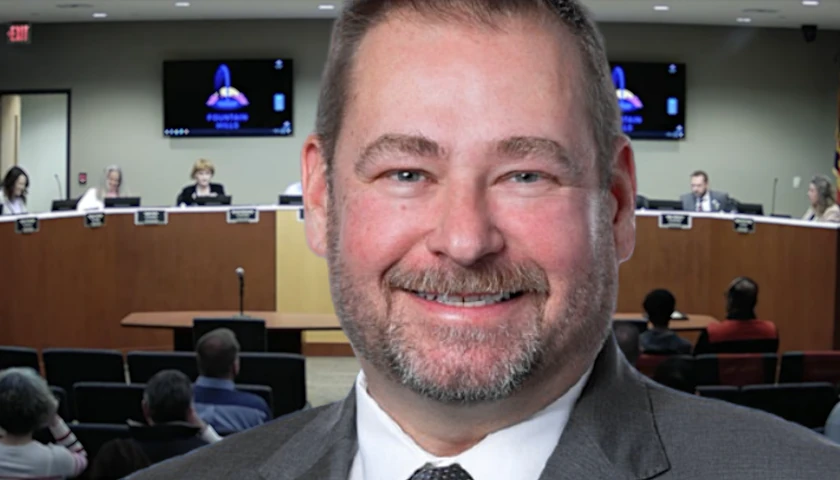
Skillicorn (pictured above) offered the motion to cancel what he referred to as the “Woke DEI Vision Zero Road Diet Plan,” and Vice Mayor Hannah Toth seconded the motion.
The FY 2024 SS4A Grant Program offered by the Federal Highway Administration was for development of a Comprehensive Street Safety Action Plan, ostensibly to reduce traffic-related deaths. According to the Vision Zero Network, “Vision Zero is a strategy to eliminate all traffic fatalities and severe injuries, while increasing safe, healthy, equitable mobility for all.”
Vision Zero Network is a project of Community Initiatives – an Oakland, California-based nonprofit that, according to their tax filings, is 98 percent funded by taxpayers to the tune of about $50 million annually. Community Initiatives bills itself as “a dedicated fiscal sponsor whose sole purpose is to provide best-in-class infrastructure for nonprofit leaders.” The organization lists Vision Zero as one of its 132 projects.
A review from Mission Local published last March found that 10 years of Vision Zero in San Francisco had not reduced road deaths. “Nearly as many people are dying on city streets as ever,” the article said. “Over the past decade, 299 people have been killed on city streets. In 2022, deaths totaled 39 — more than in any year since 2007.” Similarly, in Los Angeles, which has adopted Vision Zero, there were 312 traffic deaths in 2022, its highest total in 20 years. In Denver, traffic fatalities rose every year since Vision Zero was adopted in 2017, affecting the mayoral race in 2023.
Fountain Hills Public Works Director Justin Weldy, who supported obtaining the grant, told the council and new Mayor Gerry Friedel that in order to apply for federal grants, the criteria usually requires a showing of how it will benefit underserved or impoverished communities, and must use FEMA’s definition of those communities. He said complying with the terms wouldn’t be a problem, but didn’t explain.
Newly elected council member Gayle Earle expressed her skepticism. She said she was uncomfortable with the requirement that the town spend $60,000 in order to receive $240,000 merely for planning. “These different things kind of make my hair stand up,” she said. Additionally, she objected to providing reasoning on how their implementation will be “racially equitable” and what will be the “climate change and environmental justice impacts.” She said, “I don’t even know how they relate to the streets.”
Skillicorn said when Vision Zero was implemented in New York a few years ago, it didn’t work. “Now here in Fountain Hills, we’ve already seen a severe road diet with Golden Eagle [Park], where people now have parking lots and bike lanes that seem to be more important than traffic lanes,” he said. “And, you know, people would say they can’t make a left turn on some streets there because the … lane is so shrunken … that’s very significant.”
Vice Mayor Hannah Toth said, “And my concern with Vision Zero is it does reflect ideal reality. And what I’ve noticed is very often on the on one of the sides of the aisle of things, where people look really sweet and kind and have a good smile, or the websites really nice, and what they’re saying sounds like a wonderful thing, if we could do that, and you find out it’s not so great in practice.”
In the statement provided to The Sun Times, Toth said, “Of course we want zero pedestrian injuries. My job is to find hidden meanings, often these are not so great in practice. Fifteen Minute Cities sound great but are not. Vision Zero is something I do not feel comfortable inviting into our town.”
Council member Brenda Kalivianakis said she was going to vote to accept the grant on a “leap of faith.” She said, “I’m going to be optimistic and hope that when we receive it, it’s going to be well spent and hopefully it will prevent lives being lost.”
Council member Peggy McMahon, who was the only other member who voted in favor of the grant, said it was a good deal to spend $60,000 to get the $240,000.
Several members of the public next provided comments. Shelby Lee Blecker, who said he’d moved to the area from Los Angeles, said, “I would say the town already has a pretty solid reputation of fulfilling the ideals of Vision Zero. So why do we need to spend $60,000 to study what else we can do?” He said that he’d been warned by more than one person not to speed in town, due to efforts by law enforcement to crack down on it. He believed those efforts have been successful.
Greg Johnson compared Vision Zero to the federal government’s now-defunct law mandating 55 mph on the highways in order to save lives. He said it was rescinded because it didn’t save lives. Johnson said the four traffic related fatalities in the town had nothing to do with speed, but instead “bad driving,” such as driving under the influence or dropping a lit cigarette on your lap while driving. He noted that the Arizona Department of Transportation dropped a study of Vision Zero since they found it didn’t work.
The City of Scottsdale came under fire recently for approving road diets. The votes contributed to voters ousting Scottsdale’s independent mayor David Ortega, replacing him with Republican Lisa Borowsky, and ousting two left-wing Democrats on the Scottsdale City Council. Far left council member Tammy Caputi, who switched her party registration from Democrat to independent before running for office, was defeated, and Incumbent Tom Durham dropped out of his reelection race.
Fountain Hills is a conservative enclave, voting for Donald Trump for president over Joe Biden by over 20 points in 2020.
– – –
Rachel Alexander is a reporter at The Arizona Sun Times and The Star News Network. Follow Rachel on Twitter / X. Email tips to [email protected].