
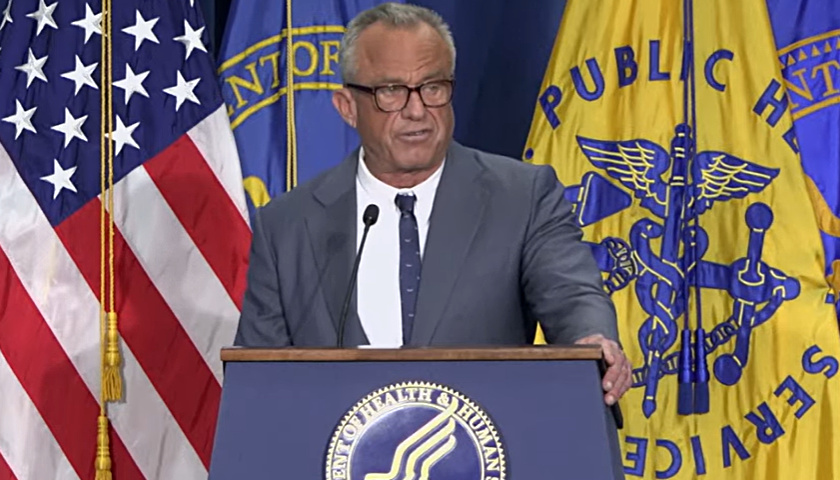
The U.S. Department of Health and Human Services, led by Secretary Robert F. Kennedy Jr., announced on Wednesday a sweeping set of proposed regulations to bar hospitals and providers from performing pharmaceutical or surgical gender-transition procedures on children under 18.
“Under my leadership, and answering President Trump’s call to action, the federal government will do everything in its power to stop unsafe, irreversible practices that put our children at risk,” Kennedy said. “This Administration will protect America’s most vulnerable. Our children deserve better — and we are delivering on that promise.”
The actions, outlined in multiple proposed rulemakings and enforcement measures, implement President Trump’s recent executive order directing HHS to end such practices on minors. The department described the interventions — including puberty blockers, cross-sex hormones, and surgeries — as “sex-rejecting procedures” that expose children to permanent harm, such as infertility, impaired sexual function, diminished bone density, and altered brain development.
Centers for Medicare & Medicaid Services (CMS) plans to issue a notice of proposed rulemaking that would bar hospitals from performing these procedures on minors as a condition of participating in Medicare and Medicaid. Because nearly all U.S. hospitals rely on these programs, the rule would effectively prevent the procedures in most facilities nationwide.
A separate CMS proposal would prohibit federal Medicaid funding for the procedures on individuals under 18 and extend the ban to Children’s Health Insurance Program (CHIP) funding for those under 19. Currently, 27 states already decline Medicaid coverage for such interventions on minors.
Secretary Kennedy signed a formal declaration Wednesday, based on an HHS peer-reviewed report, stating that the procedures do not meet professionally recognized standards of health care. Providers performing them on minors would be considered non-compliant with those standards.
CMS Administrator Dr. Mehmet Oz called the procedures “experimental interventions” with “life-altering risks and no reliable evidence of benefit.” He added that the proposals aim to ensure federal programs promote child health and safety.
In related actions, the Food and Drug Administration is issuing warning letters to 12 manufacturers and retailers for illegally marketing breast binders — classified as Class I medical devices — to children for treating gender dysphoria. FDA Commissioner Marty Makary, M.D., M.P.H., warned of further enforcement, including seizures and injunctions, if the practice continues.
HHS is also proposing to reverse a Biden-era interpretation that included gender dysphoria within the definition of disability under Section 504 of the Rehabilitation Act of 1973. The revision would clarify that gender dysphoria, absent physical impairments, is not a covered disability, allowing federally funded entities to limit or prohibit the procedures without violating nondiscrimination rules.
Deputy Secretary Jim O’Neill described the prior interpretation as an “abuse” of the law that pressured providers to support the interventions.
The announcements follow last month’s release of an HHS peer-reviewed study concluding that current evidence does not support the safety or effectiveness of puberty blockers, cross-sex hormones, or surgeries for pediatric gender dysphoria. Claims data cited in the release indicate nearly 14,000 minors received such procedures between 2019 and 2023.
These actions also build on a landmark Supreme Court ruling earlier this year in United States v. Skrmetti, in which the justices voted 6-3 on June 18 to uphold Tennessee’s Senate Bill 1 (SB1) — a 2023 law prohibiting puberty blockers, cross-sex hormones, and related procedures for minors experiencing gender dysphoria.
The Court decided that the measure did not violate the Equal Protection Clause of the Fourteenth Amendment, finding that it classifies based on age and medical purpose rather than sex or transgender status, and thus warrants only rational basis review, which it easily satisfied given the state’s interests in protecting children’s health from potentially irreversible risks. With the high court’s decision affirming states’ authority to enact such restrictions, the HHS proposals extend similar protections nationwide through federal funding conditions and regulatory enforcement.
The proposed rules will undergo public comment periods before finalization.
Watch the full announcement:
– – –
Christina Botteri is the Executive Editor at The Tennessee Star. Follow her on X at @christinakb.