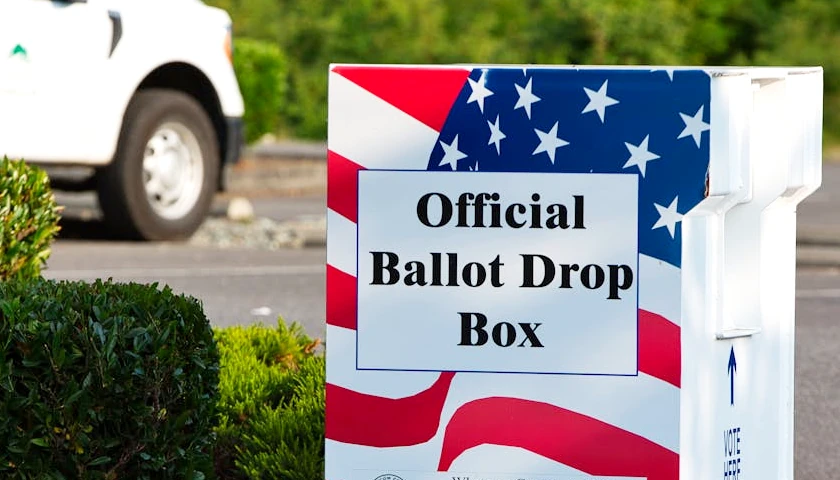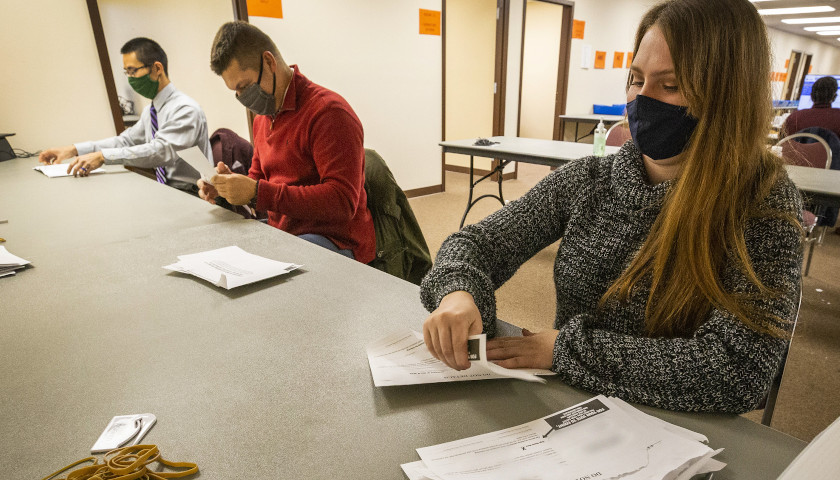
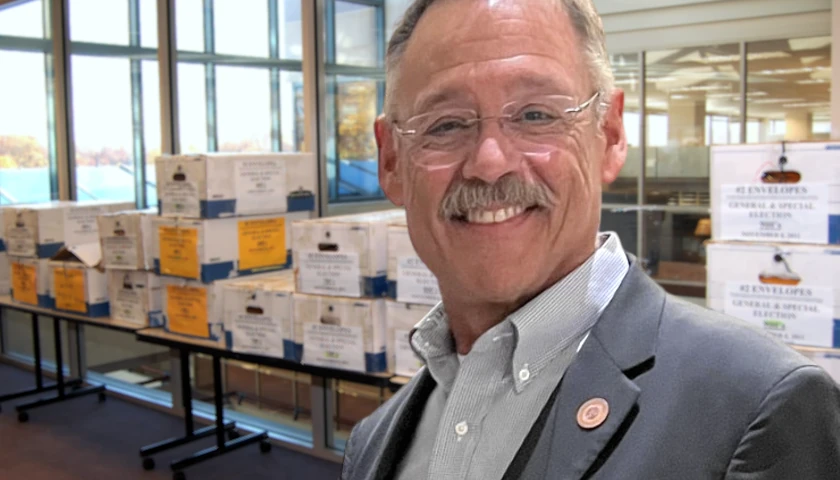
The State Senate passed legislation down party lines sponsored by State Senator Mark Finchem (R-Prescott) on Monday that would increase the security of paper ballots. SB 1123 requires the use of at least three of 10 fraud countermeasures on ballots. Accusations arose in recent elections that unofficial ballots were submitted that did not conform to the required standards, raising suspicions they were artificially inserted into the elections process by bad actors. The bill moves to the State House of Representatives next.
“Arizonans deserve fair and accurate elections, free from fraud and illegal influence,” said Finchem in a statement released by Senate Republicans. “This bill was carefully crafted and is a commonsense solution that will increase voter confidence. By adding these countermeasures to our ballots, we can ensure that every vote is accurately counted, verified, and speaks to citizens and the right to exercise their franchise. Fraud has no place in our election system, and this bill will make it more of a challenge for bad actors to manipulate the system.”
The 10 fraud countermeasures are specified in the legislation. They are:
1) watermarked security paper;
2) secure holographic foil that acts as a visual deterrent and anti-copy feature;
3) branded overprint of any hologram that personalizes the hologram with customer logo;
4) custom complex security background designs with banknote-level security;
5) secure variable digital infill;
6) thermochromic variable inks;
7) stealth numbering in ultraviolet, infrared or taggant inks;
8) multicolored micro-numismatic invisible ultraviolet designs;
9) unique forensic fraud detection technology that is built into security inks; or
10) unique barcode or QR code that is accessible only to the voter and that tracks the voter’s ballot as it is processed.
Other states have encountered possible fabricated ballots. During the 2020 election in Georgia, Fulton County poll manager Suzi Voyles found while sorting through mail-in ballots that many absentee votes contained perfectly filled-in ovals for Joe Biden — except that each of the darkened bubbles featured an identical white void inside them in the shape of a tiny crescent, indicating they’d been marked with toner ink instead of a pen or pencil. Additionally, she noticed that those ballots were printed on different stock paper than the others she handled as part of a statewide hand recount, and none were folded, which was odd for mail-in ballots.
Another bill from Finchem, SB 1063, also passed the Senate on Monday. It allows the jury commissioner to give a qualified juror who receives a jury summons between the period of 120 days to 90 days preceding the date of the general election the option to serve as a temporary election worker instead of jury service. Democrats have complained that if voting is returned to smaller precincts instead of the large vote centers that some of Arizona’s counties have recently adopted, there won’t be enough election workers.
Another bill addressing the election worker shortage passed the Senate on Tuesday. State Senator Tim Dunn (R-Yuma) sponsored SB 1319, which adds a six-month training window in even numbered years. The bill allows certification for the first six months of an election year instead of in odd years only.
Similar bills to SB 1123 were proposed in previous years, but there was always at least one Republican legislator who voted with the Democrats to defeat it. This session, Republicans have their strongest majorities in both chambers in years, in part due to Finchem defeating former Senator Ken Bennett in the Republican primary last year, a frequent no vote on election integrity legislation.
While Democratic Governor Katie Hobbs is likely to veto most election integrity legislation, some of these bills could be converted to ballot referrals instead, bypassing her.
Hobbs hasn’t vetoed all election integrity bills. Last year in February, Hobbs signed HB 2785, which makes multiple adjustments to the election timeline, codifies statewide signature verification standards for the first time, and shortens time to cure missing or non-matching early ballot signatures. In 2026, a provision from the bill will go into effect giving early voters the option of bringing their ballots to the polls on Election Day and scanning them onsite after showing identification.
– – –
Rachel Alexander is a reporter at The Arizona Sun Times and The Star News Network. Follow Rachel on Twitter / X. Email tips to [email protected].
Photo “State Sen. Mark Finchem” by State Sen. Mark Finchem.