
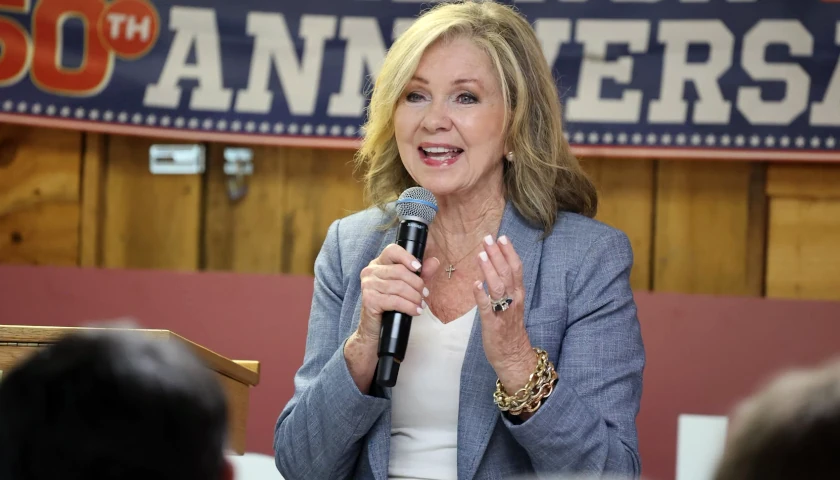
Tom Pappert, lead reporter at The Tennessee Star, said U.S. Senator Marsha Blackburn’s (R-TN) successful Republican gubernatorial primary campaign demonstrated the importance of voter outreach, local political relationships, and accurate turnout modeling in defeating U.S. Representative John Rose (R-TN-06).
Blackburn won the August 6th Republican primary with 311,328 votes, or 43.55 percent, according to the Tennessee Secretary of State’s final unofficial results from all 95 counties. Rose finished with 235,511 votes, or 32.95 percent, while State Representative Monty Fritts (R-Kingston) received 167,971 votes, or 23.50 percent.
The final margin between Blackburn and Rose was 10.60 percentage points.
Appearing Monday on The Michael Patrick Leahy Show, Pappert discussed a post-election memo released by Blackburn campaign manager Ward Baker titled “How We Won,” which outlined the campaign’s strategy.
“The spending of the Blackburn campaign appears to have been very efficient. She was a very good steward of her donors’ dollars, in other words,” Pappert said.
According to Pappert, the memo credited Blackburn with receiving approximately 77 million advertising impressions during the final weeks of the campaign, compared to 13.2 million for Rose.
Pappert said the campaign also credited a network of Tennessee political figures who campaigned on Blackburn’s behalf, including U.S. Representative Tim Burchett (R-TN-02), Knox County Mayor Glenn Jacobs, U.S. Representative Chuck Fleischmann (R-TN-03), U.S. Representative Matt Van Epps (R-TN-07), and other state and local officials.
The campaign’s analysis found Blackburn performed particularly well outside Rose’s congressional base.
“They ran the numbers she performed exceedingly well in counties that had never had John Rose on the ballot before,” Pappert said. “So out of Tennessee’s counties, there are 75 that have never voted for John Rose, never had the ability to vote for John Rose. She won 73 out of those 75.”
Pappert said the results suggested Rose struggled to expand his support beyond areas where voters already knew him.
“So essentially, it looks like despite spending all of this money, saying he would leave Congress to become governor, et cetera, John Rose really failed to make much headway outside of his congressional district and the area where voters already knew him,” he said.
Pappert also discussed the Blackburn campaign’s criticism of polling conducted on behalf of the Rose campaign. The Blackburn memo accused Rose campaign’s consultants of creating an inaccurate picture of the race by suggesting Rose was tied with or leading Blackburn.
He said the memo stated, “Our polling never once had this race in double digits,” and argued that an allegedly independent poll was wrong either because its pollsters did not understand Tennessee Republican primary voters or because they “purposely put their thumb on the scales, or a combination of the two.”
Pappert said the Blackburn campaign’s turnout modeling was another significant factor.
“It’s very interesting that the Blackburn campaign was so accurate. Within about 6,000 voters, they projected the exact turnout of the race,” Pappert said.
The campaign had projected 709,000 Republican primary voters, while 715,739 ballots were ultimately cast.
Pappert said Blackburn’s ability to win a high-turnout Republican primary was particularly notable because Trump-aligned candidates have not always benefited from larger primary electorates.
“I think that is a significant shift, and something that suggests Make America Great Again candidates, MAGA candidates, are really the primary faction of the party,” Pappert said.
Pappert also pointed to the defeat of incumbent U.S. Rep. Andy Ogles (R-TN-05) by former Tennessee Agriculture Commissioner Charlie Hatcher as evidence of a broader trend.
“I think it is a reflection of the same exact thing, where social media is not real life, mainstream media is not real life,” Pappert said. “I don’t think Charlie Hatcher even has a Twitter account. He barely has a Facebook account. He was interacting with the voters—and that’s how you win.”
Blackburn will now advance to the November 3 general election, where she will face Democratic nominee Jerri Green.
Tune in now to The Michael Patrick Leahy Show – your AMERICA FIRST news talk!
– Watch LIVE here on X
– Watch LIVE on YouTube / Rumble / Roku / AppleTV
– Listen on Spotify
– Listen on WENO AM760 in Nashville
– Read more at @TheTNStar https://t.co/flKnbOwiF2— Michael Patrick Leahy (@michaelpleahy) August 10, 2026
– – –
Kaitlin Housler is a reporter at The Tennessee Star and The Star News Network.
Photo “Marsha Blackburn” by Marsha Blackburn.



Ahsley, check back with me after a year of the worthless Blackburn in office. BTW the Founding Fathers were wise enough to establish the Electoral College for the Presidential election. So you are way off base comparing a state political party primary election to the Presidential general election. Nice try but a miss!
This “we don’t want Marsha coz more than 50% voted for someone else” stuff is stupid. So you’re saying we didn’t want Trump? He got way less than 50% in the 2016 primary. So spare me your grousing. I’m looking forward to having her in the governors office. Finally someone who has actually done something!
What an interesting analysis. The big news is 2 relatively unknown statewide Conservatives combined to beat Blackburn 60 40. Most of the folks do not want Blackburn. This race was a classic split the MAGA vote so a RINO wins.
This woman belongs in a nursing home, not the Governor’s mansion. You people make me sick supporting this woman who has a record of nothing to show for stint in Washington.
What I want to come out of this primary is a change in the Tennessee election laws to require a runoff if no candidate achieves a 50% majority. I think Blackburn would lose in a runoff against Rose.
Her campaign was not at all successful. More people voted against Blackburn than voted for her. Tennessee needs to start utilizing the run-off process to guarantee the winner of any race is truly the people’s choice. Rose and Fritts together got more votes than did Blackburn. That shows Tennesseans did not truly favor her. And the voter apathy is embarrassing. She got 311,000 votes in a state that has 4.3 million registered voters. SHAME ON YOU for not getting out and voting. And now we are stuck with a DC bureaucrat as our Governor. Hope you like your data centers, AI and Flock cameras watching EVERYTHING you do. You had the chance of a lifetime to put a true constitutional conservative in the Governor’s mansion (Monty Fritts) and you chose to either sit home or just vote for the person the media told you was going to win. SHAME ON YOU.