by David McKenzie
I can’t believe I am saying this, but I have to defend LSU and Lane Kiffin here. I don’t enjoy it.
Strip away the pearl-clutching and read the SEC’s own complaint and Sankey’s declaration. The conference seems intent on doing something regardless.
Complaint ¶ 94 and Sankey ¶ 44: the CEOs will proceed “whether LSU renounces its intention to roster and play professional players on its football team, or not.” Paragraph 81 goes further, saying the same thing whether or not LSU ever rosters anyone at all.
That language was drafted to survive precisely what happened Tuesday night when LSU filled its roster to 105 and left no room for the pros. I get that it may succeed procedurally. It fails catastrophically as persuasion because it concedes that the expulsion has nothing to do with the conduct the lawsuit is about.
So look at what is actually left. Kiffin’s press conferences, his obnoxious halftime remark, his GameDay appearance, and LSU’s supposed alignment with the Baton Rouge plaintiffs who hold that wacky, overbroad injunction. Compl. ¶¶ 77, 89-92. That is the gravamen. If the SEC disciplines LSU on that record, and asks a federal court to bless it, what it is really punishing is a public employee’s speech about a matter of public concern.
That is a First Amendment case. It just isn’t the SEC’s. It’s Kiffin’s. Fifteen of the sixteen members are public universities, and the conference is governed by their presidents, who are themselves state actors. Brentwood Academy v. TSSAA, 531 U.S. 288 (2001), held that a private athletic association can be a state actor through pervasive entwinement with the public institutions that constitute it. Whether the SEC clears that bar is a serious question, and I wouldn’t call it a foregone conclusion. But the irony writes itself. The SEC’s entire theory depends on LSU officials being state actors, and the SEC pleads at ¶ 96, citing citing West v. Atkins, that Kiffin is one. Ironically, if not shockingly, that supplies the predicate for Kiffin’s claim against it.
Kiffin is a public employee criticizing his governing body’s policy, which puts him on the side of Pickering v. Board of Education, 391 US 563 (1968) (teacher fired for a letter to the paper criticizing how his school board spent money, where the Court held a public employee does not surrender the right to speak as a citizen on matters of public concern, and courts must weigh that interest against the employer’s interest in running its operation). If Kiffin pleads retaliation as a counterclaim, it will be a much, much better First Amendment claim than the one the SEC is asserting in its complaint.
To be clear, I think LSU and Kiffin instigated this mess, and I think conferences can write product-defining eligibility rules. Alston did not bless such rules, but it did not condemn them either. Justice Gorsuch’s opinion for the Court was careful to decide only what was in front of it — education-related benefits — and it left undisturbed the finding that some restraints preserving the line between college and professional sports can be procompetitive. The SEC has a real defense there, subject to the rule of reason like anyone else. I am on Team SEC.
But the conference is missing a lot. It meets today to consider punishing LSU and Kiffin. It can punish a violation of its rules. What it cannot do is punish speech alone. After Tuesday night, speech is all that is left. LSU filled its roster to 105. No professional will play a down. The harm the SEC went to federal court to prevent never happened.
LSU and Kiffin just talked about it.
– – –
David McKenzie is an attorney specializing in Intellectual Property and Constitutional Law. He has argued matters to courts of last resort, including the United States Supreme Court. He lives in Raleigh, North Carolina.
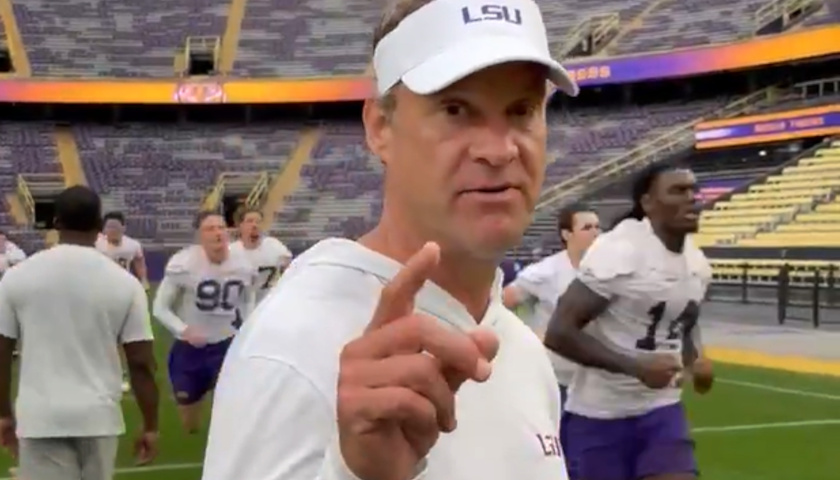
Image “Lane Kiffin” by Lane Kiffin.