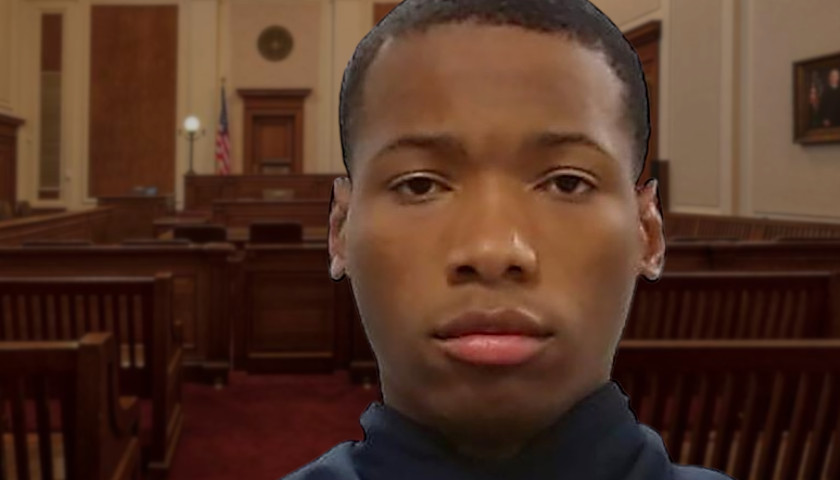
Judson Phillips, Tea Party Nation founder and former Tennessee assistant district attorney, offered a detailed legal analysis Wednesday of the murder conviction and sentencing of Karmelo Anthony, the Texas teenager found guilty of fatally stabbing 17-year-old Austin Metcalf during a high school track meet in 2025.
Speaking on The Michael Patrick Leahy Show, Phillips explained why he believed the jury reached its verdict quickly and why the defense strategy was focused less on acquittal than on reducing potential punishment.
Anthony was convicted of murder and sentenced to 35 years in prison by a Texas jury on Tuesday.
Phillips noted that Texas is among the states that still allow juries to determine both guilt and punishment.
“Texas is one of the few states that retains jury sentencing,” Phillips said. “The juries would determine both guilt and innocence … and the sentence.”
Addressing the jury’s relatively short deliberations, Phillips argued that the self-defense claim simplified the legal questions before jurors.
“When you have a defense, you’re basically admitting pretty much all the facts of the case,” Phillips said. “That you were there, that the victim was killed, your action killed the victim. The only thing for the jury to decide is one singular issue: Was it justified? Was this guy enough of a threat to you to justify the use of deadly force?”
“So that was a really easy decision for the jury to make,” he added.
Phillips also discussed what he believed was the defense team’s strategy. Rather than expecting a complete acquittal, he said the attorneys likely sought to persuade jurors toward a lesser offense.
“Most folks think when you’re a defense lawyer and you’re trying your case, your goal is an acquittal. That’s not true,” Phillips said. “In this case, I can guarantee you that was not the strategy.”
According to Phillips, the defense attempted to “humanize” Anthony before the jury and sought an instruction on criminally negligent homicide, a charge carrying a substantially lower sentencing range than murder.
“What they wanted to do was they were hoping that the jury would fracture a bit,” Phillips said. “And then you try to get what’s called a compromise verdict.”
The jury ultimately rejected that approach and convicted Anthony of murder.
While Phillips said the conviction was a clear victory for prosecutors, he viewed the 35-year sentence as a partial success for the defense.
“The jury convicted on murder one, and then what got really interesting, the part that I think where the prosecution did screw up, and I consider this something of a win for the defense, is he only got 35 years,” Phillips said.
Phillips questioned why prosecutors did not present victim-impact testimony during the sentencing phase.
“If I were prosecuting that case, witness number one would’ve been this poor kid’s mother,” he said. “Then I would’ve brought the brother on, the twin brother.”
He suggested such testimony could have strengthened the case for a harsher sentence.
Instead, Phillips noted, the defense called Anthony’s mother, who pleaded for the jury to have “mercy” on her son.
“When the defense got up there, they put the mama up there and she’s going, ‘Please have mercy on my baby,'” Phillips said. “And clearly that carried some weight with the jury.”
Phillips explained that Anthony faced a sentencing range of “10 to 99 years or life” and speculated that jurors likely reached a compromise after debating a wide range of possible punishments.
“My guess is you probably had a few folks who said, ‘Oh, we wanna give him life. We wanna give him 99,'” Phillips said. “And there’s probably a few folks that said, ‘No, we wanna just give him the minimum of 10 years.'”
“And they argued for a little while and then eventually compromised and said, ‘Okay, can we all agree on 35 years?'”
Phillips also discussed Anthony’s future prospects under Texas law, noting that parole eligibility could be available after approximately half of the sentence is served.
“He could get out in 17 and a half years,” Phillips said. “That’s the minimum he has to serve.”
However, Phillips emphasized that parole would not be automatic.
“When this halfway period hits 17 and a half years, then he’s eligible for parole,” he said. “That decision on whether he’s gonna be released or not is up to the parole board.”
Phillips also dismissed the likelihood of a successful appeal based on jury selection issues, noting that prosecutors provided race-neutral reasons for striking several prospective jurors.
“The only issue I can see on appeal, three black jurors were excused,” Phillips said while adding that the prosecutor’s explanation that they were school employees was accepted by the judge as race-neutral.
Asked whether such an appeal would succeed, Phillips replied, “I don’t think it’s gonna go anywhere.”
Tune in now to The Michael Patrick Leahy Show – your AMERICA FIRST news talk!
– Watch LIVE here on X
– Watch LIVE on YouTube / Rumble / Roku / AppleTV
– Listen on Spotify
– Listen on WENO AM760 in Nashville
– Read more at @TheTNStar https://t.co/onPIkDfvm0— Michael Patrick Leahy (@michaelpleahy) June 10, 2026
– – –
Kaitlin Housler is a reporter at The Tennessee Star and The Star News Network.