
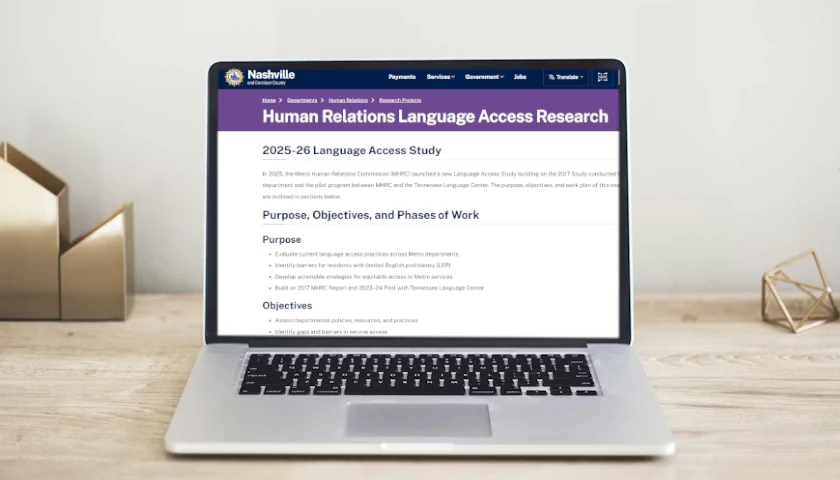
Metro Nashville this week began conducting a “language access survey” to determine how the city’s government agencies interact with non-English speaking residents, polling residents in a total of 10 languages, including three dialects of Kurdish.
Building off a 2017 study that found 73 percent of Metro departments report encountering residents who speak at least one foreign language, the 2025 Language Access Study seeks to examine “current language access practices” throughout the city, determine existing “barriers” to non-English speaking residents living in the city, and then create “actionable strategies for equitable access to Metro services.”
Objectives include learning how different Metro agencies currently handle engagement with non-English speakers, “[i]dentify gaps and barriers in service access,” then find “practical, scaleable improvements for compliance and efficiency,” while strengthening “interdepartmental coordination and digital inclusion.”
In addition to English, the survey is available in Spanish, Arabic, Somali, Tagalog, Burmese, Chinese, Nepali, Vietnamese, and the Sorani, Bahdini, and Kurmanji dialects of Kurdish.
The city’s 2017 study found that Metro departments encountered most of these languages, with Spanish the most common, reported by 73 percent of Metro departments and 86 percent of extensions.
Arabic was the second-most-commonly encountered language, with 40 percent of departments and 43 percent of extension services reporting they served residents who speak it. Kurdish, which the University of Arizona reports is spoken by about 30-40 million people worldwide, was reported by 35 percent of departments and 29 percent of extensions.
Somali was reported by 23 percent of departments and 11.4 percent of extensions; Burmese by 15 percent of departments and 6 percent of extensions; and Vietnamese by 13 percent of departments and 3 percent of extensions.
The study will be completed by the Metro Human Relations Commission (MHRC), which was created to “protect and promote the personal safety, health, security, peace, and general welfare of all people in Nashville and Davidson County,” and educates the public “to promote a better understanding between groups, cultures, and ideologies.”
According to its website, MHRC speaks on behalf of “segments of our society that have often been unheard and left out of our civil discourse and decisions.”
MHRC board members are appointed by Mayor Freddie O’Connell, who successfully obtained funding for the initiative in the 2025-2026 fiscal year. At a December Metro Council meeting, it was reportedly determined that existing translation service contracts amount to about $10 million.
Polling released last year found 96 percent of registered voters in the United States said it was important for immigrants to learn English, with the majority also supporting President Donald Trump’s efforts to establish English as the nation’s official language.
– – –
Tom Pappert is a 2025 recipient of the Dao Prize and the lead reporter for The Tennessee Star. He also reports for the Star News Network. Follow Tom on X. Email tips to [email protected].
Like any other country in the world, you want to move here, learn the language. Period.
The last time I was in Nashville, I took a Taxi, and it reminded me of New York – the driver didn’t speak English and didn’t know where he was going.
ALL government correspondence should be in English. It should be the responsibility of the non-English-speaking person to bring an interpreter- not the government’s.
They must learn English to assimilate properly. Of course, many, if not most, of them are not interested in assimilation but for handouts and a better life while maintaining their native land culture. Bad stuff.
I would bet most these people here illegally and it should not be up to our government at any level to teach them our language. that should be on their own dollar and if they’re illegal they need to be immediately. deported. do you think if you go to France or Germany they’re going to teach you their language, I don’t think so.