
by Harold Hutchison
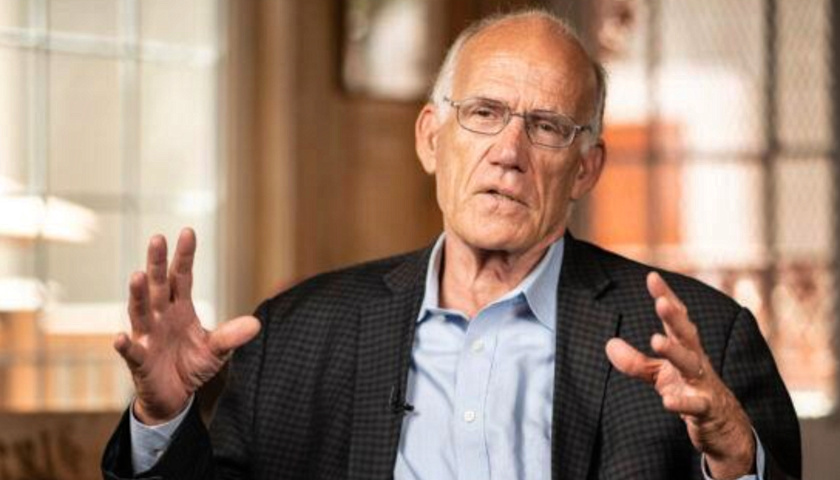
Hoover Institution senior fellow Victor Davis Hanson told Sirius XM host Megyn Kelly Wednesday he was dealing with a heart condition as a result of his battle with lung cancer.
Hanson, 72, gave Kelly the update during “The Megyn Kelly Show” about the heart condition he was dealing with due to a complication he suffered during an operation in late December, 2025, to remove a lung tumor.
“The biggest problem I’m doing having now is with the heart, because when I walk, I’m trying to build up my heart and I never know when it’ll go from 70 to 120 or something and then I’m out of breath,” Hanson explained. “I have to stop quick and but it’s not a-fib, that stopped. But it’s called episodic tachycardia, and they think it’s just the trauma of the pulmonary artery being cut and the losing all that blood and then the anemia and dehydration. I lost 60% of my blood volume. So that was pretty scary.”
 Hanson told Kelly that one major frustration with his heart issues was that he was unable to do any work on the farm.
Medical literature shows irregular heartbeat patterns called ‘supraventricular arrhythmias’ and ‘tachycardia’ occur in 10-30 percent of lung resection patients, often linked to surgical trauma, inflammation, anemia, dehydration, or disruption around major vessels.
Episodic tachycardia is a known complication following major thoracic surgery, particularly when the procedure involves the pulmonary artery or significant blood loss, such as in Hanson’s case.
“What are they saying the prognosis is? What does the future hold for you?” Kelly asked Hanson.
Hanson responded by giving Kelly some details about the type of cancer doctors diagnosed.
“The prognosis is that it’s called KRAS G12R mutation and that’s bad… I had it for about two years apparently when I had my collapsed lung and then at some point it mutated and there’s a disagreement [about whether] the mass was the size of a softball, but the interior was the size of a golf ball, the cancer,” Hanson told Kelly. “So some oncologists say, well, it must have spread all through that in stage four. And other oncologists say, ‘No, no, it it was an encapsulated tumor at stage one.’”
The relatively uncommon variant of the KRAS gene alteration found in roughly 10-15 percent of KRAS-mutant non-small cell lung cancers, meaning cancers that create tumors. KRAS mutations in general are associated with more aggressive behavior and historically poorer responses to traditional therapies, though G12R has shown somewhat more favorable outcomes in some studies compared to other subtypes like G12D or G12V.
“And then the good news is, even though it’s a very deadly mutation and it was in the airways, it wasn’t in the lymph nodes and it wasn’t in the lung lining,” Hanson continued, adding that he was undergoing blood biopsies every 120 days and that each negative test meant there was a lower chance of recurrence.
In a February 2 post on X, Hanson said that that there was a 40 percent chance of recurrence, which would be “untreatable.”
– – –
Harold Hutchison is a reporter at Daily Caller News Foundation. Executive Editor of The Tennessee Star and The Star News Network Christina Botteri contributed to this report.
Image “Victor Davis Hanson” by Victor Davis Hanson.