
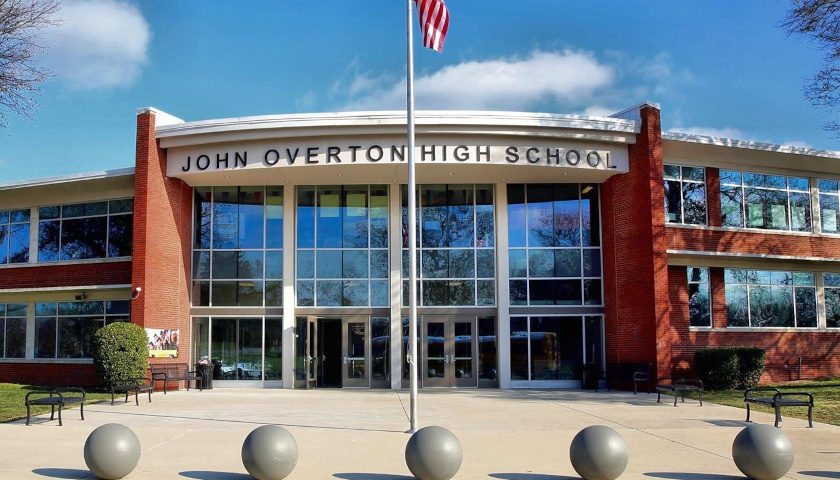
A Tuesday report released by the Nashville Banner described a series of actions taken at John Overton High School to accommodate students during the Muslim holy month of Ramadan, during which the observant do not eat or drink during daylight hours.
According to The Banner, the school marked the Muslim holy month by allowing more than 80 students to leave class to attend prayers for 15 minutes daily, creating a program where 10 teachers agreed to keep food out of their classrooms as students fasted during the day, changing the lighting in at least one classroom, and holding its “second annual iftar,” which is traditionally when Muslims break their fast at sunset.
The outlet notably reported that the “food-free zone” sign-up sheet was created by Jenna Hagengruber, the director of activities at Overton High School. One participating teacher, Revas Barwari, also reportedly increased the amount of light in her classroom for the duration of the Muslim holy month, citing concerns that observant students would struggle to focus after waking up at 4:30 a.m. to eat an early breakfast.
The high school’s cafeteria additionally hosted its “second annual iftar,” which the outlet reported was arranged by the Muslim Student Association (MSA) and decorated with the help of the Student Government Association (SGA). It ultimately included balloons, activities, and signs emblazoned, “Ramadan Mubarak” and “Ramadan Kareem,” as well as Islamic symbols.
Hagengruber was reported by The Banner to lead the SGA, but told the outlet that the MSA president, a student at Overton High School, should receive credit for the iftar event.
In addition to creating the sign-up sheet for teachers to offer ‘food-free zones’ during lunch and helping coordinate SGA decorations for the iftar, Hagengruber also created a sign-up sheet for students to receive electronic hall passes for prayer.
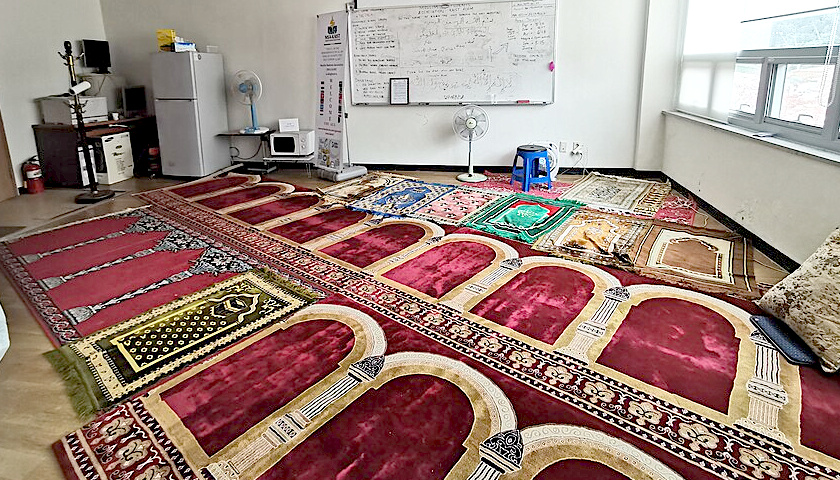
These prayers occurred at a reserved space on campus, according to the outlet, which said more than 80 students requested permission to attend.
Another Metro Nashville Public Schools (MNPS) support staff member, Al-Nadir Muhammad, was reportedly charged with “overseeing the daily prayer,” while Hagengruber told the outlet that attendance was a privilege that could be revoked.
“If they’re making bad choices behaviorally or lying about going to pray … it’s a privilege too, you know?” Hagengruber reportedly told The Banner. “We want to give them time every single day to pray during class, but also if they’re failing their classes, there needs to be accountability.”
Though a MNPS spokesman reportedly clarified no schedule was actually changed, Barwari told the outlet of the prayer meetings, “What school do you know that actually changes their whole bell schedule to work around students being able to go pray?”
MNPS also told The Banner that the school’s Ramadan events were student-led, including through the SGA and MSA, and that similar accommodations would be considered if made by students of other faiths.
The Tennessee Star contacted MNPS Chief of Communication and Technology Sean Braisted to clarify the school’s Ramadan accommodations, including the extent of faculty involvement with the reportedly student-led events, and whether its accommodations to Muslim students were reviewed for compliance with U.S. Department of Education policy by legal counsel, but did not receive a response prior to press time.
The U.S. Department of Education’s Guidance on Constitutionally Protected Prayer and Religious Expression, updated February 5, 2026 under the Trump administration, states that schools must remain neutral, and accordingly cannot sponsor prayer, show preference for one religion, allow religious observation while denying similar requests, or excuse students from class for prayer if such events impede the education of other students. Public schools must annually certify their compliance with the guidance in order to receive federal education funding.
As a member of the school’s support staff oversaw the prayer meetings, and the director of activities described attendance as a privilege that could be revoked, the article could reflect faculty involvement that runs afoul of the prohibition on school sponsorship.
Details described by The Banner could raise questions about whether certain elements fall within the guidance, or cross from permitted student religious exercise into school sponsorship or preferential treatment. These include the school’s staff-created sign-up sheets, use of its electronic pass system, reservation of space for 80 students, staff and faculty participation, and use of space for the iftar event.
The federal guidance is the product of more than six decades of litigation over permissible religious expression in schools, including the landmark 1962 decision by the U.S. Supreme Court in Engel v. Vitale, which found that schools cannot compose or lead official prayers, determining such prayers a violation of the First Amendment’s Establishment Clause.
In its 1963 decision in Abington School District v. Schempp, the court similarly determined school-sponsored Bible readings and prayers violated the Establishment Clause.
While the directions of the high court’s decisions on the topic were consistent as recently as 2000, when the high court ruled against allowing student-led prayer over school loudspeakers in Santa Fe Independent School District v. Doe, the current court appears more interested in preserving religious expression.
In 2022, the Supreme Court determined in Kennedy v. Bremerton School District that schools cannot suppress private religious expression due to concerns it will be interpreted as a school endorsement, and last year, the high court sided with parents in Mahmoud v. Taylor, which challenged a school policy prohibiting students from opting out of LGBTQ+ curriculum based on their religious views.
U.S. Representative Andy Ogles (R-TN-05), who recently said he called for all Muslims to be deported from the United States to advance a Republican immigration agenda, questioned the practice in a Wednesday post to X.
“John Overton High School is changing its entire bell schedule, creating specialized cafeterias, and hosting Ramadan dinners on its campus to cater to Muslims in my district,” wrote Ogles. “MNPS teachers are providing prayer rugs for students. Meanwhile, Christians have seen every trace of their religion erased from American education.”
This year, Ramadan occurred from February 17 until March 18.
– – –
Tom Pappert is a 2025 recipient of the Dao Prize and the lead reporter for The Tennessee Star. He also reports for the Star News Network. Follow Tom on X. Email tips to [email protected].
Photo “Muslim Prayer Room” by AhmedAlElq CC4.0.



Total BS.
Yes it is and it needs to be cut off before America comes like Britain and France.
That should immediately stop and there should be no special treatment for them. I would fire the teachers and administrators who allow this crap to go on. What to do for one group you have to do for all of them and they don’t do that.
The cancer is spreading. Special treatment for muslims. Do the schools do the same for Christians? Hindus? Jews?
Get serious.
I have never seen a school do anything special for Catholics on Fridays.