Oregon attorneys represented by the Goldwater Institute filed a petition for certiorari with the Supreme Court last week requesting consideration of their lawsuit challenging the constitutionality of mandatory bar associations for attorneys. Crowe v. Oregon State Bar originated after the Supreme Court ruled in 2018 in Janus v. AFSCME that public-sector unions cannot require non-members to pay fees to support union activities. Attorneys Daniel Crowe, Lawrence Peterson, and the Oregon Civil Liberties Attorneys filed the lawsuit in 2018, asserting violations of free speech and freedom of association.
The lawsuit has wound its way twice up the courts through appeals. The case arose after the bar published a statement in its magazine claiming that President Donald Trump promoted white nationalism. The plaintiffs argued that the statement was non-germane to the bar’s regulatory purpose, constituted compelled political speech, and infringed on their freedom of association by forcing them to be members of an organization engaging in ideological activities they disagreed with.
Magistrate Judge Jolie Russo first dismissed the lawsuit, then U.S. District Judge Michael Simon, an Obama appointee, agreed and affirmed the dismissal in 2019. He said the statements were “germane to improving the quality of legal services,” promoting access to justice and a fair judicial system.
A panel of three judges for the Ninth Circuit Court of Appeals, all appointed by President Barack Obama, affirmed the lower judges’ decision in part and reversed in part in 2021, and remanded the case back to the trial court. U.S. Circuit Judge Michelle T. Friedland wrote the opinion, joined by U.S. Circuit Judge John B. Owens and Senior U.S. District Judge William H. Orrick, sitting by designation from the Northern District of California.
The judges found Crowe’s accusation valid that the Oregon bar violated his constitutional rights by accusing Trump in the bar’s magazine of catering to white nationalists. The court said the infringement on Crowe’s freedom of association did not survive exacting scrutiny because the communications were not related to the Bar’s regulatory purpose.
The lengthy statement was placed in the magazine with the bar’s logo next to it and signed by six of the bar’s officers, including the president and chief executive officer. It condemned the 2017 Unite the Right in Charlottesville where a man was killed and other incidents, and the “systemic failure to address speech that incites violence.”
A second statement next to it, which was signed by several voluntary bar associations, specifically denounced Trump. Among other claims about Trump, it alleged, “President Donald Trump, as the leader of our nation, has himself catered to this white nationalist movement, allowing it to make up the base of his support and providing it a false sense of legitimacy.”
The panel stated that since the statement was presented with a reference to a “unified bar,” not just the bar leadership, it implied that it represented all attorneys who were members of the bar.
The court held that the bar is an arm of the state, and while sovereign immunity protects the bar from the lawsuit, it doesn’t protect its officers. “Specifically, the formatting and content of the two statements made it appear as though OSB essentially adopted the Specialty Bars’ statement.”
Afterwards, the plaintiffs applied for certiorari with the Supreme Court, which was denied in May 2021. Remanded to the trial court, Simon found that a single non-germane statement — the voluntary bar associations’ statement referencing Trump — did not meet the threshold for a constitutional violation, so he granted the defendants’ motion for summary judgment to dismiss the case. He said the bar’s statement did not contain inherently partisan or political viewpoints.
Crowe appealed again and was assigned a different panel of judges who came to a different conclusion.
The second Ninth Circuit panel was composed of Circuit Judges Jay Bybee, Lawrence VanDyke, and District Judge Kathleen Cardone, all appointed to the bench by Republican presidents. They issued their opinion in 2024. They found that the bar was not an arm of the state entitled to sovereign immunity. They dismissed the free speech claim, but held that the district court erred by dismissing plaintiffs’ free association claim as barred by precedent, stating that the issue was a new one not yet considered by a court.
The judges said the free speech claim was foreclosed by Keller v. State Bar of California, a 1990 case which found that mandatory bar dues are allowed for germane activities, and that the bar’s refund process was adequate. However, they said the freedom of association claim was not resolved by Keller or Lathrop v. Donohue, which held that state bars may be compulsory, as neither case directly addressed a broad challenge to mandatory bar membership itself. ““Lathrop’s ‘free association’ decision was limited to ‘compelled financial support of group activities’”; it did not address “‘involuntary membership in any other aspect,’” they said.
The case was remanded back to the district court to evaluate whether the bar’s activities were non-germane and rose to a constitutional violation.
If the Supreme Court accepts the case, it will likely resolve a split between circuit courts. Unlike the Ninth Circuit Court of Appeals, the Fifth Circuit Court of Appeals has held in cases like McDonald v. Longley and Boudreaux v. Louisiana State Bar Association that compulsory bar membership engaging in non-germane speech violates the First Amendment.
– – –
Rachel Alexander is a reporter at The Arizona Sun Times and The Star News Network. Follow Rachel on Twitter / X. Email tips to [email protected].
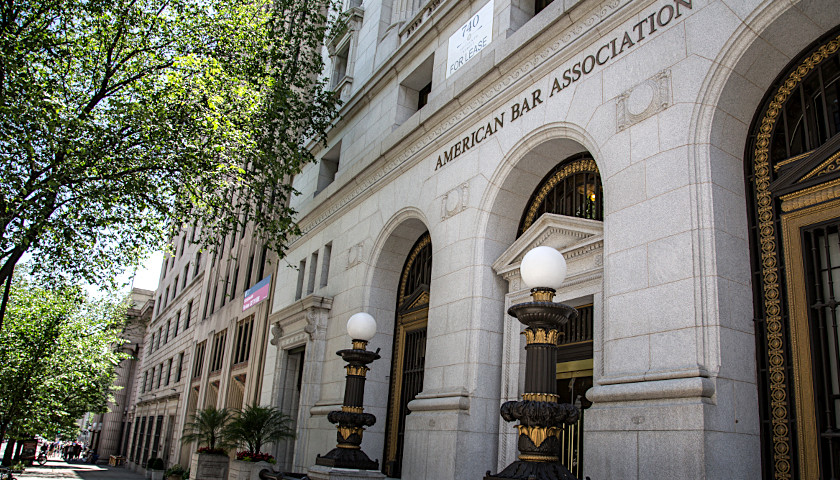
Photo “American Bar Association” by Tony Webster CC2.0.