
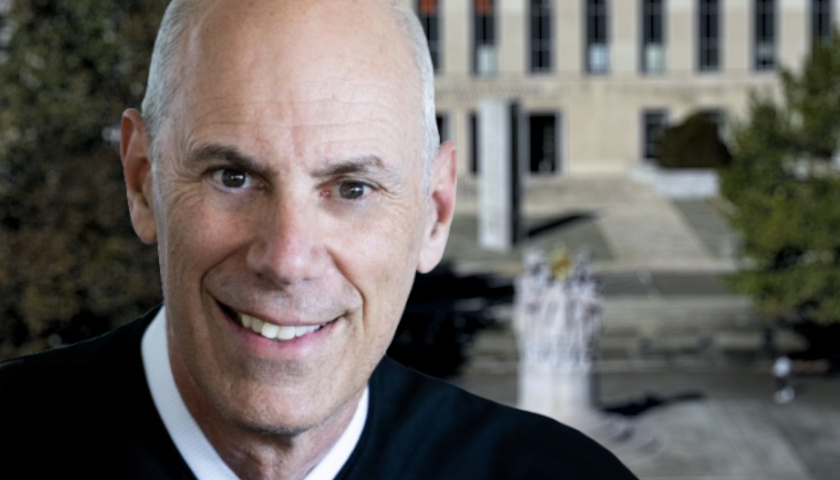
On May 25, 2023, Chief Judge James Boasberg of the U.S. District Court for the District of Columbia issued a court order to Verizon forbidding the company from informing Sen. Marsha Blackburn (R-TN) for one year that he had signed a subpoena requiring them to turn over metadata and toll-record information from the senator’s account with the company to a grand jury convened as part of the Biden administration’s Operation Arctic Frost.
Judge Boasberg’s gag order was an illegal violation of a federal statute (the Stored Communications Act), the Speech and Debate Clause of the Constitution, the Separation of Powers doctrine of the Constitution, as well as Sen. Blackburn’s First Amendment free speech rights, Fourth Amendment protection from illegal search and seizure rights, and Fifth Amendment due process rights. The issuance of this illegal gag order is grounds for Boasberg’s impeachment by the U.S. House of Representatives.
Fifteen federal judges have been impeached by the U.S. House of Representatives in the history of our republic. Eight of those judges have been convicted by the U.S. Senate and removed from office. Four have been tried in the Senate and acquitted. Three resigned before their trials were conducted in the Senate.
One of those fifteen impeached judges, Federal District Court Judge for Eastern Illinois George English, was impeached in 1926 on five charges, including “Tyranny and oppression, and abuse of the powers of his office,” “Improper and unlawful conduct in connection with a ‘bankruptcy ring’ operating in his district,” and “A general course of conduct constituting misbehavior and misdemeanor in office.”
Evidence of Judge English’s abuse of the powers of his office included his issuance of an illegal court order that imprisoned a litigant before him, Harry Crawford, for one year on charges of contempt of court. Crawford’s alleged crime was criticizing Judge English for his conduct on the bench in a receivership case in which Crawford was before the court. Crawford served several months in prison before the Court of Appeals ordered his release in the famous case Crawford v. United States (7th Circuit, 1924).
The Appeals Court found that Judge English violated Crawford’s due process rights:
The contempt proceeding grew out of a bankruptcy matter pending before Judge English in the Eastern district of Illinois, in which one Frank W. Cline was adjudged a bankrupt. Crawford was attorney for certain creditors. The order of adjudication was entered August 25, 1923. On September 4th following, Judge English made an order fixing the time for the first meeting of creditors, and directing that the trustee qualify and take possession of the bankrupt’s property.
On September 8th Crawford wrote a letter to Judge English, which is set forth in full in the opinion of the District Court. It is a severe arraignment of Judge English for the course pursued by him in the Cline bankruptcy proceeding. It charges the judge with acting “arbitrarily and unjustly,” and with “great prejudice” against the creditors whom Crawford represented, and with “favoring the bankrupt.” The letter closes with this statement: “I am writing this letter to you, not because I have any hope that you will change your mind, but as a matter of record, so that the higher courts of this land may know the manner in which Judge George W. English conducts his court.”
The receipt of this letter was acknowledged by Judge English, who at once caused an order to be entered finding Crawford guilty of contempt of court, and sentencing him to imprisonment for one year. No citation was served upon Crawford, and no notice was given to him of the pendency of the contempt proceeding. He was arrested upon a bench warrant issued upon this order, and was taken into custody by the marshal…
The order finding Crawford guilty of contempt was made without notice to him, and without giving him an opportunity to be heard. Even if the letter had constituted a contempt, he was entitled to notice and an opportunity to be heard before he could be summarily punished. (emphasis added)
Subsequent to Crawford’s release, an investigative reporter for The St. Louis Post-Dispatch, John T. Rogers, wrote a number of stories that documented in detail a litany of abuses of power by Judge English. Those stories caught the attention of Rep. George Graham (R-PA), the Chairman of the House Judiciary Committee, who began an impeachment inquiry. (For his reporting on Judge English, John T. Rogers won the 1927 Pulitzer Prize.)
The House of Representatives ultimately impeached Judge English in a 306 to 62 vote on April 1, 1926. Judge English resigned from the bench before the Senate was scheduled to conduct his trial later that year.
A full century after Federal District Court Judge English issued the illegal contempt of court order that led to his impeachment, Federal District Court Judge James Boasberg issued a similarly illegal court order that will lead to his impeachment.
In April 2022, the Biden-era Federal Bureau of Investigation opened the investigation dubbed “Arctic Frost,” focused initially on alleged election-interference schemes relating to the 2020 presidential election and later expanded to include hundreds of subpoenas targeting Republican individuals and organizations.
On May 25, 2023, Judge Boasberg signed a gag order issued to Verizon that accompanied a grand jury subpoena from Special Counsel Jack Smith for phone records of several Republican U.S. Senators. (Similar subpoenas were sent to AT&T.) Boasberg’s order included this language:
This matter having come before the Court pursuant to an application under 18 U.S.C. § 2705(b) requesting an order directing Verizon (“PROVIDER”), an electronic communication and/or remote computing service provider located in Bedminster, NJ, not to notify any other person of the existence of subpoena number GJ20230524-E0361 issued by the United States on behalf of a federal Grand Jury empaneled in the United States District Court for the District of Columbia (the “Subpoena”), the Court finds reasonable grounds to believe that such disclosure will result in destruction of or tampering with evidence, intimidation of potential witnesses, and serious jeopardy to the investigation. See 18 U.S.C. § 2705(b)(3)-(5).
IT IS THEREFORE ORDERED that, pursuant to 18 U.S.C. § 2705(b), PROVIDER and its employees shall not disclose the existence of the Subpoena to any other person (except attorneys for PROVIDER for the purpose of receiving legal advice) for a period of one year (commencing on the date of this Order), unless the period of nondisclosure is later modified by the Court.
(Emphasis added)
At the October 29, 2025 press conference when Sen. Charles Grassley (R-IA) released these subpoenas and the gag order, Sen. Blackburn called the surveillance “illegal” and demanded a “reckoning” for telecommunications firms that cooperated with the subpoenas.
At that same press conference, Sen. Ted Cruz (R-TX) called on the House of Representatives to impeach Judge Boasberg, as The New York Post reported:
The order was signed by US District Court Chief Judge James Boasberg and barred the cell carrier [AT&T] from letting Cruz know about the request “for at least one year,” he said.
The Texas Republican and others called for Boasberg’s impeachment in the House, with Cruz claiming the judge was “abusing his power” by asserting in the order there were “reasonable grounds to believe that such disclosure will result in destruction of or tampering with evidence, intimidation of potential witnesses and serious jeopardy to the investigation.”
“We don’t know that for a fact, but I feel confident that he concluded it’s likely that Lindsey Graham would destroy evidence and Marsha Blackburn would destroy evidence, and Eric Schmitt would destroy evidence, and Chuck Grassley would destroy evidence,” Cruz went on.
Cruz focused on this specific language from Boasberg’s gag order: “the Court finds reasonable grounds to believe that such disclosure will result in destruction of or tampering with evidence, intimidation of potential witnesses, and serious jeopardy to the investigation.”
“If a judge signs an order reaching a factual conclusion for which there is zero evidence whatsoever, that judge is abusing his power. I am right now calling on the House of Representatives to impeach Judge Boasberg,” Cruz said.
Legal experts note that the phrase “reasonable grounds” has a defined and limited meaning under U.S. law. It represents a specific evidentiary threshold — lower than probable cause but higher than a mere hunch. Courts have long held that such a finding must rest on specific, articulable facts that would lead a reasonable person to infer that unlawful activity might occur. The standard is objective, not subjective: a judge or officer must be able to point to concrete observations or information, not conjecture or general suspicion.
As Sen. Cruz pointed out, in the case of his illegal gag order, Judge Boasberg had “zero evidence” –no specific, articulable facts–to support his assertion there were “reasonable grounds” that the nine Republican U.S. senators whose cell phone providers were subpoenaed would destroy or tamper with evidence and intimidate potential witnesses.
In practical terms, the “reasonable grounds” Boasberg invoked in his order to Verizon would have required the government to present specific and articulable evidence — such as documented threats of witness tampering, prior destruction of evidence, or credible intelligence — demonstrating that notifying the senators would jeopardize the investigation. The record, however, shows no such factual basis.
Boasberg’s conclusion that disclosure would result in “destruction of or tampering with evidence” lacked the evidentiary foundation that the “reasonable grounds” standard demands. By asserting the existence of facts for which no proof was presented, Boasberg likely crossed the line from judicial discretion into abuse of judicial power, echoing the same type of overreach that led to Judge George English’s impeachment a century earlier.
The foundational concept of “due process” has been in the news a great deal of late, often in regards to the “due process rights” of illegal aliens who are subject to final deportation orders. It is the ultimate irony of American life in 2025 that the regime media–and many federal district judges–have repeatedly demonstrated great concern for the due process rights of illegal aliens, but, in the case of at least one federal district judge, absolutely no concern for the due process rights of nine Republican U.S. senators.
Under the Fifth Amendment, no person may be deprived of life, liberty, or property “without due process of law.” For a federal judge, this requirement creates an affirmative duty: before authorizing an intrusive government action — such as a secret subpoena or nondisclosure order — the court must ensure that the target receives notice, an opportunity to challenge the request, and a meaningful record on which appellate review can rest. Exceptions to notice, such as in national-security or grand-jury matters, must be narrowly tailored and supported by specific, on-the-record findings. The Stored Communications Act itself requires a judge to find clear, factual justification before issuing a gag order, and to revisit or lift that order when the justification no longer exists.
In this case, Judge Boasberg appears to have bypassed those procedural safeguards. He issued a court order affecting sitting U.S. senators, denied them any opportunity to contest the subpoena, and sealed the proceeding for a full year — without articulating verifiable evidence that disclosure would endanger the investigation. By doing so, he deprived the affected parties–nine Republican U.S. Senators including Sen. Blackburn and Sen. Cruz– of their statutory and constitutional right to due process.
As was the case with the impeached Judge George English a century earlier, Judge Boasberg has engaged in a litany of abuses of the powers of his office, all of which demonstrate a political bias against the Trump administration. In addition to Boasberg’s grant of gag orders and grand-jury subpoenas for phone records tied to the Arctic Frost investigation, his cases and rulings involving the Trump administration include:
Mar 15, 2025 — Temporary Restraining Order blocking deportations under the Alien Enemies Act (J.G.G. v. Trump).
Boasberg issued a TRO halting the administration’s use of the 1798 Alien Enemies Act to remove certain Venezuelan nationals, saying the invocation raised “serious and novel” legal questions and required a hearing.
Mar 20, 2025 — Order demanding detailed government explanations about deportation flights.
After aircraft carrying detainees left U.S. airspace, Boasberg blasted the government’s responses as “woefully insufficient” and ordered precise timing and chain-of-command information to determine compliance with his earlier order.
Mar 27, 2025 — Preservation order for Signal group-chat messages (American Oversight v. Hegseth).
In litigation over officials’ use of auto-deleting Signal messages about a Yemen operation, Boasberg ordered agencies to preserve Signal communications from March 11–15 and to submit declarations about preservation steps.
Apr 16, 2025 — Finding “probable cause” to hold the government in criminal contempt for violating the Alien Enemies TRO.
Boasberg concluded there was probable cause that officials willfully disregarded his order when deportation flights proceeded, opening the door to contempt proceedings. That contempt finding was later appealed.
Aug 8, 2025 — D.C. Circuit vacated Boasberg’s contempt finding (appeal).
A three-judge D.C. Circuit panel overturned the contempt finding, concluding Boasberg had overreached and intruded on executive foreign-affairs authority; the panel remanded certain issues back to the district court.
James Emanuel “Jeb” Boasberg was born in 1963 in San Francisco, California. He graduated magna cum laude with a B.A. in history from Yale College in 1985, obtained a “Master of Studies” degree from Oxford University in 1986, and a J.D. from Yale Law School in 1990. After graduation, Boasberg clerked for Judge Dorothy Wright Nelson on the Ninth Circuit (1990-91) and spent five years in private practice. In 1996, he joined the U.S. Attorney’s Office for the District of Columbia and specialized in homicide prosecutions.
In 2002, President George W. Bush appointed him to the D.C. Superior Court; in 2011, President Barack Obama nominated him to the U.S. District Court for the District of Columbia, and he was confirmed 96-0.
From 2014 to 2021 Boasberg served on the Foreign Intelligence Surveillance Court, including as presiding judge from 2020-2021.
On March 17, 2023, he became Chief Judge of the D.C. District Court.
Should impeachment proceedings prove successful, he would be the 16th federal judge in United States history to be removed from the bench.
– – –
Michael Patrick Leahy is the founder and CEO of the Star News Network, which includes The Tennessee Star. Follow Leahy on X at @michaelpleahy.
Photo “Judge James ‘Jeb’ Boasberg” by DC Courts and “Prettyman Court House” is by Toohool CC3.0




Thank you Tennessee Star for accurately reporting on democrat activist judges like James Boasberg who ignore Constitutional law for political purposes.
I believe Isaiah 5:20 refers to this problem.