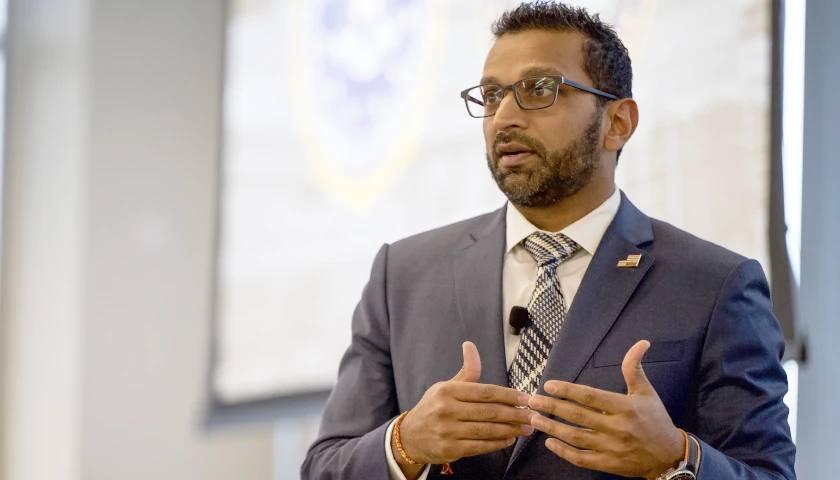
The litigation between FBI Director Kash Patel and The Atlantic, which published an article claiming Patel has a serious drinking problem that impacts his job performance, raises a number of questions about the outlet’s editorial policies, as well as the legal footing for the lawsuit, which the nation’s top law enforcement officer has called a “legal lay up.”
The Atlantic published its high-impact article last week, alleging Patel alarms colleagues with his “episodes of excessive drinking and unexplained absences,” citing information provided by more than 24 anonymous sources. The outlet also included specific allegations, including that Patel allegedly became visibly intoxicated at a private club in Washington, D.C., and a members-only establishment in Las Vegas, Nevada.
However, according to Patel and his legal team, the magazine did not acknowledge or respond to a detailed letter, sent by his attorneys before the article was published, which claims to have refuted 19 allegations contained in the article, and requested more time to provide a more thorough response.
According to the lawsuit, The Atlantic “did not even respond to the Pre-Publication Letter.”
Patel alleges, “They did not acknowledge the publicly available counter-evidence identified therein. They did not retract or modify the false statements identified. They made no meaningful response at all. They simply ignored the Pre-Publication Letter and published the false claims a few hours later.”
The existence of the letter could be important to the lawsuit, as the standard for defamation of a public figure was set in the 1964 U.S. Supreme Court decision in New York Times Co. v. Sullivan.
In his majority opinion for that case, Justice William Brennan wrote, “The constitutional guarantees require, we think, a federal rule that prohibits a public official from recovering damages for a defamatory falsehood relating to his official conduct unless he proves that the statement was made with ‘actual malice’ – that is, with knowledge that it was false or with reckless disregard of whether it was false or not.”
While the standard for a public figure to prove actual malice is high, The Atlantic‘s failure to cite or investigate the errors of fact detailed in Patel’s letter could provide evidence the claims made in The Atlantic‘s article demonstrated “reckless disregard of whether it was false or not.” In addition, if the director’s suit survives the likely motion for summary judgment, he could be empowered to pore through the outlet’s private communications, as the U.S. Supreme Court’s 1979 decision in Herbert v. Lando specifically determined, “internal communications occurring during the editorial process,” are not protected by the First Amendment.
A decade later, the high court further held in Harte-Hanks Communications v. Connaughton that public figures can establish a libel claim if publishers act with “reckless disregard” for the accuracy of their reporting, which constitutes “actual malice” to meet the conditions set by the court in New York Times Co. v. Sullivan.
In addition to the legal ground, the use of more than two dozen anonymous sources in the article about Patel appears to contradict the advice of most style guides, which caution against using information from sources that do not want their identities published.
The Society of Professional Journalists (SPJ) urges reporters, “Consider sources’ motives before promising anonymity,” and advises reserving such commitments “for sources who may face danger, retribution, or harm, and have information that cannot be obtained elsewhere.” Under such circumstances, journalists should explain their decision to grant anonymity in their reporting.
National Public Radio (NPR) has similarly published a specific web page explaining its stance on anonymity, establishing that anonymous sources “should rarely be heard at all and should never be heard attacking or praising others in our reports,” with exceptions reserved for whistleblowers and those making allegations of sexual assault.
A 2016 letter from top editorial staff at The New York Times appears to reveal that industry-wide conversations about the use of anonymous sources have been ongoing for over a decade.
“The use of anonymous sources is sometimes crucial to our journalistic mission. But it also puts a strain on our most valuable and delicate asset: our trust with readers,” the editors of The Times wrote in March 2016.
Noting that anonymity sometimes results in good reporting, the editors added, “In other cases, readers question whether anonymity allows unnamed people to skew a story in favor of their own agenda. In rare cases, we have published information from anonymous sources without enough questions or skepticism — and it has turned out to be wrong.”
More than a decade later, in its article, The Atlantic explained that the sources who provided information about Patel were granted anonymity “to discuss sensitive information and private conversations.”
The Tennessee Star on Tuesday asked The Atlantic if it received the letter sent by Patel’s attorneys prior to publication, whether the magazine had an editorial policy or style guide for its reporters, whether this policy was available for the public to review, and to explain the outlet’s specific guidelines for the use of anonymous sources.
The Star also asked The Atlantic whether the outlet was aware of Frank Figliuzzi, a former FBI agent whom Patel sued over his claims about the FBI Director drinking in Las Vegas, and whether Figliuzzi was among the sources granted anonymity for its article.
In response, Anna Bross, the senior vice president of Communications for The Atlantic, referred The Star to the statement the outlet shared on X after Patel sued on Monday.
“We stand by our reporting on Kash Patel, and we will vigorously defend The Atlantic and our journalists against this meritless lawsuit,” the outlet stated.
Clint Brown, a former U.S. Senate staffer who shepherded Patel through the presidential transition and confirmation process, told The Star on Monday that he saw no evidence of alcohol abuse during the three months he spent in close proximity to the FBI Director.
“I knew when the guy went to bed. I knew when he got up in the morning because we were working all through the night. There’s just no possible way,” said Brown.
He told The Star, “Most days I’d see Kash more than my family. We were together from 7:30 a.m. until eight or ten at night, and then I would go home, log on, and begin working on materials for the next day, send those to him in the middle of the night, and then he’d be responding back and forth on those materials, and then do it all again the next day.”
Patel’s lawsuit is assigned to U.S. District Judge Emmet Sullivan, who was appointed by former President Bill Clinton in 1994, and previously drew controversy when he refused to comply with the U.S. Department of Justice (DOJ) request to drop its case against former national security advisor Michael Flynn.
– – –
Tom Pappert is a 2025 recipient of the Dao Prize and the lead reporter for The Tennessee Star. He also reports for the Star News Network. Follow Tom on X. Email tips to [email protected].
Photo “Kash Patel” by FBI.