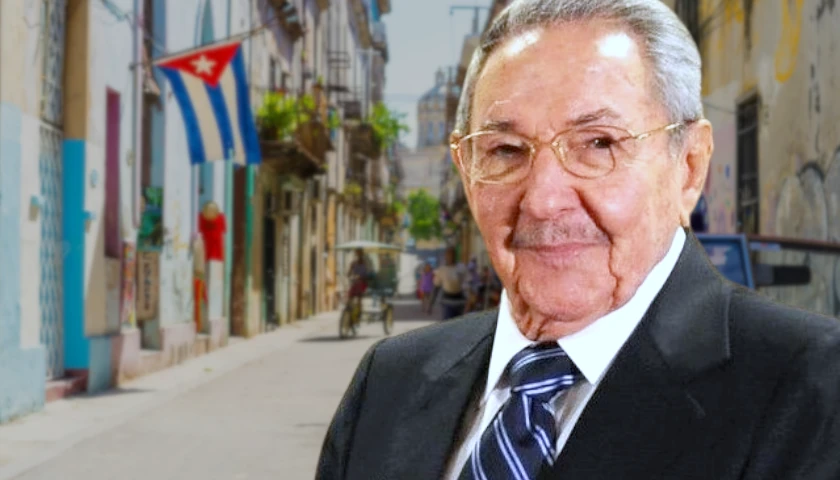
A newly unsealed U.S. Department of Justice (DOJ) indictment charging former Cuban leader Raúl Castro and five co-defendants in the 1996 shoot-down of two Brothers to the Rescue aircraft represents an escalation in U.S. efforts to hold Cuba accountable for the deaths of four men, according to former Kansas Attorney General Phill Kline.
The DOJ announced Wednesday that Castro and five alleged Cuban regime co-conspirators were charged with conspiracy to kill U.S. nationals, destruction of aircraft, and murder for the February 24, 1996, destruction of two unarmed civilian planes operated by Brothers to the Rescue over international waters.
Speaking during Thursday’s edition of The Michael Patrick Leahy Show, Kline argued that the case reflects a major shift in U.S. policy under President Donald Trump and Acting Attorney General Todd Blanche.
Kline said the prosecution is rooted in international aviation law and longstanding U.S. authority to pursue those responsible for killing American citizens.
“I think you have a president who is willing to assert his authority or our nation’s authority under the law to prosecute those who intentionally kill United States citizens,” Kline said.
He explained that the indictment relies in part on international agreements tied to the 1944 Chicago Convention governing airspace and civilian aviation.
“The United States maintains that they were shot down over international waters, but even the treaty as it relates to the 1944 Chicago Convention says you cannot fire on an unarmed civilian aircraft even if it’s in your airspace, and that would be a crime nevertheless,” Kline said.
According to the DOJ indictment, Cuban military pilots flying Soviet-made MiG fighter jets allegedly fired air-to-air missiles at two civilian Cessna aircraft operated by Brothers to the Rescue, killing Americans Carlos Costa, Armando Alejandre Jr., Mario de la Peña, and Pablo Morales.
Kline noted that under the indictment, the U.S. government is asserting that sovereign immunity protections do not apply.
“Jurisdiction is determined under international law, and the United States is claiming that sovereign immunity is not available here and that the United States, under the 1944 treaty, has the right to act, to make an arrest,” he said.
When asked why it took three decades for the U.S. government to indict Castro, Kline pointed directly to the Trump administration’s posture toward Cuba and Latin America.
“Probably because of President Trump, I imagine,” Kline said. “We have a new administration that is certainly focused on Cuba, focused on Latin America, and focused on this hemisphere.”
Kline also described the indictment as part of a broader strategy to increase pressure on the Cuban government economically and diplomatically.
“Trump is applying a lot of pressure to Cuba, and this indictment is another piece of leverage as it relates to the president obtaining his objectives in relationship with Cuba,” Kline said.
Despite the historic charges, Kline expressed skepticism that U.S. authorities would attempt a military-style operation to seize Castro from Cuba.
“We have recognized Cuba as a legitimate government,” Kline explained. “So our act of going into Cuba would be in an international law sense, an act of war.”
He contrasted the situation with previous U.S. operations that ended with the captures of foreign leaders such as Manuel Noriega and more recently Venezuelan Dictator Nicolas Maduro.
“This case is a little bit different, and it would be more difficult to actually enter Cuban territory to arrest Mr. Castro,” Kline said. “So I don’t see that – but who knows?”
Kline added that Trump has demonstrated a willingness to aggressively test the limits of executive authority in foreign policy matters.
“You can’t predict what this president might be willing to do,” Kline said.
Tune in now to The Michael Patrick Leahy Show – your AMERICA FIRST news talk!
– Watch LIVE here on X
– Watch LIVE on YouTube / Rumble / Roku / AppleTV
– Listen on Spotify
– Listen on WENO AM760 in Nashville
– Read more at @TheTNStarhttps://t.co/9jeV22i8RL— Michael Patrick Leahy (@michaelpleahy) May 21, 2026
– – –
Kaitlin Housler is a reporter at The Tennessee Star and The Star News Network.
Photo “Raul Castro” by Kremlin.ru. CC BY 4.0.