
While President Donald Trump earlier this month issued pardons for those who faced legal scrutiny by the Biden-era U.S. Department of Justice (DOJ) after helping the president contest the 2020 election results, at least three who were pardoned continue to face prison in Wisconsin.
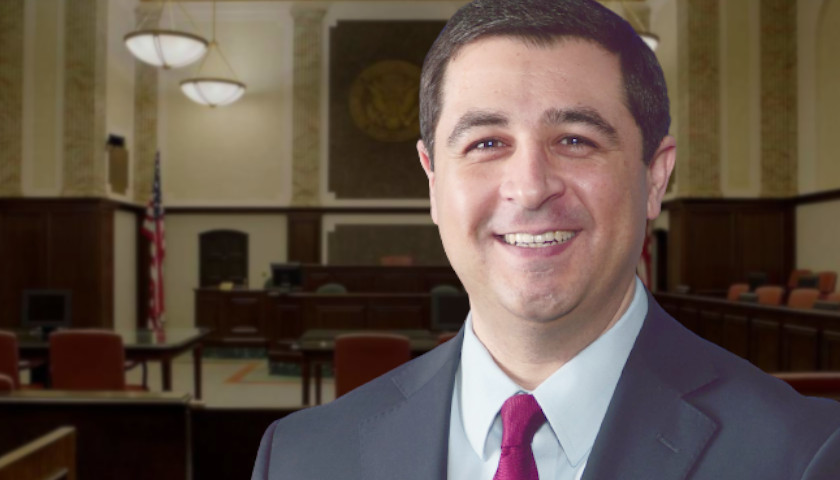
Though facing no federal charges, last year Wisconsin Attorney General Josh Kaul, a Democrat, filed charges against former Dane County Circuit Judge Jim Troupis, election attorney Kenneth Chesebro, and Republican opposition researcher Michael Roman, alleging they conspired to fabricate and submit a false electoral certificate, with the goal of confusing the certification process on January 6, 2021.
Kaul initially filed his indictment in June 2024, more than three years after Troupis, Chesebro, and Roman committed their alleged offenses, but just five months prior to that year’s presidential election. Only one month after Democrats saw devastating defeats in the November 2024 elections, the attorney general amended the complaint to add 10 felony counts for each defendant, meaning each could now face decades in prison if convicted.
The indictment last year notably came after Kaul twice acknowledged the defendants were following election contest procedure by assembling alternate electors to preserve Trump’s legal options after the election.
He first wrote in a December 2020 legal filing that federal election law, “anticipates the possibility of more than one certificate,” being sent to Washington, D.C., because U.S.C. 6 requires the National Archivist to transmit copies of “each and every such certificate,” to Congress ahead of the vote count on January 6.
Later in the same filing, Kaul wrote that the statute, “indicates that a certificate of determination may be issued after the electors have convened and cast their electoral votes,” acknowledging not only that multiple slates of electors could be submitted, but that the state may later change its determination about which slate is correct following the outcome of an election challenge.
Kaul went further in a February 9, 2022 legal opinion memorandum from the Wisconsin Department of Justice to the Wisconsin Election Commission, when he specifically said there was no Wisconsin law broken by Troupis, Chesebro, Roman, or those who became alternate electors in a bid to preserve Trump’s legal challenge.
“Nothing in either statute prohibits or otherwise limits a party from meeting to cast electoral votes during a challenge to an election tabulation,” wrote Kaul of Wisconsin Statute 5.02(2m) and 12.13. “Wisconsin law does not prohibit an alternative set of electors from meeting.”
Examining federal law, the attorney general later referenced the Hawaii alternate delegates in the 1960 presidential election, who were enlisted to preserve the legal right of former President John F. Kennedy to contest the state’s electoral outcome, writing that their actions, “were similar to those of the Democratic presidential electors in Hawaii.”
Kaul notably did not charge the defendants until the conclusion of the civil lawsuit brought by Wisconsinite voters through the Institute for Constitutional Advocacy and Protection (ICAP), which is a part of the Georgetown University Law Center. The litigants were also represented by Law Forward, a legal nonprofit based in Wisconsin.
The lawsuit targeted Troupis and Chesebro, as well as the alternative electors themselves. As part of their settlement, the electors admitted their votes were used for, “an effort to improperly overturn the 2020 presidential election in Wisconsin.” By contrast, Troupis and Chesebro did not admit wrongdoing, and instead agreed to turn over documents related to the effort, while pledging they would not engage in presidential electoral challenges in the future.
When ICAP announced the settlement, a Law Forward spokesman said the civil case would be “one piece” of “accountability” for those who “perpetuated this scheme” against Wisconsin’s voters.
Mary McCord, the executive director for ICAP, similarly said that the Wisconsin alternate electors, “provided the narrative that thousands of Americans used to justify the attack on the U.S. Capitol,” on January 6, 2021. McCord said the settlement would help, “ensure this will not be repeated in future presidential elections.”
Formerly the acting assistant attorney general for National Security at the DOJ during the Obama administration, McCord has emerged as a subject matter expert in the years since the January 6 protests.
Prior to the Wisconsin civil litigation, McCord provided expert testimony to the U.S. House Select Committee that investigated the protests, which included a brief explanation of how ICAP litigated against those involved with the 2017 Unite the Right Rally in Charlottesville, Virginia, before urging the Department of Justice to be prepared to act against militias like those she said were present in Virginia.
Specifically, McCord called for, “a civil enforcement mechanism that would allow the U.S. Department of Justice to seek injunctive relief and civil forfeiture against armed paramilitary actors and their organizations,” to prevent protests like January 6.
Her status as an expert on the subject was already emergent in March 2021, when McCord was interviewed by the Combating Terrorism Center (CTC), a civilian academic research center affiliated with the United States Military Academy at West Point.
“If anyone were ever inclined to discount the threat of far-right extremist violence in the United States, the insurrection at the U.S. Capitol certainly should have changed their views,” McCord told CTC.
Blaming Trump for the protests, McCord told CTC, “The former president sowed the seeds for this even before the election as he claimed that mail-in ballots were particularly susceptible to fraud and that the only way he could lose were if the election were rigged.”
In addition to litigating against those who assisted with Trump’s election effort, and urging for the federal government to assume new powers targeting militias, McCord argued that the DOJ under former President Joe Biden should have continued to pursue the question of presidential immunity, even after the U.S. Supreme Court issued its ruling that limited the circumstances under which Trump could be prosecuted for actions taken while in office.
“The Department of Justice, through Special Counsel Jack Smith, should consider filing a petition for rehearing so the justices can correct course before the unanticipated consequences of their broad opinion come to pass,” wrote McCord for Bloomberg Law. She urged former Special Counsel Jack Smith to act, even if doing so would delay the outcome of his case against Trump.
McCord and ICAP have played roles in previous legal efforts involving Trump and his supporters as well, including during the investigation by former Special Counsel Robert Mueller, when ICAP represented the House Judiciary Committee in a lawsuit seeking to compel a former White House lawyer to testify about Trump-Russia collusion claims.
The organization was founded in 2017, just months after McCord left the DOJ, and was initially given $200,000 by the Democracy Fund, which purports to be solely funded by eBay founder Pierre Omidyar.
Since then, ICAP has also received funding from the Ford Foundation and the Heising-Simons Foundation, but in 2023, it revealed that it was recruiting for a new fellowship that would be partially funded by George Soros’ Open Society Foundations.
Law Forward similarly boasts a tie to Soros, this time through donations from the Hopewell Fund, which counts both Soros and LinkedIn founder Reid Hoffman among its donors. It has also received support from the New Venture Fund, Rockefeller Philanthropy Advisors, and the Telescope Fund.
It remains unclear whether the civil litigation against Troupis, Chesebro, and the 10 alternate electors impacted the decision by Kaul to bring charges last year, but the attorney general’s analysis in 2020 and 2022 closely comports with the public explanation of Trump’s pardons that was offered by DOJ Pardon Attorney Ed Martin, who explicitly cited Kaul’s earlier writings.
Noting that the Wisconsin Elections Commission twice voted unanimously to reject complaints claiming the alternate electors acted improperly, Martin wrote that as part of the first rejection, “the Commission attached a letter from the Wisconsin Department of Justice concluding that the electors did not violate the law and were legitimately trying to preserve President Trump’s legal standing as election challenges unfolded.”
Martin later described the state-level prosecution of individuals like Troupis, Chesebro, and Roman, as “baseless partisan retribution for otherwise legal conduct,” and expressed optimism that they would fail in court.
“These constitutionally suspect prosecutions continue to impose intolerable costs on the innocent victims,” wrote Martin, before appearing to caution at they may constitute a civil rights violation.
The Pardon Attorney wrote, “each one of these citizen possessed an inalienable Constitutional right to seek Congressional redress for the illegal acts and fraud that occurred during the 2020 Presidential Election. For states to punish or prosecute these individuals now, for exercising that individual right, fundamentally undermines our Constitutional system of government.”
– – –
Tom Pappert is the lead reporter for The Tennessee Star, and also reports for The Pennsylvania Daily Star and The Arizona Sun Times. Follow Tom on X/Twitter. Email tips to [email protected].
The whole lot of these leftist subversive cretins should be federally indicted and charged with malicious false prosecutions and violations of their civil rights.